![]() |
|
![]() |
|
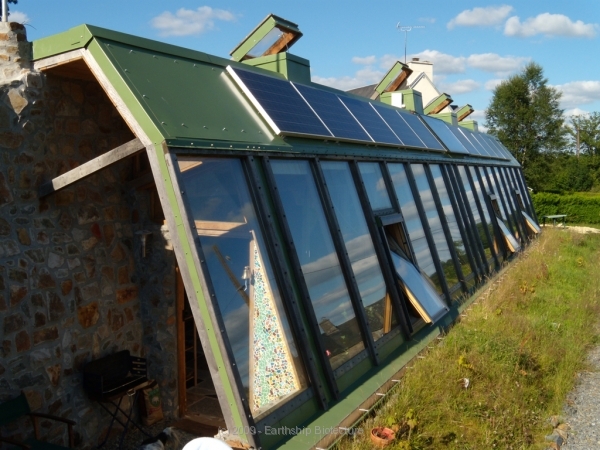
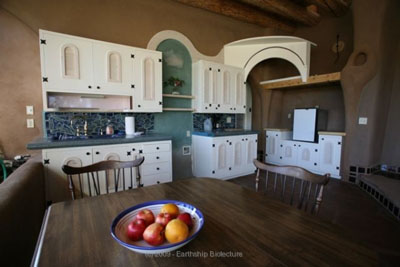
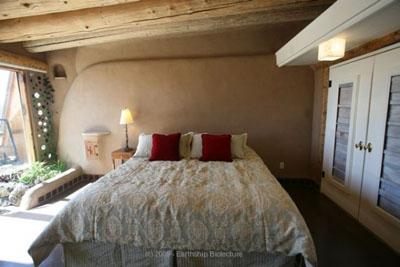
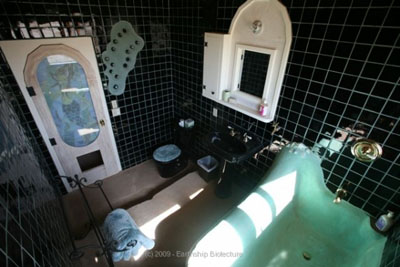
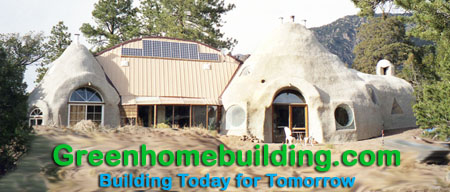
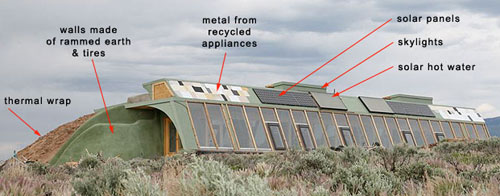
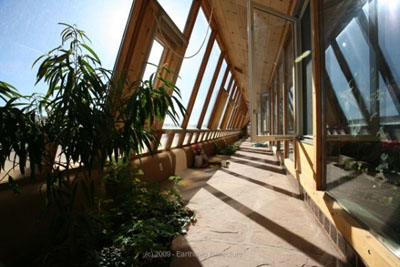
Earthships The Earthship concept is the brainchild of Michael Reynolds, who has written several books on the topic. Near Taos New Mexico, where he has his Earthship Biotecture business, are whole communities of earthships. The basic earthship design incorporates substantially bermed, passive solar architecture. The primary retaining walls are constructed with used tires, filled with earth and stacked up like bricks. The interior surface of the tires is then plastered with adobe or cement so the tires don't normally show. Mike has also pioneered the use of empty aluminum cans mortared into lightweight, curvable walls. Earthships often employ many ecological concepts, such as water catchment from the roof, reuse of greywater, composting toilets, indoor gardening, etc. While some of the work of building is simple to do, it also tends to be very labor intensive. Furthermore, the wood framing required is not simple. Some of the earlier designs tend to overheat, especially in the summer, because of the slanted glass to the south. I have seen some truly elegant earthships, along with some that are pretty funky. Engineered plans are available that seem to please building inspectors, as these have been built in many localities. |
RESOURCES ARTICLE: |
||||||||||||||||||||||||||||||||||||||||||||||||||||||||||||
Earthships in Europe by Mischa Hewitt and Kevin Telfer, 2012. The new edition of this successful book is a detailed description and evaluation of earthships in Europe. Its main purpose is to judge whether the translation of earthships – an American architectural concept pioneered in the New Mexico desert – to a European setting has been successful. The book includes case studies of people who have built earthships in France, Spain and Britain and a round-up of other projects. It also includes analysis of the most detailed thermal monitoring ever carried out on an earthship and the only ever known airtightness test. This analysis is used to make a series of design recommendations to help make earthships more effective in different climactic conditions. The book concludes by predicting the likely future of earthships in Europe – whether they will become a model for large-scale low-carbon housing or remain the preserve of a few brave self-builders.
Earthship: Systems and Components by Michael Reynolds, 1991. This second book in the series goes into more detail about specific systems that are adjuncts to the basic earthship. Earthship: Evolution Beyond Economics by Mike Reynolds, 1993. This last book in the original trilogy is more of an exposition of Mike Reynolds's ideas about building and its place in the scheme of societies.
Comfort in Any Climate by Michael Reynolds, 2000. Comfort in Any Climate is about creating a comfortable space in any climate without the use of fossil fuels for heating and cooling. The book breaks down important sustainable design concepts into clear, easily understood elements: thermal mass, insulation, heating, cooling, and ventilation. Using examples of built Earthship designs, the author shows applications of the presented concepts through text, illustrations and color photos.
Water From The Sky by Michael Reynolds, 2005. This book takes its readers from problem to solution. It addresses the water shortage in New Mexico, the United States, and around the world. Step by step the book outlines how to solve the problem of water shortage through catching, storing, using, reusing and treating rainwater.
Earthship: I Want one by Michael Reynolds, 2011, Kindle Edition. This book the first in a series of short publications designed to provide the information necessary for people to secure the type of sustainable housing that will soon be a necessity. These books discuss concepts relative to today's current way of thinking and ways in which we will we have to think in the future as a species in order to survive on this planet. We must evolve.
Earthship Global Model Operation One: Tire Work (Earthship Global Volume How to Build Your Own) by Earthship Biotecture, 2011, Kindle Edition. With input from the Earthship crew, this 38 page booklet takes you through, step by step, on the tire work phase of a typical Global Model Earthship. It covers building walls, thermal wrap, vent tubes, cistern installation and front stem walls. Photographs, diagrams and thorough explanations of procedures will guide you through the tire work phase of the building. There is a Kindle Edition of this.
The Tire House Book by Ed Paschich, 1995. What are tire houses? Who builds them? How do they do it? Will I see the tires when the house is finished? How weird are they? Can I do it myself? You'll find the answers to these questions and more in this book that "Earth Quarterly" called "...an excellent addition to the library of any potential tire house builder, offering a wealth of unique ideas that can jump-start you to getting up, getting out, and building that sucker!" And the "Albuquerque Journal" said: "Better keep this one on the night table; you'll probably want to refer to it as you build a home or an additiona to one." Using "landfill" tires and a revolutionary process, houses are being built that are both revolutionary and evolutionary--Michael Reynolds builds self-sufficient EarthshipsT, and Ed Paschich builds traditional homes using tires for the exterior walls. This book will tell you how you can be more responsible when you build a home, improve a home, or add a garden. You'll learn about constructed wetlands, solar air conditioning, and xeriscape landscaping. It's all here with many illustrations and photographs.
Sustainable Living, Vol. 2: Green Building, LEED, Energy Star, Off-the-Gride, Earthships, Straw-bale Construction, Rammed Earth, Earthbag Construction and More by Elane Casselberry, 2011. This book discusses "green" or sustainable building methods used in the United States that are both centuries old and state of the art. It includes an over-view of LEED certification, Earthships and their creator Mike Reynolds, straw-bale construction, rammed earth, adobe, and earthbag construction.
The Zero-Carbon House by Martin Godfrey Cook, 2011. All aspects of the zero-carbon house, from its evolution to achieving carbon neutrality in old and new homes and even entire communities Ideal for anyone starting their journey to a low carbon lifestyle, this book includes an overview of zero carbon and how to achieve it on a global scale, covers communities of zero-carbon houses, and provides inspirational examples of low-carbon lifestyles. Case studies show how principles are put into successful practice to save energy, carbon, money, and the environment.
|
|||||||||||||||||||||||||||||||||||||||||||||||||||||||||||||
These are some of the latest plans from Earthship/Biotecture, Mike Reynolds' planning company. This is called a "Castle Earthship" and is the more basic of three new plans. A more advanced plan includes a two story jungle greenhouse.
|
|||||||||||||||||||||||||||||||||||||||||||||||||||||||||||||
|
Global Model Earthship
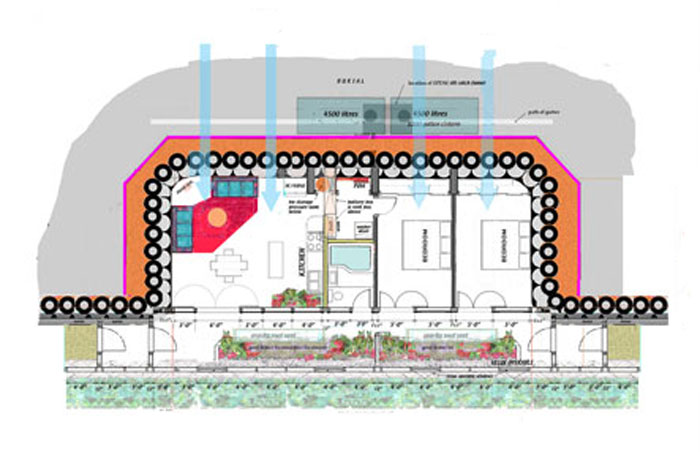
The Earthship home will keep you comfortable in most any climate on the planet. These Earthship plans are the result of 40 years of research and development in the field and on the drawing table. Because these plans are "off-the-rack," this a very "user friendly" approach for the owner/builder. This unit can be the easiest first step into the Earthship method of living. Sizes begin at the 800 square foot "Nest" studio and go up to a 3 bed, 2 bath Earthship and larger. Because every room surrounds you with thermal mass, the rooms provide an embracing thermal stability. The Earthship modules may be built individually, in a step by step fasion to create a comprehensive approach for all aspects of a completely sustainable home. Studio - 800 sq. ft. One Bed - 1000 sq. ft. Two Bed - 1200 sq. ft. Three Bed - 1500 sq. ft.
Floor Plan for 2-Bedroom Model
For more information about this plan, and many others, visit our sister site www.dreamgreenhomes.com, where you will find a wide range of plans for sustainable homes, greenhouses, small buildings, garages, and food storage space for sale. Dream Green Homes is a consortium of outstanding architects and designers, who have pooled their talent and expertise for your benefit. |
|||||||||||||||||||||||||||||||||||||||||||||||||||||||||||||
|
earthship.org this is the home site of earthship/biotecture, Mike Reynolds' business. youtube.com Earthship 101, Part 1; youtube.com part 2. youtube.com "Earthship Journey" Earthship tours: /youtube.com, youtube.com, youtube.com, therubberhouse.nl is a blog about building a tire house in Gambia. The Tire House Book by Ed Paschich, Paula Hendricks, 1995. earthship.es is a blog about a hybrid earthship/geodiesic structure in Spain. This video features an interview with Michael Reynolds and shows various earthships. |
|||||||||||||||||||||||||||||||||||||||||||||||||||||||||||||
|
|||||||||||||||||||||||||||||||||||||||||||||||||||||||||||||