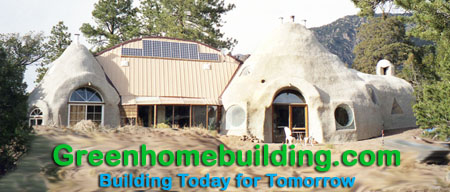
Earthship Questions and Answers
Michael Reynolds, creator of the Earthship concept, is a world leader in environmental building. He is the author of five books and has 30 years experience designing and building fully self-sufficient homes. The innovative Earthship design combines passive solar heating with thermal mass construction to create buildings that heat and cool themselves without consuming fossil fuels. Earthships create all their own electrical power with sun and wind, collect and treat their own water with integrated water systems. The main building block of the Earthship makes use of one of the worlds most plentiful, and most troublesome "natural resources", scrap automobile tires. Thousands of Earthships have been built all over the world in the US, Canada, Mexico, Bolivia, Japan, South Africa, Honduras and Belgium. Michael's Earthship/Biotecture website provides a wealth of information about his innovative building concepts.
Questions and Answers
Q: How are earthships built?
A: (Kelly) Earthships are typically built with various recycled materials (such as tires and aluminum cans), earthen plasters, large wood beams, and lots of glass for south-facing windows.
What are the first steps to take before building one?
To build a true Earthship, it is probably best to obtain plans from the original designer, Michael Reynolds.
Are there certain rules/regulations/permits needed?
This depends on the regulations in the particular place where it is to be built. Earthships are well-designed, and usually can be built with the proper permits.
Approximately, how long is the process to build one?
This can vary quite a bit, depending on how many people are working, how much time they have to devote to the project, and how much experience they might have in construction.
Do professionals need to build it, or can anyone build it?
Many Earthships have been built by owner/builders, but it is best to have some construction experience before embarking on such a project.
Would you happen to have an idea of approximately how much energy is spent in an earthship compared to a normal single family house?
One of the attractions of Earthships is they they can be practically self-sufficient, energy-wise. So if this is true, they could be considerably more efficient than conventional houses.
What are the cons to earthships?
One of the biggest cons is that the labor involved in pounding soil into the tires for the walls is extremely intensive, very tiring and time consuming. Also many of the Earthships, especially the earlier designs with slanting glass, tend to overheat in warm weather. And they may take a year or two of use before they become comfortably warm enough in the cold season. Also, many people don't like the idea of living in used tires...
How difficult is it to live in one, or to adjust from living in a single family home to this unique structure and energy saving home?
Well, I don't live in one, but I have lived in well-designed passive solar homes before. It is not difficult to live in one, but it does take some attention to making adjustments to window shades to conserve heat at night, and adjust vents for proper ventilation. The general comfort level is very nice, in that they tend to stay a comfortable temperature most of the time, without suffering great fluctuation between too hot or too cold.
Q: What are some of the main materials used in the process of building an Earthship? I am wondering this because I was thinking of building a model of an Earthship as part of my display.
A: (Kelly) Used tires filled with packed soil are used for most of the walls. Some of the interior walls are made with aluminum cans and concrete. Big wooden beams are used to hold up the roof, and other wood is used to finish the roof and frame all of the windows. The tire walls are often covered with a mud plaster, so you could make a realistic model by just piling up mud (with plenty of clay in it) and letting it dry.
What is the average price of an Earthship; plus the most expensive Earthship there is on the market and the cheapest one?
Earthships cost anywhere from about $50,000 to several million dollars, depending on how big and lavish they might be. Average might be $150,000.
How long does it take to build a Earthship? Does it take longer than a regular house to build?
It probably takes a little longer than an average house, because of all the time it takes to pound dirt into the tires and then plaster them.
What are the main jobs of the people in the process of constructing an Earthship?
People need to build the tire walls and pound them full of dirt and then plaster them. Carpenters need to build the roof and frame all of the windows and vents. Plumbers and electricians need to install of these facilities. There is lots to do.
Q: I watched a show about 2 years ago & you guys were on there. I have been in love ever since. Some day I hope to have an earth ship. Everyone I have told thinks I am crazy & that it is a silly idea for a home. I strongly disagree. My husband gives me a hard time, but if we were able to have one, I know he'd love it. After all this time w/ just keeping "Michael Reynolds earthship" on a scratch piece of paper, it crossed my mind to see if there was anything on the web. I am so pleased to see all the information. However, the one question I do have is, is what is the typical cost of one of these earth friendly homes?? I'd like to have some idea. That is another reason why everyone thinks I am so crazy, because they say that one of these so called homes will be more than I could probably ever afford. So, just for giggles, I'd like to know the price range. My husband & I just weeks ago found out that we qualify for a $70k loan. I'm sure that is not even close to ya'lls cost. But, maybe when we think about a new home in the future...we might be able to give this earth ship a go. I can't express to you just how impressed I am w/ this earthship idea. How blessed you must feel. How awesome.
A: They cost about the same as conventional housing – as with conventional housing, there are cheap generic approaches and more expensive custom approaches – They range from $120 per sf and up. The main difference is that you have no utility bills in this kind of home - I suggest they look at...Earthship/Biotecture and click on Packaged Earthship for the most economical models.
Q: There is a vacant earthship in Texas. Apparently, there were some structural problems with the tire construction. I've been looking at this home trying to decide if I want to buy it or build my own. I've considered strawbale and earthbag homes. What is your opinion of the earthships?
A: (Kelly) Earthships come in all flavors and degrees of sophistication; I've seen near hovels and grand palaces. The basic concept of the earthship is the same as any other passive solar home: lots of south-facing glass, thermal mass, and earth-bermed north side. The earlier earthship designs utilizing slanted glass tend to over-heat in many climates. In general they are quite energy efficient, and often employ water saving technology (rainwater catchment and gray water reuse). If they have been well built, they can be excellent homes. The earth in the tires has to be very compacted with lots of pounding to make them stable, so if this earthship has structural problems with the tire walls, then this might be the problem, and mitigating against this might not be very easy. I would suggest you get the advise of a competent engineer who knows about earthship design to take a look at it before you purchase.
Q: I am very interested in the earthship concept. My question is whether I live in an area (Austin, TX) that will support an earthship. I read in one of your books that in a hot humid climate, the greenhouse area should be facing north. Is building an earthship practical here? If so do you know of any more books that might discuss the specifics of building an earthship in this climate.
A: Perhaps the following can help you understand the Earthship concept more and how to proceed with it...The concept of thermal mass housing works both to cool and heat. Natural dehumidification is also available. The buildings can be adapted to whatever extreme necessary for more performance in cooling, heating and/or dehumidification. We have a new book called COMFORT IN ANY CLIMATE that fully explains this. More about this book at...www.earthship.com Look under Education. WE ALSO HAVE A NEW KNOWLEDGE BASE. This knowledge base has current projects and much more information relative to specifics of the Earthship concept.
Thermal mass structure can be achieved with many materials - earth rammed tires being the most economical and having the best structural integrity. However, concrete, stone and adobe work well also as long as the building is "tuned" to your climate. All other aspects of the Earthship concept, the catch water and waste water treatment systems and the solar/wind power systems, are tuned to your climate and your local codes as well. We have the support of New Mexico officials on these systems. We often “dovetail” into existing “on grid” systems for backup. We have many generic points of departure to try and take advantage of what we already have worked out, but usually some customizing is necessary. Any custom amenities are possible and can be integrated into the function of the home. It is simply a matter of "off the rack" designs being cheaper than custom.
While Earthships exist in almost every state and in many countries around the world in virtually every climate habitable; we have been asked repeatedly not to give out names and addresses of Earthship owners. They usually are not into receiving visitors and questions after the initial wave in the beginning. It has become an invasion of their privacy. Earthship is a concept - not limited to tires - it is a building that will take care of you by interacting with and encountering the biology and physics of the earth. Concrete Earthships are now available in all "off the rack" designs. They are just more expensive than earth rammed tires. Earthship homes will work in any climate. One first step is to confirm if the earth rammed tire building method will pass codes in your area. We can help with this as well. There are a few places that it is more trouble than it is worth to get the earth rammed tire method through codes. In this case you must use concrete, adobe or block to achieve the same design – our services involve all methods of creating the thermal mass building.
BALLPARK COSTS ARE AS FOLLOWS...30% LABOR 30% MATERIALS 18% SYSTEMS 12% SUBCONTRACTORS 10% PROFIT. BASE THE ABOVE ON ABOUT $135 PER SF FOR THE PACKAGED EARTHSHIP AND $150 FOR THE MODULAR AND MORE FOR THE CUSTOM. TAKE OFF PROFIT AND LABOR IF YOU BUILD IT YOURSELF. YOU WILL FIND THESE COSTS TO BE SIMILAR TO CONVENTIONAL CONSTRUCTION - BUT THE DIFFERENCE IS THESE HOMES HAVE LITTLE OR NO UTILITY BILL SO THE OVERALL MONTHLY LIVING EXPENSE (mortgage payment plus utility bills) IS LESS IN AN EARTHSHIP - NOT TO MENTION THE SECURITY OF HAVING YOUR OWN UTILITIES.
We can guide you in your efforts to obtain a sustainable home. We can provide a design and detailed construction drawings aimed at owner/builders. We have a private viewing site on the web where we post designs for your project for immediate viewing. We send them in hard copy as well. We can help you obtain local builders and permits. We can provide experts on site if and when needed. We have nightly rental demonstration homes in Taos, New Mexico. CALL 505 751 0462 FOR BOOKING. We do owner/builder seminars through out the spring, summer and fall - ask for a schedule at 505 751 0462. We have recently been doing 200 square foot Thermal/Solar Room demonstration projects around the world. These projects take eight days and accommodate a local seminar as well - ask for more information on these if you are interested. You can order a video of one of these demo projects on line at...earthship.com
or call 505 751 0462.
This is not a rigid thing - it is a concept that we help you apply to your specific situation. COMFORT AND "MINIMAL-TO-NO" PUBLIC UTILITY USE IN ALL CLIMATES IS POSSIBLE WITH THIS CONCEPT. We take a $75 retainer to schedule a phone consultation with you to begin. In this phone consultation we collect information from you and establish some ball park figures on cost of design, construction drawings and building costs relative to your specific needs, site and climate. We then work up the design. Next we provide the detailed construction drawings and help you get local permitting. We also consult and/or participate in the construction and supervision using local builders and subcontractors as much as possible. If you would like to proceed to the next step in obtaining a home based on the Earthship concept, please schedule a phone consultation by calling 505 751 0462 and make a $75 deposit by credit card. During the half hour consultation, you can provide us with where you want to build, a list of spaces you want, any site information you have, your budget limitations, the level at which (or if) you plan to participate in the project. We will also ask for winter low temperature and summer high temperature and elevation above sea level.
We have thirty years of experience at helping people get into sustainable homes all over the world. We know how to make it easy, safe and step by step. We are building a new demonstration web site at ...earthship.com Here, there is a gallery and other information. Please check it out. Thank you for your interest in Earthships.
Q: I want to level out my garden and for this I need to build a 2 meter high retaining wall. I would like to use car tyres for this but I'm not sure how they would need to be put together, whether concreting is necessary and also whether I would need to dig foundations.
A: (Kelly) A tire retaining wall should not need a foundation beyond just the tires sitting on the ground. Such walls are usually made by filling the tires with soil that is packed (or pounded) very firmly into the tires, so they end up being very firm and quite heavy. The work is done in courses, with each successive course overlapping the first, like bricks are laid. If the wall is curved it will be much stronger and more likely to withstand the lateral forces of the berm. Tires are not usually connected to each other, except through friction and weight. For a more aesthetically pleasing wall, the tires can be plastered with earthen or cement plaster, which also helps bind the wall into a monolithic whole.
Q: I am considering building a small Earthship "survival pod". This plan requires a large earth cliff for most of the wall space. I would like to use earthbags for the above grade courses and a living roof. I would like your opinion on the earthcliff (and other aspects) and its feasibility. Also, do you think the walls could take berming?
A: (Kelly) The way I understand the "earthcliff" concept is that the wall has no retainer, such as the tires normally used in earthships. If this is so, I would not recommend doing that where the soil is at all loose, or where moisture entering the building could be an issue (which is most places). My suggestion would be to use earthbags for the whole bermed portion of the building (below and above grade), because they are easy to handle and easy to plaster and can be filled with scoria, which would give you an insulated wall. A curved earthbag wall, similar to most earthship designs can take considerable berming.
Q: I am interested in using recycled tires to complete a retainer wall. Any information that you can present me with to help in the construction of the project would be greatly appreciated.
A: (Kelly) Mike Reynolds has pioneered the use of tires for building "Earthships" and has written several books on the topic. Also this book might have useful information for you: The Tire House Book by Ed Paschich, Paula Hendricks, 1995. Both of these are listed above. The concept is very simple; just packing similar tires with earth and then stacking them like bricks to build the wall...then it can be plastered with earthen materials or stucco to make a uniform surface.
Q: I have been interested in earthships for some time now but am still having trouble finding easy to understand information about building them. I am not interested in building it myself. Are there companies or organizations that you can hire to build your earthship? Also, is it possible or even wise to build an earthship in Oklahoma? I am currently living in Birmingham, Alabama, but am planning on moving back to my hometown in Oklahoma in the next year or so. I would love to build or buy an earthship there when I return, but am unclear if the climate and weather would be suitable there.
A: We can help arrange the building of an earthship, and Oklahoma is a good place to do this.
Q: How much does it cost to build the packaged earthship from your plans? I am in the country outside Eugene Oregon currently living in a passive solar house with composting toilet, gray water system, propane fireplace and propane hot tub, garden/orchard, meadow with waterfalls, the entire lot is surrounded by trees. It is not off the grid by any means though, so I am interested in the packaged earthship. Would you require more information to answer this question?
A: If you build it yourself - about $75 per sf. If you have it built - about $155 per sf.
Q: I am very excited by the idea of building an earthship from stone. Could you give me some advice about insulation and waterproofing.
A: (Kelly) The shell of a traditional Earthship is made from earth-packed tires, as you probably know. This is primarily a thermal mass material, as is stone, so the packed tires could be replaced effectively with stone. The tire wall is entirely backfilled with soil in such a way that there is a waterproof rigid curtain of insulation surrounding the backfill. See the cross section illustration for more clarity about this.
Q: I'm an architecture student and I am about to start an important 3rd year project and I would like to use the earthship concept. I was wondering if they are suitable for hot humid climates (eg: Sarasota, Florida)? If so, could you indicate some sites, or books where I could read about it and methods of construction in these conditions.
A (Kelly): The conventional earthship is a highly passive solar design and would overheat in Florida without modification. The designer of earthships, Michael Reynolds, has written a book called Comfort in Any Climate, listed at earthships that might help with your study.
Q: I have a dream to build earthship type houses in the world. My son is co owner of 3 tire stores. He will truck the tires locally to the site. He has to spend over $10,000 a year to have the tires hauled away. When we can pull all these elements together, get some land, build the house, have a prototype to show people. This area missed Katrina winds by a miracle; these homes withstand 150MPH winds. Perhaps show them as a backyard hurricane shelter also? If you have some cohesive ideas I would welcome the feedback.
A (Kelly): Tire houses can certainly be made to withstand tremendous wind and other rigors of nature. And the designs of the Earthship people are quite innovative and utilize many sustainable technologies. One word of caution about stockpiling tires: one reason that it costs so much to get rid of them is that they can become an environmental liability, since they do not biodegrade, might be considered a visual blight, and there may be health concerns related to the mosquitoes they can harbor. So it is best to only accumulate enough for the project at hand, and not keep a lot of them in piles for very long.
Q: OK, so I have been looking at building with tires for about 15 years now and am in the position to build in a couple of years, but time is an issue for me (getting ready to start my doctorial program and work as a teacher full-time). So here is my idea I have developed with my partner. Instead of ramming the tires with dirt why not fill them with papercrete? We can used recycled newspaper and portland cement. The issues we have come up with could be not being able to get the tires totally filled unless we drilled holes in the top of them. Do you feel like this would be an alternative to the labor intensity of a traditional earthship?
A: (Kelly) I don't think that filling the tires with papercrete would be a good idea, for several reasons: 1) Papercrete must be able to drain excess water freely in order to cure properly, and being placed into a tire would not allow it to dry out or cure. 2) Tire houses require densely packed tires in order to support the weight of the structure and be heavy enough to make the wall solid, so even if you were able to get the papercrete to cure in tires, it would likely be too spongy to suit this need. 3) It is actually a lot of work to make a papercrete mixer and then make the papercrete and fill the tires with it...so you probably wouldn't be saving any time or expense. Here is another idea for more easily filling the tires, and perhaps making a better insulated home: you might experiment with filling the tires with either crushed volcanic rock (scoria), if available, as it is quite insulating and would be fairly easy to pour into the tires....or even a loose gravel might work.
Q: I am a disabled vet. and I want to build a home myself with very little help. I am considering an above ground home, similar to an adobe home, only the walls are made of concrete filled tires. I can't pound dirt and can't afford to hire it done. Does this sound reasonable and feasible? I plan on using as much recycled material as possible in the home. I plan on making my home completely off the grid. This seems like a building built to last. Do you know of any homes built like this. Also, do you know of a spray on material that is breathable like adobe mud for the exterior?
A: (Kelly) Certainly tires filled with concrete would last a very long time. I have actually thought that filling the tires with washed gravel might be easier and yield a better-insulated wall. As for breathability, this would only occur in the minor spaces between the tires. A cement stucco that is somewhat weak in the ratio of cement to the sand can breath some, although not as much as an earthen plaster would. It is possible to spray either of these.
Q: My wife and I are finally in a place where we my be able to build a home for ourselves. We have a friend who has been singing the praises of earthships and my initial investigations make them seen super hippy cool. The concern I have is that I live in the Pacific NW and I am not sure if it is a green home that will work here. Has anyone built an earthship in our area? We are on the wet side of the mountains. Is there another green home that has the same type of low impact pro environment outlook that is more suitable to the area? Lastly, do the tires in an earthship poison the surrounding land with heavy metals and stinky tireness.
A: (Kelly) Earthships should actually perform quite well in the Pacific Northwest. Even though you don't get as much sunshine as the SouthWest, what sun you do get will help heat the home...and all of those windows will help bring more light into the house, which can be a problem there. Some people don't like the idea of all those tires around them but they actually don't have any heavy metals that I know of, and they get well sealed with plaster so they don't smell either. Another option would be to build the same design with earthbags, which may be aesthetically more pleasing for you.
Q: Since one of the drawbacks to using the earth for insulation is the finished look of a house I was wondering if anyone has ever thought of the possibility of building a multi-layered wall with 2 or more layers of tires (in the vertical) to take the place of a big berm. Then you could get a more conventional look, although it would be a lot more work, to satisfy the square house lovers. Would this work?
(Kelly) Do you mean that the wall would be composed of two parallel stacks of tires with earth placed between them?
Exactly, and could you connect the tires together for added strength?
A: Yes, tying them together (galvanized wire would likely do) would help stabilize the wall...curved walls would also help with this. To make it easier to fill the tires without pounding them like the earthship people do, I have often thought that using gravel instead of earth would make it easier and give you a bit of extra insulation from having all the air space between the gravel.
Q: I will have to convince my wife about green homes and earthships, as I like the idea but she considers this type of building to be too dungeon-like as she likes a lot of light. We are going to the big island of Hawaii next month and I think there is a relatively new earthship there I wish to show her. How do most municipalities feel about this type of construction? I know realtors (valley girl businessmen) frown on it unless they are about to make a big commission.
A: (Kelly) I'm sure that reaction to earthships varies quite a bit around the country. In the Southwest they have become quite common, and many of them are even lavish, up-scale affairs. They are well-engineered, so there is seldom much real concern about their integrity from the building authorities.
Q: I have a question about vapor barriers. Does the bermed wall need any barrier other than the rigid insulation? Do people build stick framed walls in front of the tire walls?
A: (Kelly) Yes, it is is always a good idea to have a solid membrane moisture or vapor barrier on any bermed portion of a building, because the last thing you want is water in the house. As far as framing in front of the tire wall, I would not advise it, because you want the tire wall to act as thermal mass, and this would inhibit this.
Q: I'm assuming 6 mil. plastic, but is it applied on the back side of the tires before the berm is pushed up against the tires?
A: (Kelly) Yes, one or two layers of 6 mil plastic should suffice. Looking at the cross section diagram at the bottom of this page, it would be against the rigid insulation before backfilling.
Q: I'm wanting to know how to build a stable base for my shed, using reclaimed tyres. I was wondering if I can use landfill waste to fill them? I am dependant on state benefits so really need to use anything that I can obtain without financial cost. I have just myself and a garden spade to do the job plus my 2 little ones! Can you give me very simple but detailed advise how to do this? I have just soil underneath and am at the present time clearing very old brambles from the area.
A: (Kelly) You can certainly use old tyres to provide a foundation for a shed, but this method tends to be a lot of work because they must be filled with compacted soil, which means a great deal of pounding with a mallet. Landfill waste would not be an appropriate material to fill them with, because it cannot be guaranteed to remain compacted. A much simpler method of making a foundation is the use a rubble trench, which is basically digging a trench below frost level where you want the foundation to be and filling this with cobbles or rubble. This can be mounded up somewhat to get the building above grade level. Then, depending on the nature of the building itself, you can begin the construction on top of this. Or another simple method is to use earthbags (polypropylene sacks) that can be filled with soil or gravel for a foundation. In fact you can build the whole shed this way. See www.earthbagbuilding.com for more about this...
Q: We have a large family. We need 6 bedrooms and an Office. Have any Earthships been built that large? Is there any reason to think it can't be done. We are planning to build an underground type home in 2009. I like the idea of having indoor gardens and using gray water, well all the energy efficient concepts in the Earthship. Is it possible to have the home built for us here in Oklahoma?
A: (Kelly) The earthship concept is expandable to virtually any size. The traditional earthship is composed of a series of U-shaped rooms, with the top of the U facing south; as many of these can be lined up as you want. It shouldn't be too difficult to have such a home built in Oklahoma.
Q: I am looking into the Earthship for a home. I would also like to build it very large, with extensive green houses to make a living with as a small time vendor of fresh foods. An Eco Farmship. But I want to build it in a place not known for raising beans and corn: Arizona. Any ideas? for the semi retiring?
A: (Kelly) I see no reason why the Earthship concept couldn't be adapted to a huge solar greenhouse, since that is basically what the front is designed for anyway. With more skylights and good ventilation the growing area could be extended as well.
Q: I am a Naval air crewman Medic. I have been deployed for the past 5 years straight. I have seen my share of war and now wish to fall off the grid with my new family. My family's background is construction with a "if you can't build it, we can" kind of attitude. My dream plan is for my house to be built first but then later add houses for my family. I am finishing up my enlistment with roughly 25 grand debt free, so money is an issue for me having a family but there is still in my head no reason I cant do this. My main concern is making it all work as your design shows. In my situation do you think this is do able or should I just save an save up more an more before really going for it ?
A: (Kelly) I would say that if you already have the land, you can get pretty far into your project for 25 grand. Used tires are free, as are the old pop cans and mud...
Q: I would really like to know what the oldest tire house is and if there has been any testing to see if there are any gases coming off the tires as they get older?
A: (Kelly) Mike Reynolds, the inventor of Earthships, published his first book about them in 1990, so he obviously has been experimenting with the concept of using old tire since at least some time in the 1980's.
According to Mike Shealy, who has a lot of experience building with tires, "The surface of used tires has been subjected to years of exposure to oxygen by high speed rotation in the atmosphere. This exposure causes a phenomenon called oxidation. Oxidation 'interlocks' the surface molecules with oxygen and 'out-gassing' (fly-away molecules of synthetic rubber) is considerably limited, if not stopped completely. It's the new tires that stink/outgas, they just need to "rust" for a while, before they are suitable for use as a building material."
http://www.sisweb.com/referenc/applnote/app-37a.htm reports on some test done on Volatile Organic Emissions From Automobile Tires. It does seem to be primarily associated with new tires.
And Leonard Jones reports: When a tire bale building is initially enclosed, the tires may be left uncovered for a time. During this period it is possible that occupants may be able to smell the "rubbery" odor of the tires. However, when the walls are completed, they are covered with a 2 - 4 inch thick coating of cement-based plaster. The tires are completely covered and sealed away from the occupied space. It seems very unlikely that any out-gassing would reach the occupied space once the plaster is in place. Any residual odor will slowly but steadily be reduced by continuing ventilation of the enclosed space. This issue has been studied and commented upon extensively by designers, builders, and owners (as well as detractors) of related rammed tire earthship buildings, previously referred to. I have done much reading in this area and I have been unable to find a single case where any human or animal sickness occurred that was attributable to outgassing tires. The use of discarded tires for occupied structures is relatively new compared to other building technologies, and it is possible that long-term problems may arise. However, other outgassing issues inherent in conventional buildings, like the chemicals used in commercial glues, carpets and engineered wood, seem to be at least as serious.
Q:
I was wondering if it is the thick walls and the tires that achieve the isolation and keep a constant temperature, or if you could achieve the same outcome with just a thinner wall in the earth and the south east facing windows?
A:
(Kelly) The use of tires is just one way to build a bermed wall; other possibilities include earthbags, stone, concrete, etc. The earthship concept utilizes a large area of soil that is isolated behind the tires to create a Passive Annual Heat Storage area (PAHS), and this same thing can be accomplished with materials other than tires.
Q: Would an Earthship in Louisiana be a crazy idea? I'll soon be building a sanctuary for the blind animals in my rescue org and I'd like to to be as energy-efficient as possible, off-grid if I can do it.
A: (Kelly) Earthships have been built all over the world and in most of the states. In Louisiana you might want to diminish the amount of south-facing windows somewhat to compensate for the generally warmer climate.
Q: I am a Naval air crewman Medic. I have been deployed for the past 5 years straight. I have seen my share of war and now wish to fall off the grid with my new family. I just purchased your book on building your own earthship, next will be systems. My dream plan is for my house to be built first but then later add houses for my family. I am finishing up my enlistment with roughly 25 grand debt free, so money is an issue for me having a family, but there is still in my head no reason I cant do this. I don't plan on this happening overnight; hard work is something I enjoy. My main concern is making it all work as your design shows. I'm to a point of planning and doing, 8 months till I'm out . In my situation do you think this is do able or should I just save up more an more before really going for it ?
A: (Kelly) I would say that if you already have the land, you can get pretty far into your project for 25 grand. Used tires are free, as are the old pop cans and mud...
Q: I want to know how you'll solve the fire fighting thing? For example, the tire wall, if it caught fire?
A: (Kelly) Houses that employ tire walls almost always apply a thick earthen or cement plaster over the tires, so they are no longer exposed to the atmosphere and are unlikely to burn. The same with strawbales...they have a better fire rating than conventional stick-framed homes.
/Q: My friend's father recently passed away and left behind 25 horses. I have a large piece of pasture land that we just finished fencing for them but there is presently no shelter. I have been researching natural building for sometime now and am considering a tire shelter. I have access to as many tires as I need and I have a huge pile of washed gravel right on the site. Do you think that a shelter made of tires with washed gravel in them and some sort of good roof would work for us? I am also wondering if you think we would need to dig a foundation. We are located in Nova Scotia, Canada.
A: (Kelly) I have often thought that filling tires with gravel would be way easier than pounding earth in them, and also provide better insulation. A tire wall can basically serve as its own foundation, especially for a horse barn; any minor frost heaving, if it occurs, shouldn't be a problem. You might dig the first course of tires into the ground a bit, and also provide a rubble trench filled with the gravel to lay the first course on, especially if the soil doesn't drain very well.
Q: I have been reading a lot about earthships and rammed earth tires. For consistency, should walls be constructed with equal sized tires, i.e. 15" tire wall as opposed to a mix of 13, 14, 15, 16's etc?
A: Yes, it is way easier to stack and arrange tires of equal size, the wall will be stronger, and it will be easier to plaster.
Q: I am a disabled vet who has worked as an Architectural/ Mechanical Designer/Draftsman for most of the past 30 years. Now that I am retired I plan to build and Earthship here in Oregon. Since I am physically unable to pound the earth into the tires I was thinking of inventing a machine(s) to do the job. I am also considering powering these machines with a portable steam generator or some other "green" power source. My questions are first, what do you think of my idea of creating such machines.
A: (Kelly) Pounding tires for earthships is a notoriously difficult job, so I'm sure that some people would consider such a machine a blessing, but I question whether it is worth the trouble to devise it, for several reasons. You would likely expend more energy fabricating and perfecting the machine than actually pounding the tires conventionally (or hiring some young buck to do it). There are easier ways to build an earthship-inspired home than by using tires (such as with earthbags).
Second do you think such machines would be marketable in plan or actual form?
No. I think the market is too specialized, and many of the folks who want to build an earthship would rather do the job manually.
Have you or anybody else devised such a device that you are aware of?
No. I think that people have attempted the used of air hammers to do this, but probably not very effectively.
Q: I am interested in sustainability and know that I need to live near the North Atlantic Ocean. How would an Earthship fare in Nor'easter or Hurricane in every category? I am an artist, writer and Master Gardener and immersion in seacoast nature is germane to my survival.
A: (Kelly) Earthships are very ruggedly built and bermed with earth, so they should be able to withstand most adverse weather. The greatest vulnerability would be the exposed south-facing glass, so some shutters might be employed to protect this in case of extreme weather.
Q: Why is the cost so much?
A: (Kelly) Besides the tires and other recycled components, Earthships have many conventional (and expensive) parts, like the roof, floor, windows, doors, plumbing, electrical, etc.
Is the outer just a normal concrete or more an outdoor plaster?
The exterior plaster could be cement stucco, or a cement-stabilized earthen plaster.
Q: I am from Romania and am very impressed with using tires in construction. That's why I decided to build my fence from tires, and I need a little help from you. I need to know what kind of earth is needed to fill the tires?
A: (Kelly) The kind of earth to fill the tires doesn't matter much...the local soil is probably fine.
How do you fill up the space that remains between the first row of tires and the new tire that comes on the row?
This space can be filled up with tin cans, rocks, bits of concrete, etc. mixed with either moist clay/sand or cement.
Do I need a foundation; how deep and of what material?
The tires can act as their own foundation...just start them below your frost level.
The rain won't be a problem?
Shouldn't be...
So each tire is isolated from the others? With what? Is there a special way to do it, or do you just take some kind of material, put it on the bottom of the tire, and you start pounding the earth?
The tires are laid like bricks, with the top tire spanning two tires beneath it., and all of the tires touching each other. For stability, the tires need to be pounded full with earth to make them not move at all. All of the spaces between the tires can be filled with the various materials to make a smooth wall (or fence).
Q: Is it possible to use the earthship building in a climate like the one in Mobile, Ala?
A: (Kelly) Earthships can be built anywhere, but in warmer climates like Alabama, you might want to limit the amount of south-facing glass to some extent.
Q: With the earthship having a slab floor and being surrounded 75% with dirt, are bugs a big problem?
A: (Kelly) I have never heard of bugs being a problem in Earthships. When I lived in an earthen house with a flagstone and adobe floor I never had bug problems. Any house can have problems with ants, but these can be dealt with in many ways.
Q: Does an earthship home require more maintenance than a traditional home? My wife and I both work and do not want to spend our spare time doing upkeep.
A: (Kelly) I wouldn't expect a well-built Earthship to require any more maintenance than a conventional house. With any passive solar house, you might spend some time using insulating curtains for the windows, especially in cold weather, but this is part of the fun of living with natural energy to heat your home.
Q: Would you know, who and how I can get an Earthship made in the mountains of Panama?
A: (Kelly) Earthships are typically designed for cooler climates than you will find in Panama. You could still build one there, but the whole orientation and solar glass exposure would have to be carefully considered.
Q: I am wondering if it would work to simply fill the tires in an Earthship design with mud, concrete, or a mud / pebble mix instead of pounding dirt into them?
A: (Kelly) The problem with mud is that it may never dry out, but filling the tires with gravel I think would be a good option. This would provide a slight insulating factor as compared to packed earth, but in some ways this could be beneficial, allowing the space to come up to a livable temperature sooner than it would otherwise, especially if there is sufficient thermal mass in the floors and plaster to compensate.
Q: I am planning to build an Earthship in the future with my husband and I was curious, what size tires are the best?
A: (Kelly) Virtually any of the standard automobile tires will work, but I suggest that you choose one of the most common sizes since it really helps if all of the tires are the same size.
Q: I am thinking of building an earthship, but I want to know if I could build it underground and have he roof be level with the top soil?
A: The traditional earthship is basically as you describe this, being bermed on all three sides except to the south.
Would I have to use southfacing skylights?
Earthships do have openable roof vents, so you would need to provide for this, but virtually all of the natural light comes from the southern glass.
Could I build an underground Greenhouse with the same plans for a sustainable garden?
Yes, there are various plans for underground greenhouses, and the traditional earthship incorporates some greenhouse space near the glass.
Q: I was wondering if you happened to know which states had the most earthships, and if they were absolutely illegal (or ill advised) in certain areas.
A: (Kelly) There are undoubtedly more Earthships in New Mexico because that is where they were born and have thrived over the years. They are not strictly illegal anywhere that I know, although it may be hard to get a building permit in some jurisdictions that are not open to alternative construction. Earthships do well in many climate regions, but are better suited to cooler areas than hotter areas, since they are basically a classic passive solar design.
Q: I live in northern Michigan were the winters are harsh, long, and extremely cold. I have been very interested in the earthship concept. I would love to get more information on how to do it in the extreme cold climates.
A: (Kelly) Earthships would do well in your climate, and so would most well-designed passive solar homes. Going underground is another excellent choice. You can read more about all of these on this website.
Q: I'm just getting interested in the method of building with tires up here in Alaska. I've networked to get tires delivered and even get paid $50 a ton to accept them. I've watched a lot of what is available on the web in regards to tire building, and I notice that there isn't much linking the tires together as they are built. There are the metal bands lining the inner walls and laid offset to the next row this leaves 4 vantage points where those rings will over lap the lower (and 4 more to the top on the bottom of the next row).I plan to drill a hole through both rings and use a blind rivet trifold type to band these metal rings together. It makes sense to me that binding the metal imbedded in the rubber makes a type of 3D chain link fence. Also being that it is Alaska we are after super R ratings so we plan to go double tire thick running chain link or chicken wire in between and interlocking tires side by side as well. Rrivets aren't free but they are inexpensive fasteners and incorporating them with washers and the metal already in the tire makes a wonderful structure, and might help in some of the code issues involved in getting these buildings recognized properly. Please tell me what you think.
A: (Kelly) It is certainly a good thing to recycle tires in such a positive manner. Fastening the tires together with rivets as you suggest should work, and would likely add to the overall stability of the system, but I question whether it is really necessary. There sheer weight of all of the earth-packed tires pressing them together provides a great deal of friction (and nesting) to keep the tire wall monolithic; I have never heard of such a tire wall failing. But if riveting the tires together makes the building authorities happy, then this is small price to pay...
Q: My partner and I are interested in the design of Earthship. The question we have is that we own land in Honduras in the mountains of La Esperanza and it is the rain forest. Plenty of water and sun. Can we build there where it is not dry as NM?
A: (Kelly) While the Earthship designs were first built in the arid SW US, they have been built successfully all over the world. Sometimes it is necessary to temper the design some to increase or decrease the solar exposure, depending on the climate. In Honduras, I would expect that you would not need as much passive solar heat as you would in New Mexico, so the southern glass may need to be shaded more. As for rain, I wouldn't expect that to be much of an issue. Earthships are designed to capture rain water and use it for domestic purposes, so this system would need to be able to handle the overflow.
Q: I live in upstate New York. It is possible to build such a structure in this part of the country, correct? Also how long does it typically take to get the structure to a point where one could live inside. And last but not least about how much can I expect to spend to build such a structure. A ball park figure would be good, cause I know that the inside is like any other house. Meaning you could spend tons if desired. But about how much to get the structure built and livable.
A: (Kelly) Earthships have been built in most states, although it may take some hand-holding to get your local building authorities to accept it. They should perform very nicely in that climate. I usually say that most green buildings (including Earthships) can be built for no more than the common cost per square ft. of new construction in your region . You can check with local contractors or real estate professionals for this figure. Much of the material (the tires) is free, but packing them and finishing the walls is labor-intensive, so this might balance out. A lot depends on how much you can do yourself, or with the help of friends. Sorry I can't give you a definitive figure for the cost...
Q: Do earthships work well in the Northeast, i. e. mountains of Pennsylvania?
A: (Kelly) Earthships have been built all over the world. Even in the Northeastern US, where sunlight is not as abundant during the winter as some other places, a well designed passive solar house will save energy and be comfortable.
Q: Is this design ok for the southern Caribbean?
A: (Kelly) Earthships are designed for passive solar heating. Most places in the Caribbean don't really need a great deal of heating during the year, so this aspect of the earthship design might need to be altered somewhat for that climate. This could be done by using less glazing, employing shades for the windows or facing the glass walls toward the north.
Q: A group of us are looking at purchasing property in Nicaragua and are wondering if you have ever built earthships there?
A: Yes we have built in Nicaragua.
Q: My land is relatively flat and has very high water table so excavation would be problematic. Does that pose a barrier to building an earthship?
A: (Kelly) Not really...you can still build an earthship and simply bring in soil to berm around it.
Q: My husband and I are wanting to build a two story home out of rammed earth tires is this possible?
A: (Kelly) Rammed tires are very stable, and I would expect that with proper engineering they could be extended to two stories. It might take some sort of bond beam at the level of the first floor and then again at the top. Check with a good engineer.
Q: Where do you buy old tires from? I'm working on a spiral home, well, five years from now anyway, and tire building looks like a good alternative. What do they cost? I'm trying to get an idea, so I can see how many I need to set aside.
A: (Kelly) Old tires are a tremendous problem to dispose of in most communities throughout the U. S., and can usually be gotten for free. I suggest querying your local tire shops; they may be willing to save them for you. It is illegal to stock pile them in some places though, because they can harbor mosquitoes.
Q: I'm interested in building a earthship in New Hampshire. I was wondering about the materials needed for 1200 sq. ft. home? I've been looking at earth sheltered kits and would like to learn as much as I can about Earthship building costs.
A: (Kelly) Earthships use a lot of recycled materials, like used tires and aluminum cans, in addition to earth, glass, and timbers. Much of this is either free or not terribly costly. On the other hand, Earthships are labor intensive to build, so this means time and money if you pay for labor. So it really depends on how you go about building it how much it might cost. In general, I would say that an Earthship should cost no more than the going rate per square foot for new construction in your area.
Q: Are there any special considerations or alterations necessary to an Earthship in Alaska? I am concerned about freezing/thawing, heaving, permafrost, excessive moisture, etc.
A: (Kelly) The basic Earthship concept should work very well in Alaska, particularly since they are designed to store solar heat provided during the summer for use in the winter. The very large insulated thermal storage area is located behind the walls of tires. As with any house, you will need to provide a proper foundation, plaster, etc. that can withstand any frost heaving or excessive moisture. My understanding is that the permafrost is not remaining frozen in many areas of the north, and this will be a major issue as time goes on. The tire walls create their own foundation, but these walls do need to be set on undisturbed soil that is below any probable heaving activity during the cold season, or thawing activity during the warm season. To deal with excessive moisture around the foundation you may need to install a sort of French drain system that will carry away any water runoff to an area away from the house.
Q: How much does a earthship run if it's about 1200 sf? I live in Oregon.
A (Kelly): Earthships cost approximately the same per square foot to construct as conventional homes. The cost savings is reflected in the fact that once complete, the Earthship home will have little or no utility bills. You can ask local realtors or builders what the cost per square foot of building tends to be in your region.
Q: I just purchase a parcel that is 1.25 acre but the property is square. I want to build a 3 bedroom earthship on this parcel, is there a required minimum land size for these types of homes?
A (Kelly): You should have no trouble situating an earthship on land that size. All you really need is enough land to allow the footprint of the home (plus the dimensions of the berms and any set-back requirements)...and to be sure that there are no obstructions for passive solar gain to the south.
Q: I am preparing to build a papercrete/rammed tire structure, wondering about the possibility of pouring papercrete as a partial filler in the tires, either building bracing to pour roughly four inches of the slurry into the tire on its end, with bracing keeping the tire bulged. And then jamming dry papercrete in to fill the void once it shrinks from drying before removing bracing. Followed by typical ramming with earth. The result hopefully being a rammed tire with the exterior wall being papercrete for insulation. Alternately following the same earthship technique for placement of bond beam, ramming a tire full, then hollowing out the center and pouring papercrete in. Ideal results being a rammed tire wall with a papercrete center. Any thoughts would be appreciated.
A (Kelly): The trick to what you describe would be getting the papercrete to dry completely once it is poured into the tires. Since it can't air out very well, this may take quite awhile. But if you can figure out a way to do this, then it might work for you. This will definitely take some experimentation.
Q: Can a earthship walls be build out of earthbags?
A (Kelly): Yes, I have often thought that the basic earthship design would be much easier to accomplish using earthbags.
Q: We are a small group of people starting a deli/cafe/pub in Houston, TX and would like an earthship structure. We are unaware of any earthship based restaurants and want to influence Houston and encourage them to be more environmentally conscientious, an earthship would be ideal. Do you think an earthship could support our needs? We're into the green movement and don't think there are enough people out there who know about earthships and this would be an excellent way to promote building styles that are respectful to the environment. We will not be running a full kitchen, so that's a plus.
A: (Kelly) The Earthship concept embraces many aspects of sustainable architecture and may well work for your needs, but it may not be the very best design for you. Earthships are optimized for passive solar heating and in Houston this will not be of much use. They are substantially bermed so that this tends to even out the temperatures, but they are also inherently rather dark without the massive south-facing windows...but maybe for a pub this is OK.
Q: I was salivating listening to the two videos about the earthships but then I got to the part that said they start at $150,000 to build. Where is the biggest cost coming from...the solar panels? Is there any way to cut the cost down to something less than a conventional home?
A: (Kelly) You can certainly build a nice home that resembles an Earthship for less than $150,000. There are many factors that influence how much a house will cost to build. Some of the designs that call for expensive solar equipment might cost more; some of the designs that use simple earthen concepts might cost less. The size of the house makes a big difference as well. Other factors, such as how much you are willing to do yourself and how good you might be at finding good deals on building supplies, can make a difference...so in other words, it all depends....
The Earthship plans themselves are quite expensive, so one place to save money is by finding similar plans that are less expensive. We have quite a few plans available at www.dreamgreenhomes.com for a few hundred dollars rather than thousands.
Q: Wondering if you could help me find a solution / answer to the odor the rubber tires emit. How is the odor prevented from entering living space?
A: As tires used in interior walls are plastered over using either adobe or cement plaster, no smell is able to emit from them. If you would like to experience staying in an earthship yourself please consider staying in one of our nightly rental units: http://earthship.com
Q: I was wanting to get some information from you all about learning how to build an earthship. The twist is, is that I am looking to move to Haiti as a full time missionary and I am really excited about finding a self sustaining and environmentally friendly house design to learn to build there. I would even further like to learn to become proficient in these designs to use the structure as a business plan for local Haitians to 1) clean up the abundant trash around the country and 2) allow for more jobs so people can support themselves!
A: There are several avenues to pursue here: one option could be to purchase the books/DVDs form our website that detail how to build your own earthship. The most detailed are 'The Hut' DVD and Earthship Volumes 1-3 which detail how to make a larger home including all the systems. Please see earthship.com for our extended selection and to order.
Perhaps you would also be interested in interning with us here or on our proposed trip to Haiti to get some hands-on work experience? For more information on our internships please see http://earthship.com and I will add your name to our 'Haiti interest' file so that we may contact you in the future to see if you would be interested in working with us while we are in Haiti. For information on all aspects of earthships and their systems please check out our website at www.earthship.com. Please feel free to schedule a consultation with Michael Reynolds to discuss your ideas further should you wish to do so.
Comment: I think for pounding the dirt into the tires, which you seem to stress is the hardest physical part of the whole project you could use something called a tamping machine. Its meant to pack dirt to dirt tester's standards and I think it could do a lot more than a sledge, substantially quicker. They are also very cheap to rent and easy to use and move around... :)
Q: We live in Australia and are building an underground shelter, using the rammed tires method. I would like to know your thoughts on waterproofing it? We were going to do plastic wrapped all around it, with the tires pounded on top of it, but found the the tires slip around too much on top of the plastic. We have already got a drainage system with aggregate, ag-pipe and geo-fabric. Do you think for the walls we could just wrap a couple layers of plastic around the outside of the tire walls, with maybe 100mm tucked under the foundation tires? Your thoughts would be greatly appreciated.
A: (Kelly) I think that it would probably work fine to wrap a couple layers of plastic around the outside of the tire walls. I did this very thing with a bermed earthbag wall over a decade ago and it is still holding out moisture very well.
Q: I have been doing a lot of reading about earthships and I was curious... How come they don't use those 5 gallon buckets to build walls? You can get them for free in mass abundance at conventional construction sites as well as from restaurants. Wouldn't they be great for using as walls since they are extremely durable, impenetrable, and can hold a variety of contents easily and even be stacked on their sides or on top of each other, I might be missing something here but it seems to me like a great idea for a resource that is free, very light to move, durable, and can hold contents.
A: (Kelly) Tires make a very stable and durable wall because they can be stacked like bricks and have a very wide base. No matter how you stack 5-gallon buckets, the wall would not be as stable. But you might experiment with your idea and see if you can make it work well enough. If you do, take some pictures and let us know how it worked out.
Q: I am looking into building an Earthship in Kane County, UT. I want to know what questions I need to ask the county about building permits. I would hate to put all this money in only to be denied due to regulations. So what exactly do I ask them? I've looked on the Earthship website, and Kane county isn't in their map of "pockets of freedom." Where would I find the most resistance of building one, as far as regulations go?
A: (Kelly) I suggest that you take some photos and descriptions of Earthships under construction to you building department and ask them if they are open to this type of construction. Maybe even one of the Earthship books would be good to show them. If they are skeptical, then find out why, and what they need too make it work for them. It might be that they require a local engineer or architect to stamp the plan, so then you know that and can plan accordingly.
Q: I live in SW France and want to build an eco-house of some sort. Very keen on the Earthship plan but wonder if this will be too expensive for me. I imagine I would need to employ people with the 'know-how' for this although, of course I can do some work myself. Can you give me any idea of how to cost it out? I know this is hard, especially as I live abroad but I just need some idea.
A: (Kelly) You're right, it is hard to estimate the cost because of all the variables. You might get some idea of general construction cost/square meter in your area (contractors or realtors should know), and this would give you a base line idea. The more you can do yourself, the more money you will save, and if you are good at shopping for good deals or finding second-hand or recycled items, that can also save money. Earthships are usually built with used tires and recycled cans for part of the construction, and these can be free. But there is a lot of time consuming work in pounding tires, plastering, and carpentry, so the labor cost could be substantial.
Q: We have been fixing up homes for the past 25 years. My husband and I both got hurt at the same time. Which ended our income. So we have lost everything, So we need to start over. I know we can build an Earthship. I'm just wondering about the windows and the water pumps and filters. Is it possible to get them cheep or recycled?
A: (Kelly) Windows can often be found inexpensively at glass shops where people have ordered the wrong size, or there are minor defects. You can often buy sliding glass door replacements that are also seconds quite cheaply. Ask you local glass suppliers about this too. As for pumps and filters, you might check surplus plumbing and equipment places. There are several online outlets that you can find by googling.
Q: I have a traditional home in Eureka, California. I would love to have one of these Earthship homes. I doubt I could convert my current home due to the neighboring homes and city laws, ordinances and such. It feels as though I would need to buy a piece of land somewhere in order to build an Earthship home. Aside from that, what is an approximate cost of building one of these homes.
A: (Kelly) The cost of building varies somewhat from region to region, but most homes can be built for no more than the average building cost per square foot for new construction in your area. You can ask local realtors, contractors, or bankers for this information. Earthships use a lot of free or recycled materials, but they also have some specialized equipment and are rather labor-intensive to build. Other factors, such as how much you are willing to do yourself and how good you might be at finding good deals on building supplies, can make a difference...so in other words, it all depends....
I think I am going to just green up the house I have..it's way easier and already established.
Sometimes the greenest thing to do is to "green up" what you have.
Q: I am a small business owner in Minnesota. We are science specialists focusing on engineering and environmental science classes for children ages 3 - 6 and their families. Currently we travel to schools but my dream is to have an establishment where children and families may come to interact and learn about science - science through play! I saw your Earthships on the Travel Channel and thought that it would be great to have Curious Minds in an earthship - it fits our philosophy as educators and makes sense on many levels. However my concern is the MN winters. It seems your Earthships are in warmer climates. Have you ever had an Earthship in a colder climate?
A: (Kelly) Earthships were first developed in the Taos, NM area, but have been built in many climates around the world. Actually, Taos, NM has much more severe winters than you might imagine, with night time temperatures dipping well below zero frequently. With the well insulated passive solar design, Earthships are perfect for cold climates, often needing no additional heat for long periods. I can easily image your school meeting in one of the larger Earthships designs.
Q: We're about to start an earthship here in New Zealand and are in the process of collecting tires. My question is, do the tires need to be the exact same? or is a similar size alright, allowing say 5mm in width or length?
A: (Kelly) It is easiest to build an Earthship using similar tires because of the way they stack, but small differences should not pose a problem since there is some leeway with the tamping and eventual plaster.
Q: I do not know how to figure up how much plaster I will need for the interior walls. How do I know how much wall space a certain amount will cover? What recipe should I use?
A: (Kelly) I think it would be a bit difficult to estimate how much plaster will be needed to cover the walls of a traditional Earthship; I know that they use considerably more plaster than most other kinds of wall. Often aluminum cans and other "fill material" is used as well to help fill up those voids between the tires.
There are many recipes for lime and earthen plaster, some stabilized and some not. One recipe for a finish plaster is:
2-2.5 fine sand
1 pure clay
1/4 flour paste
The clay for this is bagged pottery clay (Kaolin). If you use wild clays the recipe will vary. You will need to do tests.
Q: Looking at retiring with in the next 6 years; I have the property and am looking at building an Earthship, but I have a unique situation. I'm living in the hot humid south. Got an earthship for a guy like me?
A: (Kelly) The basic Earthship design is optimized for colder climates, but that doesn't mean that you can't utilize some of the concepts employed. One approach would be to simply orient the home with the glass facing north, so that you don't get so much solar gain. Or you can drastically limit the number and expanse of south-facing glass.
Depending on exactly where you are, you may be facing year-round underground temperatures of about 78 degrees F., similar to Miami. That is pretty warm, but I'm sure it is better than the air temperatures much of the time. If you can live with the level of heat, then an Earthship or other earth-sheltered plan might serve you well...but you certainly wouldn't want to add any solar gain to this. An earthen interior plaster, or lots of earthen mass within the house can also help moderate the humidity.
Q: What do you think of Earthships?
A: (Kelly) Earthships have been around for a couple of decades and have proven themselves to be excellent designs for sustainable housing generally. Some of the earlier plans tended to over heat, but they seem to have corrected this in later models.
Q: My husband and I really admire the Earthship homes. My only question is would it be able to stay heated and warm enough to function in Alaska?
A: Earthships generally perform well in most cooler climates, but during those months when you have very little sun you might need to supplement the heat a bit.
Q: My thought is to do rammed earth with tires. But instead of earth, I want to use "crushed run" bluestone. My thought is it would take a fraction of the time to compress and pack and that labor savings would MORE than recoup the cost of the gravel...which is really cheap. What do you think?
A: (Kelly) I have often thought that it might work to pack tires with gravel and that it might be easier than pounding earth into the tires. One factor is that the gravel will not provide the degree of thermal mass that packed soil would, so this may or may not work with your design. I would expect the gravel packed tires to provide more insulation.
Q: I woould like to know if you can use truck tires 11/22.5 and can you advise on building on a hill side. Do I need to do soil & water run off test? I plan to cut out a flat spot for the home.
A: (Kelly) You must be thinking about building something with tires, similar perhaps to what the Earthship folks near Taos have been doing. You can use any size tires to do this, but it is best if they are all uniform in size. It is always advisable to prepare any building site for potential water run off, and this could include doing soil samples. You want to make a foundation that can handle any water problems; rubble trench foundations are often a good solution for this. And grading the soil around the house to naturally drain water away is good.
Q: I live in the Texas Hill Country at about 2100' elevation. What are your thoughts on building an "earthship" type home with 2'x2'x5' limestone blocks as the outer walls (N,W,E) as opposed to the rammed earth tires? (no sloping south glass) I am thinking it can be done with some type of insulation and maybe an EPDM barrier between the earth and the insulation.
A: (Kelly) I think that your idea has merit. You would have a very solid home, with perhaps much less work than pounding all of those tires. My guess is that the underground temperature in that location year round is in the mid-sixties, so you could conceivably do without the insulation, depending on what sorts of temperatures you find comfortable. Traditional earthships include a large bermed area around them that is isolated from the surrounding soil, and this becomes part of the thermal mass of the structure, but my guess is the large limestone blocks would provide plenty of thermal mass.
Q: Can you build a Earthship type home with straw bales covered over with concrete? I like the idea of the thermal mass but do not have the ability to do all that pounding.
A: (Kelly) It is not wise to place strawbales anywhere near the earth, and since Earthships are generally buried in the soil, this would not be a good idea. You might investigate the use of earthbags for building an Earthship, as these are much easier to fill in place and there is minimal tamping.
Q: I noticed that you do not recommend Earthships for hotter climates. I would be building this in Texas. Why do you not recommend it? Earthship designs are used in the desert. I would think the earth berms would aide in keeping the house cooler and the heat for the greenhouse section could be kept out of the main house by a combination of window screens and doors. The greenhouse would enable me to plant some things that I may not otherwise be able to plant in that climate (some tropical plants). A fan could probably cool it off if I needed it to.
A: (Kelly) Earthship designs were developed in the high desert area near Taos, NM (over 6,000 ft elevation). Usually people use Earthships where they need the extra heat that can be funneled into the house, as well as all of the greenhouse space. The plan could be used in warmer climates, as long as the ventilation issues are sufficiently dealt with.
Q: Is it possible to build a two story home like this in the side of a hill?
A: (Kelly) In some ways a hillside is ideal for siting an Earthship if it is dug into the hill, as long as the hill slopes generally toward the south (in the northern hemisphere). With two stories, depending on how steep the hill is, some of the house might need to be either dug deeper into the ground or part of it sticking up above the ground, or both. I have never seen a two-story Earthship.
Is it possible to achieve a uniform height using tires? How expensive is building with tires versus concrete, and how would you stop erosion between tires?
Yes you can achieve a uniform height as long as all of the tires are the same size. Tires are free, and so is the soil that gets packed into them, but of course there is a lot more that goes into a house than that. The tires have to be filled in with plaster, cans, etc. to avoid erosion. All of this is very labor intensive. I would prefer to build an Earthship with earthbags myself...much easier.
Q: I want to build an earthship in NE Montana; is it feasible and what about the utilization of flax bales?
A: (Kelly) Earthship designs should be ideal for the Montana climate. Since much of the shell of an Earthship is bermed underground, using straw or flax bales for exterior walls would not be a good idea. You need to use materials that will not biodegrade over time, such as the traditional tires or earthbags.
Q: I have some questions about pest in the soil and how this is dealt with. Michigan has many bugs so how are they kept out of the finished model once it is ready to occupy. Also is there any off-gasing from the tires and how are bugs and other pest like mice prevented from entering into the earthship?
A: (Kelly) I have never heard of insects or mice being a problem with Earthships. Normally any exposed areas of tire walls are heavily plastered in such a way that insects can't get through in either direction. Other people have been concerned about off-gassing of the tires, and the Earthship folks claim that this is not an issue because the tires are so well sealed with the plaster.
Q: I am doing a sustainable development project in my AP Environmental Science class, and I was wondering if you could answer a few questions. My most important question is, what is the most ideal place to build an Earthship? I'm thinking CO, but I'm not quite sure. It has to be in an ideal place that includes good agriculture, solar energy, and rainfall/water source. Also, the project states that it can't be in the middle of nowhere, the people have to go to work and make a living and such.
A: (Kelly) Earthships have been built in many places around the world, but they are really optimized for providing good thermal characteristics in colder climates, where the passive solar heat collection can be used to advantage. And, as you mention, there does have to be enough annual rainfall to supply at least the domestic water, since rainwater catchment is built into the design. As for agriculture, most Earthship designs incorporate indoor grow beds, but beyond that the design does not focus on growing food. I would say that much of Colorado would be a good location to site an Earthship, but so would many other places around the globe.
Q: I am thinking of building an Earthship so that it is expandable. What I mean is that I would start off with a tiny house, pretty much one room. I would then move in and build each room separately to expand our living accommodations. I know this would all have to be planned from the start. My questions is, has anyone done something like this? What are the pitfalls that I should be concerned with? Is the plaster for the inside and the outside the same?
A: (Kelly) It is not uncommon for people to do just as you describe; Earthships lend themselves fairly well to this modular expansion approach, since they are linear in design. Obviously the side that gets expanded will need to be left without a berm until you have arrived at the ultimate segment. The exterior plaster should be stabilized earthen plaster or stucco; the interior can be basic earthen plaster.
Q: I was all set to build an earthship, even bought the plans, but ran into a lot of problems with the tire situation, access, sensitivity to the smell, etc so I am still wanting to build an earth bermed, water collecting, gray water recycling dirt cheap home with a green house front. Can I do all of this with earthbags. My main concern is will the earthbags be strong enough to support the weight of the berm.
A: (Kelly) I have often suggested that earthbags would make a much easier and more effective wall for Earthship style homes. You could probably substitute earthbags for the tire walls and be much happier (no off gassing, no massive pounding of soil into tire cavities, no huge gaps to fill between the tires). Earthbags can be equally load bearing and have proven themselves to hold up to earth berming. You just need to make sure that you follow good building practices and assure that the wall is well buttressed because of its curved shape or otherwise.
Q: Our student group is working on a project on creating insulation from recycled materials. We can't seem to find much on tires as insulation, even though it seemed to perform well on a test that the the students did to find comparative r-value. Can you give us any information on using recycled rubber as insulation?
A: (Kelly) Tires are traditionally used to build Earthship walls, but in this case they are packed with soil and become more thermal mass than insulation. Another approach has been to build with bales of tires, as shown at http://touchtheearthranch.com/tirestart.htm, and I'm sure that this would be rather insulating with all of the trapped air in the bales.
Q: My husband and I are looking at building our own earthship home in North Carolina. We are planning to purchase the land and a temporary living situation like a cheap trailer home while we build. We are wanting to do most of the work ourselves. Our goal is to be done within 4 or 5 years. Is this too much time? Too little time? Also how much money will we be saving by doing most of the work ourselves?
A: (Kelly) I built a sizable earthbag house in about three years, most of it by myself, but I am an experienced builder. I think your allotted time should be plenty. Often you can save about half the cost of building by providing your own labor. One suggestion that would make it much easier is to use earthbags instead of pounding tires for the back walls of your Earthship. The process of pounding tires full of soil is extremely time consuming and exhausting, and then filling in all the gaps between the tires takes a lot of time and material. You can read more about earthbags at www.earthbagbuilding.com. Also, we have some similar plans shown at the bottom of this page: http://dreamgreenhomes.com/styles/earthsheltered/earthbermed.htm
Q: What about using bales of tires for building Earthships? I've always been concerned about off gassing but maybe thick cement plaster, etc. will prevent problems. If so the bales are practically free and a backhoe or tractor can set the bales in place in one day and then backfill the side with earth.
A: (Owen Geiger) You could spray the inside of the tire bales with shotcrete instead of using a plastic barrier. Shotcrete is good enough to seal irrigation canals. If it's moisture proof then no vapors should leak through. Hire a contractor to do this.
A: (Kelly) Tire bales have been used for building for at least a couple of decades. Here is an article I have up about it. The Earthship folks have always denied that off-gassing is an issue, claiming that the conventional plaster is sufficient to keep it at bay. My experience is that sensitivities to such off-gassing vary markedly among individuals, with some people being extremely sensitive to environmental pollution. The mass of tire bales is considerably more than with conventional Earthships, so there is more potential for such off-gassiing. If I were to build such a house, I would probably opt for a solid vapor barrier between the wall and the interior to assure that there would be no pollution. Shotcrete is not fully impermeable. I certainly like the idea of using those bales for building in terms of recycling, and you can't beat the price since they are often free. And the walls go up almost instantly.
Q: I have question about the foundation of the earthships...how the foundation can be built for these buildings?
A: (Kelly) Earthship foundations are traditionally made with tires, which work because the rest of the wall is also made with tires. But with other wall structures, tires make a poor foundation because they basically form tangent circles. A much better foundation can be formed with a rubble trench and/or masonry materials or earthbags filled with gravel.
And do they resist earthquake?
I haven't seen any data about Earthships and earthquakes, although I imagine that they would fair pretty well generally. With earthbags, there is a lot of evidence that they handle earthquakes extremely well. Of the approximately 40 earthbag structures built in Nepal before their big earthquake none of them had anything other than cosmetic damage.
Q: In some videos it looks like there is some daily maintenance in keeping the Earthship running, like opening the windows to let the house breath. Can an Earthship function as a vacation home, with someone inside and caring for the House only periodically?
A: (Kelly) A well-tuned Earthship should be able to take care of itself for the most part. This may require some seasonal adjustments of the light admitted, or some adjustment of the vents, but this shouldn't be necessary on a daily basis. Earthships have been used for periodic rentals.
Q: I am very interested in building an Earthship home out of earthbags. What are your thoughts?
A: (Kelly) The trouble with tires is that it takes a tremendous amount work to pound the soil into the tires with a large sledge hammer. And then once they have been packed and arranged into place on the wall they don't really form a nice flat wall, since there are all of the cavities that are created by the circular patterns being tangent to each other; all of these cavities then have to be filled with plaster and/or other materials to create a flat wall. A traditional Earthship design could be built way more easily using earthbags instead of tires.
Q: Are there possibilities to build an Earthship facing away from the sun - in a hot country? Our building site is a dune in South Africa that faces south overlooking the sea. The sun shines from the north, however. Should we forget about an Earthship then?
A:(Kelly) The reason that Earthships face the sun is for the passive solar heat gain. If you do not need this gain, then facing the building in the opposite direction is a real possibility. Because of the substantial portion that is below ground, you will still enjoy moderation of the temperature inside. There may still be some loss of stored coolness through the expanse of windows, so I suggest arranging thermal curtains to pull across those windows at night or other times when you don't want them exposed.
Q: How much land is typically needed for a small earthship about 1-2 bedroom? I have a lot in Cloudcroft, NM that is .66 of an acre in size. Would that be too small for an earthship? I don't need an extremely big place to live. I am even good with 1 bedroom, kitchen, bath etc.
A: (Kelly) You could easily fit an Earthship on your lot with lots of room to spare.
Q: I'm nearing retirement, and am looking at a couple of Earthship homes for my down-sized life, but am planning on being nomadic for about 4 months/year. Given the manual issues of managing temperature, humidity, watering indoor gardens, etc, that are inherent to Earthship homes, would it be possible to 'abandon' them for months at a time, without running into trouble damage from mold, flooding, frozen pipes, and dead plants? Can these houses become fully automated?
A: (Kelly) Well designed passive solar homes, like Earthships, can often be left for considerable periods without concern for interior freezing or other damage. I suppose that a self watering system could be set up for garden beds set up on a timer. Thermostat controlled vents are also possible to keep things from getting too hot or too humid. Earthen homes in general deal with humidity better than most homes, so using earthbags instead of tires to build an Earthship might be better.
Q: I am looking to build a poultry brooder house and was considering doing it as a hybrid earthship style with the bottom half of the walls being tires. How would I figure up how many tires I need for each row of the wall if it is built as a Circular layout with an interior diameter of 10 ft.. I would be using 16 and 17 inch vehicle tires.
A: (Kelly) a 12' diameter (to the center of each tire) circumference measures 38', so you would need about 27 tires for each row you go up, minus any space for doors, etc. Those tires would have to be packed with earth, which is a lot of work.

For Email contact go to About Us
See this page to read our Privacy Policy
Established in 2001, GreenHomeBuilding.com is primarily a labor of love. Kelly, and the GreenHomeBuilding team of experts, have answered thousands of questions for readers over the years, and we continue to publish up-to-date information about increasingly important sustainable architecture. If you feel moved to assist us in this work, your kind donation would be much appreciated; this can be easily done through our PayPal account:

VISIT OUR OTHER WEBSITES:
[Natural Building Blog] [Earthbag Building] [Dream Green Homes]
Disclaimer Of Liability And Warranty
I specifically disclaim any warranty, either expressed or implied, concerning the information on these pages. Neither I nor any of the advisor/consultants associated with this site will have liability for loss, damage, or injury, resulting from the use of any information found on this, or any other page at this site. Kelly Hart, Hartworks LLC.