Owner/
Builder

Cob

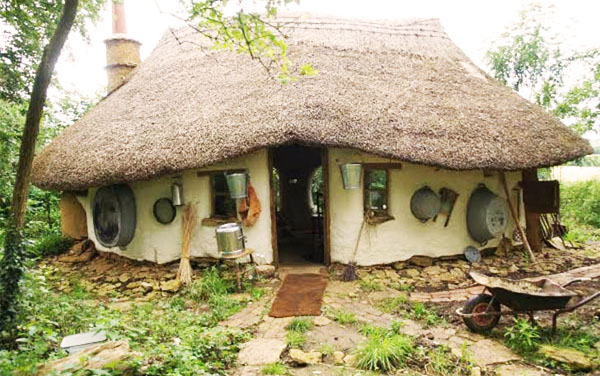
Cob is a very old method of building with earth and straw or other fibers. It is quite similar to adobe in that the basic mix of clay and sand is the same, but it usually has a higher percentage of long straw fibers mixed in. Instead of creating uniform blocks to build with, cob is normally applied by hand in large gobs (or cobs) which can be tossed from one person to another during the building process. The traditional way of mixing the clay/sand/straw is with the bare feet; for this reason, it is fairly labor intensive. Some of the process can be mechanized by using a backhoe to do the mixing, but that diminishes the organic nature of it. Because of all the straw, cob can be slightly more insulating than adobe, but it still would not make a very comfortable house in a climate of extreme temperatures. The wonderful thing about cob construction is that it can be a wildly freeform, sculptural affair. I've seen some very charming homes made this way. Cob was a common building material in England in the nineteenth century, and many of those buildings are still standing.

A variant of cob is what is commonly called "light straw/clay". This is made with the same long fibers of straw which is tossed like spagetti with a sauce of clay slip. The idea is to coat the straw fibers with enough of the clay to get them to stick together, but not so much that it makes a gummy clump. This material is then tamped into a form and left to set up enough to remove the form. Light straw walls could be useful for interior partitions and even exterior walls if it is thick enough. Such walls would be quite a bit more insulating than cob, but they require a timber frame of some sort because the straw itself would not be load bearing.
BOOKS
   
 
Click on image to buy from Amazon.com
 

The Hand-Sculpted House: A Practical and Philosophical Guide to Building a Cob Cottage by Ianto Evans, Michael G. Smith, and Linda Smiley, 2002. A cob cottage might be the ultimate expression of ecological design, a structure so attuned to its surroundings that its creators refer to it as "an ecstatic house." The authors build a house the way others create a natural garden. They use the oldest, most available materials imaginable -- earth, clay, sand, straw, and water -- and blend them to redefine the future (and past) of building. Building with cob requires no forms, no cement, and no machinery of any kind. Builders actually sculpt their structures by hand.

Building with earth is nothing new to America; the oldest structures on the continent were built with adobe bricks. Adobe, however, has been geographically limited to the Southwest. The limits of cob are defined only by the builder's imagination. Cob has been a traditional building process for millennia in Europe, even in rainy and windy climates like the British Isles, where many cob buildings still serve as family homes after hundreds of years. The technique is newly arrived to the Americas, and, as with so many social trends, the early adopters are in the Pacific Northwest. Cob houses (or cottages, since they are always efficiently small by American construction standards) are not only compatible with their surroundings, they ARE their surroundings, literally rising up from the earth. They are full of light, energy-efficient, and cozy, with curved walls and built-in, whimsical touches. They are delightful. They are ecstatic.
The Hand-Sculpted House is theoretical and philosophical, but intensely practical as well. You will get all the how-to information to undertake a cob building project. As the modern world rediscovers the importance of living in sustainable harmony with the environment, this book is a bible of radical simplicity.


Click on image to buy from Amazon.com
 

Earth Architecture by Ronald Rael, 2008. Currently it is estimated that one half of the world's population, approximately three billion people on six continents, lives or works in buildings constructed of earth. Author Ronald Rael, founder of Eartharchitecture.org, provides a history of building with earth in the modern era focusing particularly on projects constructed in the last few decades that use rammed earth mud brick compressed earth cob and several other interesting techniques. Earth Architecture presents a selection of more than 40 projects that exemplify new creative uses of the oldest building material on the planet. Rael's engaging narrative addresses the misconceptions associated with earth architecture. Rael also touches on many topics that pervade both architecture and popular media today such as the ecological benefits and the politics of building with earth particularly in developing nations where earth buildings are often thought of as pre-modern or backward. With engaging discussion and more than 300 images Earth Architecture showcases the beauty and simplicity of one of humankind's most evolved and sophisticated building technologies.


Click on image to buy from Amazon.com
 

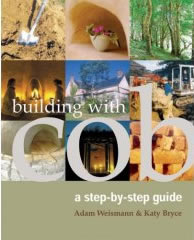
Building With Cob: A Step-by-step Guide by Adam Weismann, Katy Bryce, 2006. Cob building uses a simple mixture of clay subsoil, aggregate, straw, and water to create solid structural walls, built without shuttering or forms, on a stone plinth. This ancient practice has been used throughout Britain for centuries—in fact, the material is so strong and durable that it is currently in use for forty-five thousand houses in Cornwall, a county in southern England. Building with Cob covers everything from design, planning, and siting to roofs, insulation, and floors. It is lavishly illustrated with more than three hundred inspirational color photographs. Adam Weismann and Katy Bryce run their own building company in Cornwall. They have built and restored many cob buildings, including two-story houses, small studios, and garden rooms, outside courtyards, fireplaces, and earth ovens. In 2003 they won a Pioneers to the Nation award from Queen Elizabeth II. They live in Manaccan, Cornwall, England.


Click on image to buy from Amazon.com
 

The Good House Book : A Common-Sense Guide to Alternative Homebuilding by Clarke Snell, 2004. With this exquisitely illustrated guide, packed with 400 photos and illustrations, anyone can put environmentally friendly ideas into beautiful practice. Here’s an intelligent look at how a home is supposed to function and a variety of different building approaches. What’s important is finding the right solution to fit your individual needs, local climate, and natural resources. The broad range of topics covered include choosing a site; selecting materials; building with straw bale, cob, adobe, or rammed earth; and plugging into alternative home power systems. Interviews with six homeowners, and photos of the dream homes they built, provide invaluable insight. Clarke Snell is a builder with experience using a wide variety of materials and techniques, both conventional and alternative. The construction project closest to his heart is his own partially bermed, passive solar house, which he built in the mountains of western North Carolina. 


Click on image to buy from Amazon.com
 

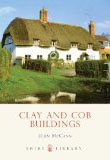
Clay and Cob Buildings, by John McCann, 2004. This book focuses on cob and clay structures in the British Isles, especially rural parts of England, Scotland, and Wales. It shows different styles of earth building prominent in those regions and also goes into detail about various techniques and history. Some restorations are shown as well as some buildings that have been left in disrepair since they were vacated. There are several hundred years of historical evidence to show what this material is capable of, proving just how beautiful and durable it is.


Click on image to buy from Amazon.com
 

Building in Cob, Pise and Stabilized Earth by Clough Williams-Ellis, 1999. Donhead Publishing; Facsimile edition.


Click on image to buy from Amazon.com
 

Building Green : A Complete How-To Guide to Alternative Building Methods by Clarke Snell , Tim Callahan, 2006. This absolutely groundbreaking manual doesn't just talk about eco-friendly building techniques, but actually shows every step! More than 1,200 close-up photographs, along with in-depth descriptions, follow the real construction of an alternative house from site selection to the addition of final-touch interior details. Co-authors Clarke Snell and Timothy Callahan (a professional builder and contractor) provide thorough discussions of the fundamental concepts of construction, substitutes for conventional approaches, and planning a home that's not only comfortable and beautiful, but environmentally responsible. Then, they roll up their sleeves and get to work assembling a guest house that incorporates four different alternative building methods: straw bale, cob, cordwood, and modified stick frame. The images show every move: how the site is cleared, the basic structure put together, the cob wall sculpted, the bales and cordwood stacked, a living roof created, and more. Most important, the manual conveys real-world challenges and processes, and offers dozens of sidebars with invaluable advice. It's head and shoulders above all others in the field.


Click on image to buy from Amazon.com
 

EcoNest: Creating Sustainable Sanctuaries of Clay, Straw, and Timber by Paula Baker-Laporte, Robert Laporte, 2005. A bird builds its nest using the materials at hand to create its perfect shelter. It doesn't fly to the next state for twigs or build a bigger home than it needs. Instinctively it creates an environment that is nurturing and nontoxic. Like the bird, humans desire shelter that is cozy and nurturing, that satisfies the soul, mind, and body. This is what you find when you step into an econest. Beginning with a timberframe structure and walls created with a mix of clay and straw, this book describes a unique method of green building that avoids the typical problems involved with conventional building, such as industrial waste, excessive chemical usage, and inefficient synthetic insulation. Design details such as which direction a home is oriented, what kind of lighting illuminates each room, and whether or not there is a step-down entryway are a vital part of creating each econest. Meet the homeowners of ten different econests around the country in regions as diverse as Iowa, Minnesota, New Mexico, and California who chose to build in appreciation of the harmony and beauty of nature, using nature's resources so as to consume less energy, create less waste, nurture their health, and enrich their senses.


Click on image to buy from Amazon.com
 
The Cobber's Companion: How to Build Your Own Earthen Home by Michael G. Smith, 1999. This book introduces you to cob and covers all aspects of building, from selecting the soil and building site, to the foundation, floor, walls and roof, and then ending with special design touches. It is extremely easy to follow and contains simple diagrams to clarify anything that might be misunderstood. This book can take you from knowing practically nothing about Cob to feeling like you could actually build your own home.
   
 
Click on image to buy from Amazon.com
 
The Cob Builders Handbook: You Can Hand-Sculpt Your Own Home by Becky Bee, 1998. This book is well written in plain, understandable language which even the most basic beginner can clearly understand. The illustrations are equally clear. There is no doubt that anyone who is interested in building with cob can follow the steps in this book and enjoy a reasonable degree of success.


Click on image to buy from Amazon.com
 

Earth Construction Handbook: The Building Material Earth in Modern Architecture by Gernot Minke, 2000. Which building material 1 - Absorbs and desorbs humidity faster, and to a higher extent, than any other? 2 - Produces hardly any environmental pollution and can be recycled any number of times? 3 - Balances indoor climate and moisture thus creating an extremely healthy environment in which to live? The answer is EARTH. In nearly all hot-dry and moderate climates of the world earth has been the predominant building material. Earth construction techniques have been known for more than nine thousand years and, even today, one-third of mankind lives in earth houses. The Earth Construction Handbook provides a survey of applications and construction techniques, including physical data, and explains the materials specific qualities together with the possibilities of optimising these. The information given can be practically applied by engineers, architects, builders, planners, craftsmen and laymen who wish to construct cost-effective buildings which provide a healthy, balanced indoor climate.


Click on image to buy from Amazon.com
 

Rocket Mass Heaters: Superefficient Woodstoves YOU Can Build by Ianto Evans and Leslie Jackson, 2006. Here is a superefficient wood fired heater you can build for yourself in a weekend for less than a hundred dollars. This book explains in detail exactly how to build one, then how to use it in a range of applications. They discuss materials: where to find them, what to pay and how to make use of found and recycled parts. The section on fire and fuels is thorough but simple; they tried to keep away from numbers wherever possible. There are success stories, case studies, references and where to find further information, all heavily illustrated. Home heating can be expensive both in capital equipment and in running costs. If we heat by gas, oil or electricity we are supporting a big corporation and impoverishing ourselves. By building an extra efficient heating system you will be one more big step off the treadmill and your move to self-sufficiency and true wealth. Good luck with your stove!


Click on image to buy from Amazon.com
 
Build Your Own Earth Oven: A Low-Cost, Wood-Fired Mud Oven; Simple Sourdough Bread; Perfect Loaves by Kiko Denzer, 2000. Building with earth is safe, easy, inexpensive, and extraordinarily effective. Good building soil is usually right under your feet! Use it plain, or mixed with sand and straw. Build the simplest oven in a day! Adding a roof and foundation makes it permanent. The simple, round shape makes a beautiful garden sculpture, or can be sculpted into a fire-breathing dragon!


Click on image to buy from Amazon.com
 
Cottage Building In Cob, Pise, Chalk & Clay - A Renaissance by Clough Williams-Ellis, 2008.

PLANS

Santa Fe IV
Sven Alstrom , Designer

This one story Santa Fe Style Guest House is based upon 24-inch wide straw bale construction or adobe block on concrete foundation & footings with crawl spaces, but would also work with cob. Natural interior plaster and natural exterior stucco are recommended. The house is 1,650 square feet gross (outside dimension) plus the courtyard & porch. The perimeter wall total of the 2 foot thick wall shown is approx. 169 sq, ft, Therefore, the net useable interior square footage is approximately 1,481 net square feet. Overall site plan dimensions shown are 43 feet wide x 50 feet deep outside courtyard wall to the front porch. This home was originally designed for a friend in Santa Fe, with the main entrance south facing, so that the kitchen is southeast for ‘ayurvedic' benefits The south facing front porch provides summer shading. This home is designed for a hot climate.

For more information about this plan, and many others, visit our sister site www.dreamgreenhomes.com, where you will find a wide range of plans for sustainable homes, greenhouses, small buildings, garages, and food storage space for sale. Dream Green Homes is a consortium of outstanding architects and designers, who have pooled their talent and expertise for your benefit.

LINKS

cobcottage site for The Cob Cottage Company features information and resources about building with cob.

cobworkshops.org lists many workshops featuring cob in North America.

naturalhomes.org lists workshops from around the world related to cob.

earthedworld.co.uk a fine, informative site about cob, listing workshops, forums, and an extensive photo gallery.

cobworks.com information, photos, workshops related to cob.

coblist email discussion group about cob.

davidsheen.com features a wonderful collection of pictures of earthen sturctures from around the world. (If Firefox doesn't work, try another browser.)

youtube.com There are a bunch of short videos about cob and natural building posted here, including interviews with Michael G. Smith, Becky Bee, Janell Kapoor, Katy Bryce & Adam Weismann, Alfie Howard, Ian Marcuse, Kiko Denzer, and Kevin McCabe.

youtube.com part 1 of an interview with Michael G. Smith about cob and earthen building; part 2:  youtube.com

daycreek.com page of photos and description of cob.

spiralworks.com is devoted to sustainable community development, and specializes in teaching about cob on the East Coast.

cobincornwall.com informative site with lots of pictures of various cob projects in Cornwall, England.

housealive.org This site is mostly focused on cob, and offers information and workshops that "empowers people to build affordable homes that are responsible and beautiful through the use of natural design and building techniques."

cobprojects.info join a cob forum or browse lots of pictures and sites devoted to cob projects.

barefootbuilder.com has information about cob and sponsors cob workshops in Tennessee

mudgirls.ca A women's cobbing cooperative in Canada that offers workshops, etc.

ilovecob.com This blog-style site has assembled lots of images of natural building projects, commentary about them, links to related sites, and even video via YouTube that tours a lovely cob creation.

edwardsecobuilding.com features information about cobbing, with photos, articles, courses, links, etc. in the UK.

cobtogether.com some nice pictures of cobworks.

cobbuildersforum.com this forum specific to cob building also has a picture gallery, videos, and workshops listed.

dancingrabbit.org this well-made and informative video features a light-straw-clay home that also uses reclaimed lumber.

earthenhand.com has a nice gallery of various cob work by Scott Howard.

livingearthstructures.com has a fun display of cob art.

startribune.com an article about two women's troubles with building a cob home in rural Wisconsin.

countrysidemag.com another article that references the cob house from above.

Disclaimer Of Liability And Warranty
I specifically disclaim any warranty, either expressed or implied, concerning the information on these pages. Neither I nor any of the advisor/consultants associated with this site will have liability for loss, damage, or injury, resulting from the use of any information found on this, or any other page at this site. Kelly Hart, Hartworks, Inc.


Home       Site Map        STORE

For Email contact go to About Us
Established in 2001, GreenHomeBuilding.com is primarily a labor of love. We do receive a small commission when you click through through and purchase books and other products listed on the site. Kelly, and the GreenHomeBuilding team of experts, have answered thousands of questions for readers over the years, and we continue to publish up-to-date information about increasingly important sustainable architecture. If you feel moved to assist us in this work, your kind donation would be much appreciated; this can be easily done through our PayPal account:
Google
 
Web www.greenhomebuilding.com
VISIT OUR OTHER WEBSITES:

[Natural Building Bookstore]       [Earthbag Building]     [Dream Green Homes]     [Solar Car]