|
Build
to Last
A prime ingredient of sustainable architecture is durability. If a
building doesn't last for a long time, it would be a waste of a lot of
embodied energy, from both a human and a resource perspective, not to mention
the economic loss.
Building to last is partly a matter of consciousness; we need to value
old architecture. Too often builders will do shoddy work or make poor
choices of construction materials because there is a sentiment that it
really only needs to last a few decades, and then it will be torn down
to create the almighty NEW. Architectural styles change, codes change,
building materials change, family needs change, so why expect a building
to last?
Well, I feel that all construction should be designed and built to last for a life time, and perhaps for centuries, with reasonable care and maintenance. Our throw away mentality needs to get thrown out the window! |
|
|
To
find out what sorts of buildings have lasted for over a century, Rosana
and I decided to visit the oldest continually inhabited town in Colorado:
San Luis. Established in 1851 by Spanish immigrants on original Spanish
Land Grants, San Luis continues to be the home of their descendents. It
was a wonderful experience to just wander around the town and look at
the mix of buildings. One short section of Main Street demonstrates the
reverence for longevity. The Costilla County Courthouse, built in 1883,
was originally made with thick adobe walls, and then added onto with cinder
blocks and cast stone. The R&R Market, with the Don Carlos hotel above,
was built in 1857, with two foot thick adobe walls.

The most charming adobe building on Main Street, to my eye, is an
old hotel, built in 1860. This now houses an art gallery run by Huberto
Maestas, who created the marvelous series of bronze sculptures that embody
the Stations of the Cross (more about this later). The hotel was built
with a deep wrap-around porch, supported by a series of columns. I suspect
that this porch has contributed to the longevity of the structure, since
it keeps moisture away from the adobe walls. I asked if I could inspect
the attic area to see how the roof was framed, and they were very accommodating.
The rough sawn planks up there appeared as good as new; obviously care
has been taken over the years to keep the roof in good shape, as I saw
no water damage.

Near the center of San Luis we found an old rock barn, with the remnants
of an adobe structure next to it. The accompanying photo shows how the
various materials have held up over time. The barn itself is still standing,
but neglect is taking its toll. The roof is falling apart, and eventually
the wooden framework will rot away. The rock walls are as sturdy as ever,
but a design flaw will eventually cause them to fail as well: there should
have been a "bond beam" at the top of the wall to keep it rigidly intact
at that level, so now large cracks have appeared and the whole back wall
will topple within a few years. The remnants of the adobe wall are amazingly
still intact, despite the obvious erosion from lack of weather protection.
Within the heart of San Luis is a small mesa, called "La Mesa de la
Piedad y de la Misericordia" (Hill of Pity and Mercy). A trail leading
up the hill is punctuated by some 15 statues representing the Stations
of the Cross. The journey up this hill would be an emotional experience
for any person, regardless their religious persuasion. The nearly life-size
sculptures document the last few hours of Jesus's life, in a very graphic
and compassionate way. When one arrives at the top of the mesa, another
wonderful experience awaits. La Capilla de Todos los Santos is a chapel
of pleasingly eclectic design. I include a description here, not because
it is old (it may be the newest building in San Luis), but because it
was built to last.

Completed in 1997, and designed by Arnie Valdez and Michael Bertin,
La Capilla is made from stabilized adobe blocks, carved stone, and massive
wooden vigas. The design derives from Mediterranean, Near Eastern and
Pueblo architectural styles. There are two half domes, and one full dome,
created entirely of adobe blocks. These domes are coated with a modern
stucco material that contains latex polymers. I think that La Capilla
represents an intelligent fusion of old and new, both in material and
design components.
All of the buildings mentioned so far demonstrate a nearly total lack
of consciousness about solar design. They do not make use of large areas
of south-facing glass, and as far as I can tell, the adobe is not insulated
from the outside atmosphere. It is true that two-foot walls of adobe will
take quite awhile to heat up or cool down, depending on the season. However,
eventually they will do so and then they will continue to rob the interior
of a comfortable temperature, requiring considerable energy input to maintain
comfort.
Over the years that I worked remodeling houses, I learned a few things
about building to last. Here are some suggestions: 1) Do not mix wood
and dirt. Inevitably the dirt wins! Termites and rot are extremely persistent.
2) Wherever possible choose materials that are not prone to rot. Water
has a way of infiltrating the most clever of human design to avoid it,
and moisture creates conditions for rot. 3) Allow things to breath as
much as possible. Because of the previous consideration, this is important.
If there is a crawl space under the house, make sure there is cross ventilation.
If the wall doesn't need a moisture barrier, don't put one there. It is
healthier for both you and your house. 4) Follow basic design concepts
for structural integrity. There is a wealth of experience to draw on from
all of the past building that has been done. Don't ignore it! |
|
|
| |
|
|
| |
Click on image to buy from Amazon.com |
|
The Smart Approach to Home Renovation by Susan Boyle Hillstrom, 2007. The Smart Approach to Home Renovation is the latest title in the best-selling series of The Smart Approach To books. Author Susan Boyle Hillstrom counsels would-be remodelers about the process, from planning and budgeting through completion. She also tells the stories of real-life homeowners and their makeovers that include kitchens, baths, additions, exterior updates, and outdoor living spaces. These Case Studies are followed by picture-driven Design Workbooks that illustrate important design features within the projects. In all, the book contains hundreds of photographs that include both before and after shots of remodelings, plus plenty of inspirational shots.
| |
|
|
| |
Click on image to buy from Amazon.com |
|
Historic Preservation: An Introduction to Its History, Principles, and Practice, by Norman Tyler, 1999. This book is an excellent resource for the beginning preservationist, whether they be a student in a formal academic setting or someone who just likes old buildings. It presents a variety of real-life examples, reflecting the way preservation is practiced and not just idealistic theory. Loaded with fresh examples of the myriad preservation activities taking place across the nation, it also details the context of the movement through analysis of the icons, both human and idealogical, of historic preservation. Clear, concise, and very readable, it will appeal to both the professional and avocationist alike. The inclusion of basic economic, social, and architectural impacts in historic preservation are welcome contributions, and the various charts and lists are extremely useful.
| |
|
|
| |
Click on image to buy from Amazon.com |
|
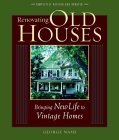
Renovating Old Houses: Bringing New Life to Vintage Homes by George Nash, 2003. For those who love to live in old houses or want to invest in one, this completely revised and updated book leaves no stone unturned. From evaluating a property to making foundation repairs to adding on a porch, it's a comprehensive guide to every aspect of making renovations and repairs whether you already live in, or are contemplating buying, an older home. Over 450 color photos and drawings are featured.
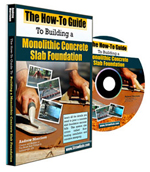
The How-To Guide to Building a Monolithic Concrete Slab Foundation DVD provides the latest information you need to know to build your own concrete slab foundation. Every stage of the concrete foundation building process is shown. By implementing these simple, how-to techniques you will be able to effectively build your own concrete foundation with no prior foundation or concrete experience. Using this DVD, you can build a structurally sound foundation as well as any builder. There is a list of all tools you need to build your project and dozens of time saving tips and techniques that will not only save your body from wear and tear, but also protect your pocket book.
| |
|
|
| |
Click on image to buy from Amazon.com |
|
Conserving Buildings: Guide to Techniques and Materials by Martin E. Weaver, 1997. Offers coverage pertaining to historic buildings along with the deterioration and conservation of all major building materials such as stone, ceramics, masonry, metals, paints, cement-based materials metal, glass, synthetic resins and polymers. Each chapter explains the characteristics of material, various forms of deterioration and a review of appropriate conservation techniques. Features information on using temperature and humidity to conserve materials and how to protect them against acid rain, earthquakes, fire, birds and other natural hazards. Also includes numerous photographs and illustrations.
| |
 |
|
| |
Click on image to buy from Amazon.com |
|
Natural Remodeling for the Not-So-Green House: Bringing Your Home into Harmony with Nature by Carol Venolia, Kelly Lerner, 2006. To have a home that's more in touch with the earth, you don't have to start from the ground up! It's possible-and more environmentally friendly-to go green by renovating an existing home. With the help of Carol Venolia, an award-winning architect and bestselling author, and Kelly Lerner, a world-famous innovator in the field of sustainable development, even the least mechanically inclined person can make a difference in his or her dwelling.and to the planet. The two have produced a remarkable book-packed with information and photos, and the first ever in full color to cover the subject. It's lush and exquisite to look at, filled with motivational case studies and informative graphics, and completely user-friendly.
| |
|
|
| |
Click on image to buy from Amazon.com |
|
Retrofitting for Energy Conservation by William H. Clark, 1997. Here is an expert guide that offers you practical solutions to remodeling and retrofitting for energy-conservation needs and code requirements. The book covers all 4 major areas of retrofit: electrical, HVAC, architectural, and control...plus techniques necessary for completing any job on time and within budget, as well as the newest and most-requested energy-efficient materials. Included are proven methods for retrofitting glass...walls, roofs, and floors...humidity control devices...lighting fixtures...motors ..attic insulation...air handlers...sensors...and much more! The author has a website (archi-tech-software.com) where the software associated with this book can be downloaded for free.
| |
 |
|
| |
Click on image to buy from Amazon.com |
|
The Complete Photo Guide to Home Improvement: With 300 Projects and 2,000 Photos by Creative Publishing international, 2005. The Bible for home improvement. Includes 300 projects, each with complete step-by-step directions. Updated to include more than 500 new photographs. In this latest edition are all-new chapters on kitchen and bathroom planning, and dozens of additional flooring, plumbing and remodeling projects. Readers will also appreciate the focus on new building materials, including laminate flooring, steel framing, PEX plumbing tubing, andglass blocks. A helpful reference appendix provides at-a-glance information essential for DIY remodelers.
| |
|
|
| |
Click on image to buy from Amazon.com |
|
Eco-Refurbishment: A Practical Guide to Creating an Energy Efficient Home by Peter Smith, 2004. This clear and accessible guide provides a comprehensive outline on how to convert your house into a more 'green' home. Buildings are the greates energy wasters and for those of us concerned about the environment, and household bills, this book presents the key design changes that we can implement to our own homes to remedy energy loss. This title covers the full range of design chanegs that are available to the homeowner and designer for renovation, from the roof to the basement, from insulation to windows. It also feature a selection of case studies illustrating the experiences of other homeowners and designers and how they have adapted and used the technology available to them in creating an energy efficient home. This is a practical, hands-on guide, ideal for architects, designers and homeowners.
|
| |
|
|
| |
Click on image to buy from Amazon.com |
|
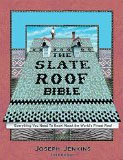
The Slate Roof Bible: Understanding, Installing and Restoring the World's Finest Roof (The Slate Roof Bible, 2nd Edition) by Joseph Jenkins, 2003. Completely revised, greatly expanded and updated version of the award-winning Slate Roof Bible, with 7 new chapters, over 350 color photographs of slate and slate roofs from around the world, and a total of over 600 photos, illustrations, graphs, charts, diagrams, maps, etc. Jenkins' down-home style converts potentially tedious subjects like slate geology, roof safety, tools, installation, and repairs into readable delights. The book covers slate roofing history, culture and geology, along with complete descriptions and sources of tools, equipment and types and colors of slate, and comprehensive, step-by-step instructions on every aspect of slate roof installation, repair, restoration and recycling. It also includes sections on rebuilding chimneys, on soldered seam copper roofs, and on repair and restoration of ceramic tile and asbestos tile roofs. It is the culmination of 10 years of research and travel by the author.
| |
|
|
| |
Click on image to buy from Amazon.com |
|
|
|
|
|
|
|
| |
|
|
|
| |
|
|
|
|
|
|
|
|
|
|
|
|
|
|
|
|
|
|
|
|
PLAN
Carriage House Kelly Hart, Designer
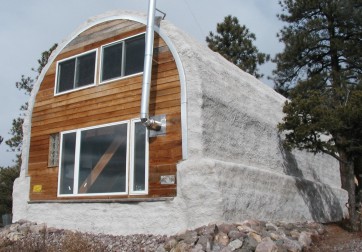
This Carriage House was initially designed to create garage and shop space, as well as office and storage space for the designer's personal use. There is potentially about 900 s.f. of usable floor area on two stories. It is a hybrid design, utilizing earthbags plastered with papercrete, a steel prefabricated Quonset-style vault, concrete floor, and wood-framed end walls. Since the steel vault is completely covered with insulating earthbags, the building is very well insulated, and comfortable year-round. This concept could be converted to residential use, with the addition of kitchen and bathroom functions, and the steel interior finish could be covered with scored sheetrock, tongue & grooved wood, or even cloth. This is rather inexpensive way to create substantial shelter. This design is based on a fairly small (16' X 34') steel building, but these structures are available in a wide range of widths ( up to sizes fit for aircraft hangers), and the lengths can be indefinite, since it is just a matter of adding more arched sections to lengthen the building.
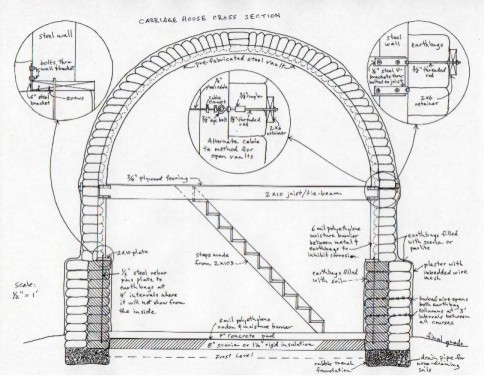
This cross section shows the hybrid nature of this design. In order to gain height, the steel shell is erected on top of an earthbag stem wall, and then the earthbags continue on up over the building. The double columns of the stem wall provides thermal mass on the inside and insulation on the outside. An insulated concrete pad is poured for the shop/garage floor. The second floor joists and tie beams are essential elements of the design, since they resist deformation of the vault from all of the weight on it.
For more information about this plan, and many others, visit our sister site www.dreamgreenhomes.com, where you will find a wide range of plans for sustainable homes, greenhouses, small buildings, garages, and food storage space for sale. Dream Green Homes is a consortium of outstanding architects and designers, who have pooled their talent and expertise for your benefit.
|
LINKS
If you are looking for a local roofer to help with your project, you can get some free quotes through elocalroofers.com.
induni.net a fascinating description of a masters course on building conservation at Bournemouth University in England.
This PDF file explains how a "rainscreen" can extend the life of siding on a conventional building.
heritagefoundation.ca and here is a link to another PDF document that further explains the use of the "rainscreen" concept.
rainscreenclip.com features
a hidden siding fastener system for rainscreen installations.
postprotector.com a product designed to add years of life to wooden posts.
Old House Web has compliled lots of articles about refurbishing old houses ecologically. |
|
 

Disclaimer
Of Liability And Warranty
I specifically disclaim any warranty, either expressed or implied,
concerning the information on these pages. Neither I nor any of the
advisor/consultants associated with this site will have liability
for loss, damage, or injury, resulting from the use of any information
found on this, or any other page at this site. Kelly Hart, Hartworks,
Inc.
Home
Site
Map
STORE
For Email contact go to About
Us
Established in 2001, GreenHomeBuilding.com is primarily a labor of love. Kelly, and the GreenHomeBuilding team of experts, have answered thousands of questions for readers over the years, and we continue to publish up-to-date information about increasingly important sustainable architecture. If you feel moved to assist us in this work, your kind donation would be much appreciated; this can be easily done through our PayPal account:
|
|