Owner/
Builder


Sustainable Architecture

Think Small

Heat with the Sun

Keep your Cool

Use Renewable Energy

Conserve Water

Use Local Materials

Use Natural Materials

Save our Forests

Recycle Materials

Build to Last

Grow your Food

Store your Food

Share Facilities

Share Facilities through Intentional Communities, Eco-Villages, Cohousing

A basic tenet of sustainability is to share what you have with others. Doing this can diminish the need for unnecessary duplication of facilities. In this way a group of people can not only have fewer tools or appliances or functional areas, but at the same time they can have available a greater variety of these facilities. This benefits both the environment (through less industrial activity) and the individual (by providing more options for living.)

Architecturally, a prime example of sharing facilities is what is known as co-housing. With this, a group of people agree to live in a housing situation that is designed so that each family unit has their own basic living accommodations, which are private, but then there are other facilities used in common. For instance, each family might have their own bedrooms, bathrooms, living room and small kitchenette, and then all of the residents might share the use of laundry facilities, meeting room, recreation room, swimming pool, a large kitchen and workshop.

Other modes of living in a cooperative group are intentional communities or communes and eco-villages. Any living arrangement where people share facilities can be beneficial.

There is a social benefit to living in community that is often of considerable appeal to the residents. With the changing make-up of our society, the single-family unit no longer defines how many of us choose to live. People often prefer to be solitary, or at least find themselves in this condition, and becoming part of a larger group can give them a sense of belonging, without the extreme intimacy of marriage.

With co-housing and other community arangements there is often the added advantage of the preservation of open space around the development. The greater density of housing can mean less impact on the environment. Here we have a winning situation for both the residents and the earth!

RESOURCES

SEARCH THIS SITE

BOOKS & VIDEOS

ARTICLES:
Ancient Cooperative Society


Housing Our Society

EXPERT ADVICE

with Michael Black

Questions and Answers

INFORMATIVE LINKS


BOOKS & VIDEOS
   
 
Click on image to buy from Amazon.com
 
Finding Community: How to Join an Ecovillage or Intentional Community by Diana Leafe Christian, 2007. Finding community is as critical as obtaining food and shelter, since the need to belong is what makes us human. The isolation and loneliness of modern life have led many people to search for deeper connection, which has resulted in a renewed interest in intentional communities. These intentional communities or ecovillages are an appealing choice for like-minded people who seek to create a family-oriented and ecologically sustainable lifestyle-a lifestyle they are unlikely to find anywhere else. However, the notion of an intentional community can still be a tremendous leap for some-deterred perhaps by a misguided vision of eking out a hardscrabble existence with little reward. In fact, successful ecovillages thrive because of the combined skills and resources of their members. Finding Community presents a thorough overview of ecovillages and intentional communities and offers solid advice on how to research thoroughly, visit thoughtfully, evaluate intelligently, and join gracefully. Useful considerations include: Important questions to ask (of members and of yourself); Signs of a healthy (and not-so-healthy) community; Cost of joining (and staying); Common blunders to avoid. Finding Community provides intriguing possibilities to readers who are seeking a more cooperative, sustainable, and meaningful life.
   
 
Click on image to buy from Amazon.com
 

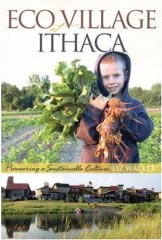
EcoVillage at Ithaca: Pioneering a Sustainable Culture by Liz Walker, 2005. In a world filled with stories of environmental devastation and social dysfunction, EcoVillage at Ithaca is a refreshing and hopeful look at a modern-day village that is taking an integrated approach to addressing these problems. This book tells the story of life at EcoVillage at Ithaca, an internationally recognized example of sustainable development. It transports the reader into the midst of a vibrant community that includes co-housing neighborhoods, small-scale organic farming, land preservation, green building, energy alternatives and hands-on education. By integrating proven social and environmental alternatives into a living model, EcoVillage at Ithaca provides a rare glimpse into one possible-and positive-future for the planet. EcoVillage at Ithaca delves into the heart of the lived experience at this innovative community. It provides a warm, personal and reflective look at what it is like to create a sustainable culture. The book tells in-depth stories about an integrated way of life: Running a family farm; Creating invented celebrations"; The poignancy of a home birth, as well as a conscious death; Community work parties; Dramatic examples of personal transformation. At the same time, as one chapter states, "This is not Utopia," and the struggles and conflicts inherent in any community endeavor are not glossed over. Human scale, accessible and inspiring, the example of EcoVillage at Ithaca will help readers imagine fresh alternatives to "life as usual." It will appeal to all who are hungry to learn about successful working models of a more sustainable approach to living with each other and the earth.


Click on image to buy from Amazon.com
 
Ecovillages (Schumacher Briefings) by J Dawson, 2006. In the last twenty years ecovillages -- local communities which aim to minimise their ecological impact but maximise human wellbeing and happiness -- have been springing up all over the world. They incorporate a wealth of radical ideas and approaches which can be traced back to Schumacher, Gandhi, the 1960s, and the alternative education movement. This Briefing describes the history and potential of the ecovillage movement, including the evolution of the Global Ecovillage Network and the current developments in both North and South. The threads that are brought together in Ecovillages include: * Learning from the best elements in traditional and indigenous cultures; * Alternative economy: community banks and currencies, and voluntary simplicity; * Designing with nature: using permaculture design, eco-building, small-scale energy generation, waste-management, low-impact transport systems, etc; * Organic, locally-based food production and processing; * Reviving small-scale participatory governance, conflict facilitation & social inclusion as well as reviving active inter-generational community; * Creating a culture of peace, and holistic, whole person education. In an age of diminishing oil supplies, the Briefing examines the lessons that we can learn from ecovillages about how to live in a more ecologically sound and sustainable way. In an age of diminishing oil supplies, the Briefing examines the lessons that we can learn from ecovillages about how to live in a more ecologically sound and sustainable way.
   
 
Click on image to buy from Amazon.com
 

The Cohousing Handbook : Building a Place for Community by Chris ScottHanson, Kelly ScottHanson, 2004. Cohousing offers an end to the isolation of the single-family suburban home. Balancing community and personal privacy, cohousing is a chance to create a modern village in an urban or rural setting. Residents own their own homes and can gather in common areas to share meals and socialize. An increasingly popular form of housing in both Europe and North America, cohousing addresses and alleviates many of the demands and pressures of modern life-everything from day care to aging at home is easier with the help of your neighbors. The Cohousing Handbook covers every element that goes into the creation of a cohousing project, including group processes, land acquisition, finance and budgets, construction, development professionals, design considerations, permits, approvals and membership.


Click on image to buy from Amazon.com
 

Senior Cohousing: A Community Approach to Independent Living by Charles Durrett, 2005. Cohousing is an entirely new way for seniors to house themselves with dignity, independence, safety, mutual concern, and fun. Providing an inside look at existing communities, Senior Cohousing demonstrates how people can make the conscious choice to live independently through community. Charles Durrett has designed more than 30 cohousing communities in North America, and coauthored the book that introduced the concept of cohousing to the United States.


Click on image to buy from Amazon.com
 

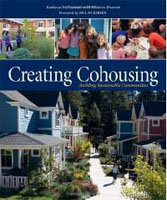
Cohousing: A Contemporary Approach to Housing Ourselves by Kathryn McCamant , Charles Durrett , Ellen Hertzman, 1993. Alright, you tried living in a commune in the 1970s, and people kept borrowing your toothbrush and leaving dishes in the sink. Then you set up house by yourself and felt lonely. You got married, started raising a family and ended up feeling isolated from your friends and the rest of the community. You go to work, wave to your neighbors over the fence now and then, and think there must be more to life than this. There is: a whole new concept of building a neighborhood and sense of community. This is the story of how and why cohousing works, and how to go about making it happen for yourself.


Click on image to buy from Amazon.com
 

Intentional Community: An Anthropological Perspective by Susan Love Brown, 2002. Although anthropologists have studied intentional communities in the past, they have seldom exerted a concerted effort to evaluate the intentional community in terms of the anthropological language of cultural change. Drawing from the work of Victor Turner, Gregory Bateson, and Anthony F. C. Wallace, Intentional Community examines historic and contemporary intentional communities within the United States, leading to a better understanding of these communities, the larger nation-state of which they are a part, and the ways in which the two interact. Applying classical anthropological theory to elements of western society, the contributors discuss how the individuals function; the ways in which these communities come into being and disappear; the various forms these communities take; how their members reinterpret features of the larger culture; and the ways in which outsiders relate to people within them.


Click on image to buy from Amazon.com
 

Voices from the Farm: Adventures in Community Living by Rupert Fike, 1998. Twenty-five years ago, at the height of the counter-culture movement, several hundred hippies drove their school buses into southern Tennessee and founded America's largest, modern-day intentional community, The Farm. In its heyday, the community was home to over 1,200 optimistic young people and the young-at-heart. Their purpose for coming together was to experiment with alternative lifestyles that could help raise the standard of living for impoverished people around the world while conserving the planet's resources. The results of these experiments were not always predictable, but were always interesting, and created lasting bonds among community members that are still strong today. The Farm remains a vibrant, working environment for change. Why has it lasted so long? Discover the answers as members past and present recount some of their more memorable experiences.


Click on image to buy from Amazon.com
 
Creating a Life Together: Practical Tools to Grow Ecovillages and Intentional Communities by Diana Leafe Christian, 2003. This book provides step-by-step practical information distilled from numerous first-hand sources on how to establish an intentional community. It deals in depth with structural, interpersonal and leadership issues, decision-making methods, vision statements, and the development of a legal structure, as well as profiling well-established model communities. This exhaustive guide includes excellent sample documents among its wealth of resources.


Click on image to buy from Amazon.com
 
Ecovillages : A Practical Guide to Sustainable Communities by Jan Martin Bang, 2005. Ecovillages have arisen around the world in response to the social fragmentation of modern life and its alienation from nature. They provide a variety of ways of living in community with others and with nature and are linked worldwide through the Global Ecovillage Network. While interest in this approach to sustainable living is rapidly increasing, there is relatively little literature on the topic and none that brings the design principles of permaculture to bear on the successful design of these communities. Ecovillages explores the new departures in personal, social, and ecological living represented by this phenomenon. This book explores the background and history to the ecovillages movement and provides a comprehensive manual for planning, establishing, and maintaining a sustainable community using a permaculture approach.

New Buffalo: Journals from a Taos Commune
by Arthur Kopecky, 2004


Click on image to buy from Amazon.com


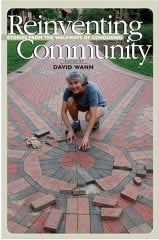
Reinventing Community: Stories from the Walkways of Cohousing
by David Wann, 2005


Click on image to buy from Amazon.com


Communities Directory: A Guide to Intentional Communities and Cooperative Living
2007


Click on image to buy from Amazon.com


Sustainable Community: Learning from the Cohousing Model
by Graham Meltzer, 2005


Click on image to buy from Amazon.com


And We Are Doing It: Building an Ecovillage Future
by J.T. Ross Jackson, 2000


Click on image to buy from Amazon.com


Living in the Margins: Intentional Communities and the Art of Interpretation
by Terry A. Veling,2002


Click on image to buy from Amazon.com


Ecovillage Living: Restoring the Earth and Her People
by Hildur Jackson, 2002


Click on image to buy from Amazon.com


The Word at the Crossings: Living the Good News in a Multicontextual Community
by Eric H. F. Law, 2002


Click on image to buy from Amazon.com


Living In Utopia: New Zealand's Intentional Communities
by Lucy Sargisson, Lyman Tower Sargent, 2004


Click on image to buy from Amazon.com


LINKS

cohousing.org The Cohousing Association of the United States lists locations of cohousing projects, frequently asked questions, web tours, news and events, and other resources, including a free magazine.

cohousing.ca The Canadian Cohousing Network has a directory of cohousing projects, a newsletter, frequently asked questions, and many other resources.

cohousing.org.au a directory of cohousing contacts in Australia.

cohousingresources.com the authors of The Cohousing Handbook provide lots of information about cohousing in general, as well as offer their consulting services.

cohousing.org.uk The UK Co-housing Network provides a wealth of information about cohousing in the UK.

converge.org.nz The Eco-Village and Cohousing Association of New Zealand: a national umbrella network linking people, projects and the global Eco-village community.

yulupacoho.com an excellent example (in Santa Rosa, California) of one of the many cohousing projects sprinkled around the world. My sister, Alexandra Hart, and her architect husband, Michael Black, were instrumental in bringing this into being.

mblackarchitect.com Community Life Development; Michael Black Associates: community planning/architecture, cohousing design, community formation and development consultation.

chicagocohousing.net provides regional and national resources related to cohousing.

directory.ic.org is a directory of communities around the world.

eldercohousing.org the online home of the Elder Cohousing Network creators of Elder Cohousing Neighborhoods for Active Adults.

sewaneecreek.com describes an intentional community in the Tennessee mountains.

greatdreams.com this is a huge directory of communities and related links to housing, energy efficiency, agriculture, etc.


Disclaimer Of Liability And Warranty
I specifically disclaim any warranty, either expressed or implied, concerning the information on these pages. Neither I nor any of the advisor/consultants associated with this site will have liability for loss, damage, or injury, resulting from the use of any information found on this, or any other page at this site. Kelly Hart, Hartworks, Inc.


Home       Site Map        STORE

For Email contact go to About Us
We are interested in exchanging links with other
informative sites on closely related topics
Google
 
Web www.greenhomebuilding.com
VISIT OUR OTHER WEBSITES:

  [Solar Car]      [Which Hobbit Lives Here?]     [Dream Green Homes]