Cordwood Masonry
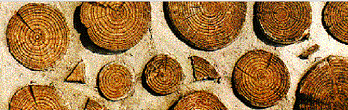
Cordwood construction utilizes short, round pieces of wood, similar to what would normally be considered firewood. For this reason this method of building can be very resource efficient, since it makes use of wood that might not have much other value. Cordwood building can also create a wall that has both properties of insulation and thermal mass. The mass comes from the masonry mortar that is used to cement the logs together, and the insulation comes from the wood itself and the central cavity between the inside and outside mortars. Like strawbale walls, many building authorities require a post and beam or similar supporting structure and then using cordwood as an infill, even though the cordwood method creates a very strong wall that could support a considerable load.
This method produces a look that is both rustic and beautiful. The process of building is similar to laying rocks in mortar, where the the logs are aligned with their ends sticking out to create the surface of the wall and mortar is applied adjacent to each end of the log. Typically the logs are not coated with a moisture barrier, but are allowed to breath naturally. It is possible to include other materials into the matrix, such as bottle ends that would provide light to enter the wall.
Recent experiments with the use of cob instead of cement mortar to join the logs have been encouraging and this method may provide a somewhat more ecological approach to cordwood building. In this case special care should be taken to have large eaves to keep water away from the wall.
After studying the wide array of "natural building" techniques for several years, I have come to accept cordwood as one of the greenest of all: it uses what is often considered a waste material, creates an insulated wall that requires no further finishing or maintenance over time, and can be done by relative novices...what more could you want?
ARTICLES:
Is Cordwood Green?
by Rob Roy
EXPERT
ADVICE
with Rob Roy

Where
to build?
Types
of wood to use
Where to Find Cordwood
Debarking and Curing the Cordwood
Foundations
Appropriate mortar and Methods
To seal or not to seal?
Structural Considerations
Code and permit issues
Cordwood
plans
Miscellaneous
The books shown below are arranged according to when they were published, with the most recent ones at the top. If you click on one of the images you will be taken to a page at Amazon.com where you can find out more about the book. If you end up buying one of them, greenhomebuilding.com will receive a small commission that will help cover the cost of maintaining this website. Thanks for your patronage.






Plans
Sacred Mountains
Kelly Hart, Designer
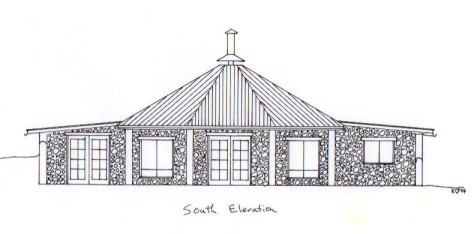 This is a 2 bedroom, 1 story, 1725 sf (to the outside) house that is designed around the traditional hogan concept of Southwestern native Americans. It would be dug into a hillside, or bermed substantially on the north side. A large south-facing living area with a vaulted cieling provides passive solar heating for much of the house. The bedrooms, bathroom, pantry and kitchen surround the traditional octagonal shape. This was originally designed for the Sacred Mountains Foundation as a demonstration home for a variety of natural building techniques, so that it employs cordwood, strawbale, adobe, rock, earthbag, and timber-frame aspects. The southern elevation shown here would be post and beam with cordwood infill. There is a unique central fire place, open 360 degrees, for back-up heat and ceremonial purposes. The large core room could accomodate large groups, or be utilized in many ways.
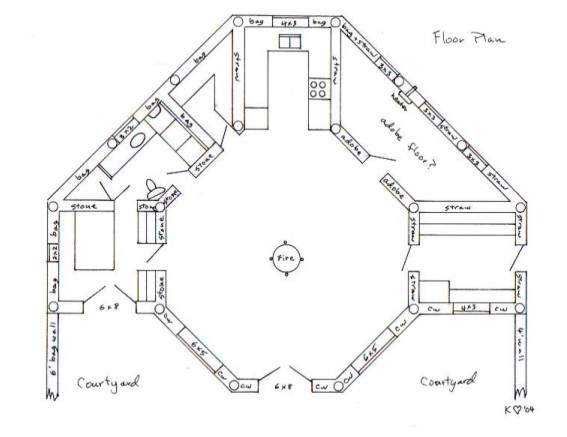 Traditionally, the native Americans enter their abodes from the east, so this where the airlock entry is situated. This large space can also serve as a closet and storage room. The large octagonal room is undifferentiated, but would serve as living, dining and ceremonial space. To the west is the master bedroom, with adjacent bathroom. To the left of the kitchen alcove is a large pantry that would be naturally cooled by its substantial earth berm. A second bedroom or studio faces the northeast. A large fenced courtyard area to the south provides privacy and wind protection.
For more information about this plan, and many others, visit our sister site www.dreamgreenhomes.com, where you will find a wide range of plans for sustainable homes, greenhouses, small buildings, garages, and food storage space for sale. Dream Green Homes is a consortium of outstanding architects and designers, who have pooled their talent and expertise for your benefit.
Informative Links
cordwoodmasonry.com Rob Roy's Earthwood Building School site, focuses on cordwood masonry and earth sheltering.
naturalhomes.org lists workshops from around the world with some of them related to cordwood construction.
daycreek.com a very informative, atractive and well designed site devoted to cordwood masonry and other forms of natural building.
smallhouseliving.org a short article published in 1941 with a photo of a cordwood cottage.
picasaweb.google.com A photo gallery of a lovely cordwood Hobbit House.
inspirationgreen.com offers a lovely collection of cordwood cabins.
cordwoodconstruction.wordpress.com Richard Flatau's cordwood blog.
For Email contact go to About Us
Established in 2001, GreenHomeBuilding.com is primarily a labor of love. Kelly, and the GreenHomeBuilding team of experts, have answered thousands of questions for readers over the years, and we continue to publish up-to-date information about increasingly important sustainable architecture. If you feel moved to assist us in this work, your kind donation would be much appreciated; this can be easily done through our PayPal account:

VISIT OUR OTHER WEBSITES:
[Natural Building Blog] [Earthbag Building] [Dream Green Homes]
Disclaimer Of Liability And Warranty
I specifically disclaim any warranty, either expressed or implied, concerning the information on these pages. Neither I nor any of the advisor/consultants associated with this site will have liability for loss, damage, or injury, resulting from the use of any information found on this, or any other page at this site. Kelly Hart, Hartworks LLC.