Owner/
Builder

Adobe

Adobe is one of the oldest building materials in use. It is basically just dirt that has been moistened with water, sometimes with chopped straw or other fibers added for strength, and then allowed to dry in the desired shape. Commonly adobe is shaped into uniform blocks that can be stacked like bricks to form walls, but it can also be simply piled up over time to create a structure. The best adobe soil will have between 15% and 30% clay in it to bind the material together, with the rest being mostly sand or larger aggregate. Too much clay will shrink and crack excessively; too little will allow fragmentation. Sometimes adobe is stabilized with a small amount of cement or asphalt emulsion added to keep it intact where it will be subject to excessive weather. Adobe blocks can be formed either by pouring it into molds and allowing it to dry, or it can pressed into blocks with a hydraulic or leverage press. Adobe can also be used for floors that have resilience and beauty, colored with a thin slip of clay and polished with natural oil.

Adobe buildings that have substantial eaves to protect the walls and foundations to keep the adobe off the ground will require less maintenance than if the walls are left unprotected. Some adobe buildings have been plastered with Portland cement on the outside in an attempt to protect the adobe, but this practice has led to failures when moisture finds a way through a crack in the cement and then can't readily evaporate. When adobe is used as an exterior plaster it is either stabilized or replastered on a regular basis.

Adobe is a good thermal mass material, holding heat and cool well. It does not insulate very well, so walls made of adobe need some means of providing insulation to maintain comfort in the building. Sometimes this is accomplished by creating a double wall, with an air space, or some other insulation in between. Another approach is placing insulating materials on the outside.
RESOURCES

SEARCH THIS SITE

BOOKS & DVDs

WATCH VIDEOS

PLANS

ARTICLES:

THE BEAUTY OF MUD AND STRAW

ADOBE:
A PRESENT FROM THE PAST

ADOBE POSTERS

EXPERT ADVICE

with Quentin Wilson


What is Adobe?
Localities where Adobe Works
Appropriate Mixes for Adobe
Ways to Make Adobe Bricks
Foundations for Adobe
Laying the Adobes
Roofs on Adobe Homes
Adobe as Plaster
Adobe Floors
Structural Concerns

Appearance of Adobe
Mass and Insulation
Education
Miscellaneous
INFORMATIVE LINKS


BOOKS & DVD's


Click on image to buy from Amazon.com
 
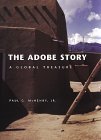
The Adobe Story: A Global Treasure by Paul Graham McHenry, 2000.Most Americans associate adobe with grand haciendas in the deserts of New Mexico and Arizona. But this earthen building material is used all over the world. Here a leading adobe architect and builder surveys the use of adobe around the world, examines the state of the adobe industry today, traces the evolution of adobe in New Mexico, and offers a tour of New Mexico adobes from prehistoric Chaco Canyon to such recent buildings as the Dar Al Islam mosque and Christ in the Desert Monastery, both near Abiquiu.


Click on image to buy from Amazon.com
 

Adobe Houses for Today: Flexible Plans for Your Adobe Home by Laura Sanchez, Alex Sanchez, 2008. This book showcases twelve plans for constructing compact, aesthetic adobe homes in modern and traditional styles. Chapters cover the history, advantages and drawbacks, and finances of owning an adobe home, as well as how to build one from the ground up. Black-and-white photographs, computer models, and diagrams clearly illustrate a variety of points. A highly recommended addition to academic and professional architectural studies collections, Adobe Houses For Today is more than a modern guide to an ancient architectural art; it is also a fascinating wealth of information and lore. --Midwest Book Review


Click on image to buy from Amazon.com
 

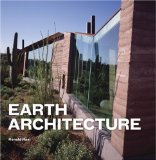
Earth Architecture by Ronald Rael, 2008. Currently it is estimated that one half of the world's population, approximately three billion people on six continents, lives or works in buildings constructed of earth. Author Ronald Rael, founder of Eartharchitecture.org, provides a history of building with earth in the modern era focusing particularly on projects constructed in the last few decades that use rammed earth mud brick compressed earth cob and several other interesting techniques. Earth Architecture presents a selection of more than 40 projects that exemplify new creative uses of the oldest building material on the planet. Rael's engaging narrative addresses the misconceptions associated with earth architecture. Rael also touches on many topics that pervade both architecture and popular media today such as the ecological benefits and the politics of building with earth particularly in developing nations where earth buildings are often thought of as pre-modern or backward. With engaging discussion and more than 300 images Earth Architecture showcases the beauty and simplicity of one of humankind's most evolved and sophisticated building technologies.

The Cheap-Ass Curmudgeon's Guide to Dirt: Hand-Building with Adobe, Papercrete, Paper-Adobe, and More by Michael Van Hall, 2009. This down-loadable e-book is a somewhat whimsical guide to building with adobe in an unconventional way. What this curmudgeon advocates appears to works pretty well and could eliminate much of the conventional labor of air drying all of the adobes and mortaring them into place. It is basically a method that combines formed bricks with hand-piled adobe (or pise) for a system that is quite maleable in wall shape and appearance. Describing how to do this is half of the book; the other half is an exhortation to think out of the box, have fun, and be creative. Michael shows many examples of his own projects and those of others that do just that. It is a fun read that will make you want to get out in the dirt and play!


Click on image to buy from Amazon.com
 

Adobe : Build It Yourself by Paul Graham McHenry, 1985. A bible for owner built adobe homes This book was written after teaching more than 1500 students a community college course by the same name. It is tightly focused on the questions and needs of the would be owner buider. While it deals primarily with the adobe styles and methods of the southwestern United States, it is a good general guide for the beginning homeowner.


Click on image to buy from Amazon.com
 

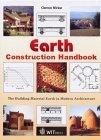
Earth Construction Handbook: The Building Material Earth in Modern Architecture by Gernot Minke, 2000. Which building material 1 - Absorbs and desorbs humidity faster, and to a higher extent, than any other? 2 - Produces hardly any environmental pollution and can be recycled any number of times? 3 - Balances indoor climate and moisture thus creating an extremely healthy environment in which to live? The answer is EARTH. In nearly all hot-dry and moderate climates of the world earth has been the predominant building material. Earth construction techniques have been known for more than nine thousand years and, even today, one-third of mankind lives in earth houses. The Earth Construction Handbook provides a survey of applications and construction techniques, including physical data, and explains the materials specific qualities together with the possibilities of optimising these. The information given can be practically applied by engineers, architects, builders, planners, craftsmen and laymen who wish to construct cost-effective buildings which provide a healthy, balanced indoor climate.


Click on image to buy from Amazon.com
 
The Good House Book : A Common-Sense Guide to Alternative Homebuilding by Clarke Snell, 2004. With this exquisitely illustrated guide, packed with 400 photos and illustrations, anyone can put environmentally friendly ideas into beautiful practice. Here’s an intelligent look at how a home is supposed to function and a variety of different building approaches. What’s important is finding the right solution to fit your individual needs, local climate, and natural resources. The broad range of topics covered include choosing a site; selecting materials; building with straw bale, cob, adobe, or rammed earth; and plugging into alternative home power systems. Interviews with six homeowners, and photos of the dream homes they built, provide invaluable insight. Clarke Snell is a builder with experience using a wide variety of materials and techniques, both conventional and alternative. The construction project closest to his heart is his own partially bermed, passive solar house, which he built in the mountains of western North Carolina. 


Click on image to buy from Amazon.com
 

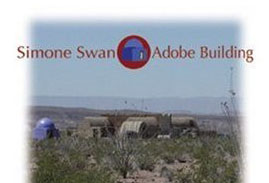
Simone Swan: Adobe Building by Dennis Dollens, 2006. Like an organism sitting and breathing on its site in the Chihuahuan desert, the Swan House is a building of organic beauty and hybrid cultural intelligence. Simone Swan has created an architectural and environmental project that re-examines and promotes traditional adobe building while introducing compatible forms, such as the Nubian vault and dome. Swan studied with the great Egyptian architect Hassan Fathy in his Cairo studio and after his death in 1989 adopted his mission of helping house the world's poor. Simone Swan: Adobe Building is the first book to discuss and illustrate Swan's architecture while also chronicling one of her annual workshops in Dollens' first-hand account. Dollens suggests that by biologically analyzing historic adobe we may be able to hybridize its constituents as replacements for current toxic materials, creating new biomimetic, adobe-related building materials suitable for green architecture.


Click on image to buy from Amazon.com
 

Ageless Adobe: History and Preservation in Southwestern Architecture by Jerome Iowa, 1985. This book provides practical details on methods of preservation and maintenance for old adobe buildings. The over 200 illustrations in the book along with directions on "how-to" will enable the do-it-yourself home owner as well as the professional architect or contractor to plan and carry out renovation. The author presents solutions to the problems of keeping an historic structure intact while repairing it and making it 20th century livable. The issue of energy conservation is discussed at length and the premise of the book is that historic integrity does not have to be sacrificed for energy efficiency. Rehabilitation is always preferable, usually possible and often more profitable than demolition.


Click on image to buy from Amazon.com
 

Adobe Conservation by Cornerstones Staff, 2006. This richly illustrated guide is acknowledged as the best source for expert, field-tested information on the care and maintenance of historic adobe buildings--from small vernacular structures to the great Spanish Colonial missions. As a true "how-to" manual, it presents a user-friendly and straightforward approach to the assessment, maintenance, preservation and restoration of earthen buildings based on time-tested techniques. Subjects include: architectural styles and materials; tools and equipment; materials and supplies; emergency shoring; moisture testing in adobe walls; material selection, mixing and testing; making adobe bricks; repairing and rebuilding adobe walls; repairing cracks in adobe walls; mud and lime plastering; earthen and lime finishes; removing contra paredes; repairing corbels; inspecting vigas and corbels; splicing vigas; compliance with State and Federal cultural resource protection legislation; glossary of terms; and bibliography. Cornerstones Community Partnerships in Santa Fe, New Mexico is devoted to the preservation of the architectural heritage and community traditions in New Mexico and the American Southwest. Through its nationally honored technical assistance, applied learning and traditional building skills programs, Cornerstones has assisted more than 300 rural Hispanic and Native American communities with the preservation of historic and culturally significant earthen buildings. Cornerstones has developed and utilized the techniques in this book throughout the American Southwest since 1986.


Click on image to buy from Customflix.com
 

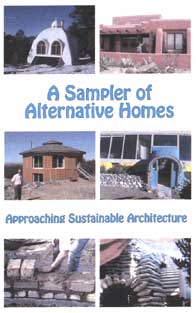
A Sampler of Alternative Homes: Approaching Sustainable Architecture . This two-hour DVD, produced by Kelly Hart, provides an overview of sustainable building concepts. You can enjoy a look at a fascinating variety of homes and the creative people who built them! Discover how passive solar design and environmentally low-impact materials can be used to create comfortable and economical homes. See the use of both traditional materials, such as adobe, and innovative materials, such as papercrete and earthbags.

This program offers a wealth of information about construction details and other considerations. It covers adobe block construction, piled adobe (similar to cob), rammed earth, both load-bearing and post and beam strawbale, earthships, earth-sheltering, cordwood, thin-shelled concrete domes, papercrete, earthbags, hybrid structures, and recycling various containers for housing. To watch a streaming video introduction to this program, click here.
$29.95

BuyDVD

For a VHS videotape of this program go to the STORE.
   
 
Click on image to buy from Amazon.com
 
The New Adobe Home, by Michael Byrne and Dottie Larson, 2009. This book presents the sophisticated, elevated use of adobe through a variety of elegant homes in New Mexico, Arizona, California, and Mexico. These homes comprise a combination of history, furnishings, art, and interior and exterior spaces with adobe construction, adobe style, or detailing. This beautiful volume features examples of luxurious adobe or adobe-style homes, including a centuries-old renovated hacienda, once the home of a past president of Mexico; a mid-century Clifford May masterpiece; a luxurious estate that pairs Southwestern style with Asian influences; a contemporary dwelling that sits like a sculpture in the Sonoran Desert; and many others.
   
 
Click on image to buy from Amazon.com
 
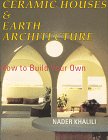
Ceramic Houses and Earth Architecture: How to Build Your Own by Nader Khalili, 1996. This book shows how to build vaults, domes and arches with adobe blocks. It then goes on to suggest how to actually fire the structure like pottery, with a glaze. It is a fiscinating concept that has seen little use, partly because the firing process can be rather polluting. This book has been updated to discuss the SuperAdobe building method of building with earthbags.. I recommend this book to everyone who is interested in alternative building methods.


Click on image to buy from Amazon.com


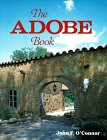
The Adobe Book
by John F. O'Connor, 1999. A fully illustrated, detailed how-to covering every phase of construction from soil and blocks to heating, electricity, plumbing, interiors, exteriors and landscaping. This is a very comprehensive text and one that will help you to either build your own adobe home or at least be knowledgeable enough to talk things over with your builder. Besides offering complete instructions, this book provides a history of adobe and drawings of fireplaces, pueblo entries, spool and territorial windows, adobe ceilings, and Mexican tile designs.


Click on image to buy from Amazon.com
 

Adobe and Rammed Earth Buildings: Design and Construction by Paul Graham McHenry, 1997. A definitive work on all aspects of adobe brick and rammed earth building, on a global scale. Photos of examples from all over the world, and alternative design details to fit every climate and situation. Includes the UBC and New Mexico Code for adobe.


Click on image to buy from Amazon.com


The Owner-Built Adobe House
by Duane Newcomb, 2001. This book is a useful guide that will help you build your own adobe house almost anywhere in the country, even in areas not usually considered “adobe country.” Duane Newcomb takes you through every step of the process, from selecting a site, obtaining building permits, drawing plans, excavating, and making bricks to adding kitchen cabinets and finishing the interior. The Owner-Built Adobe House details every aspect of various types of adobe houses and includes information on plumbing, electricity, heating and cooling, fireplaces, flooring, and the framing of windows, doors, and roofs


Click on image to buy from Amazon.com
 

Casa Adobe by Karen Witynski, Joe P. Carr, 2001. Many people find the lines and textures of an adobe building at once seductive and compelling. This book is all about the unique aesthetic of houses made of mud. Third in a series of four books on popular residential design in Mexico and the Southwest, this book contains photos of spectacular adobe homes, inside and out, in New Mexico, Arizona, Texas and various places in Mexico. The book documents the evolution of adobe from its historic past to its most modern applications, including interior details and architectural elements. The authors chose well the buildings they use as examples for their premise that "adobe is an old tradition with a new future," the recurring theme of the book.


Click on image to buy from Amazon.com
 
Adobe Details by Karen Witynski, Joe P. Carr, 2002. In vivid detail, Carr and Witynski reveal the elegant simplicity of the adobe design style: sculptural walls, nichos and bancos with contoured corners and softly flowing lines, breezy portales, stone-paved courtyards, and cross-cultural furnishings that exude warmth and grace. From rugged Arizona ranches and haciendas to contemporary Santa Fe homes, Adobe Details celebrates the natural materials - earth, wood and stone - that proudly bear evidence of the human hand. From adobe walls textured with agave fibers to hand-adzed vigas and gleaming Saltillo-tile floors, the adobe home is alive with rich surfaces that evoke a casual, timeless context.

Architecture for People: The Complete Works of Hassan Fathy by James Steele, 1997


Click on image to buy from Amazon.com


Click on image to buy from Amazon.com
 

Behind Adobe Walls:
The Hidden Homes and Gardens of Santa Fe
and Taos
by Lisl Dennis, 1997

Sante Fe has lately become known as the Beverly Hills of the Southwestern U.S. Among its full-time residents are the Dennises, the husband and wife author-photographer team who host this tour of their neighbors' private homes. The owners and designers weigh in with their own words about creating these eclectic sanctuaries, making it a very personal tour.


Thermal behaviour of adobe constructions  This digital document is a journal article from Building and Environment, published by Elsevier in 2006. The article is delivered in HTML format and is available in your Amazon.com Media Library immediately after purchase. You can view it with any web browser. The objective of this study was to assess how various factors affected the dynamic response of the thermal performance of adobe constructions.

LA Casa Adobe
by William Lumpkins, 1986


Click on image to buy from Amazon.com
 

Adobe Architecture
by Myrtle Stedman, 1987


Click on image to buy from Amazon.com
 

Build With Adobe
by Marcia Southwick, 1994


Click on image to buy from Amazon.com
 

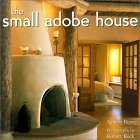
The Small Adobe House
by Agnesa Reeve, R. Reck, 2001


Click on image to buy from Amazon.com


Back to Earth: Adobe Building in Saudi Arabia
by William Facey, 1997


Click on image to buy from Amazon.com


Adobe Houses for Today: Flexible Plans for Your Adobe Home
by Laura Sanchez, Alex Sanchez, 2001


Click on image to buy from Amazon.com


Adobe: Remodeling & Fireplaces
by Myrtle Stedman, 1986


Click on image to buy from Amazon.com
 

Pueblo Architecture and Modern Adobes: The Residential Designs of William Lumpkins
by Joseph Traugott, William T. Lumpkins, 1998


Click on image to buy from Amazon.com
 

Building with Earth: Design and Technology of a Sustainable Architecture
by Gernot Minke, 2006


Click on image to buy from Amazon.com
 

Butabu :
Adobe Architecture of West Africa
by James Morris , Suzanne Preston Blier, 2003


Click on image to buy from Amazon.com


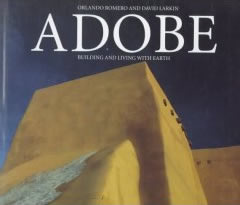
Adobe:
Building and Living With Earth

by Orlando Romero , David Larkin, 1994


Click on image to buy from Amazon.com
 

The Complete Guide to Alternative Home Building materials & Methods
by Jon Nunan, 2009


Click on image to buy from Amazon.com


Click on image to buy from Dirtcheapbuilder
 

Adobe & Cinva Ram Earth Block Information Kit If you aren't ready to build a Cinva Ram brick maker yourself but want extensive information on manual adobe making with slop molds, forms, and rams... then this is for you. This is more than 30 pages of information and articles on making and building with adobes. Some materials are from the 1930s-40s and many photos are shown of a ram and its operation to make soil blocks. Information describes soil testing, mixing, additives, curing , plus adobe construction codes, and building with soil blocks. Booklet #535 Building with Adobe & Stabilized-Earth Blocks, and #1720 Adobe & Sun Dried Bricks booklet are included. A floppy disk (PC format) of color photos and more information is included. All materials are xerographic.


Click on image to buy from Dirtcheapbuilder
 
Cinva Ram Plans Taylor Publishing offers an 11 page design-set of plans for making a CEB compressed earth block press ...aka Cinva Ram. (used by FernCo Metal to make the unit shown here. Design based on engineered specifications for manual earth block press is provided. Press was developed and engineered in third world countries for manual use. Welding of parts is recommended as part of assembly, and mechanical expertise is necessary to build these block presses. Xerographic, 40+ pages total information, sold "as is" as received from my resources. This means the plans are shown in mm, not inches, and you need a CAD or other program to convert; no lengthy assembly description is given. Booklet #535 Building with Adobe & Stabilized-Earth Blocks, and #1720 Adobe & Sun Dried Bricks booklet are included.


ADOBE POSTERS AND ART PRINTS

There is a distinctive mood and flavor to Southwest American art that reflects bright sunshine on cool adobe walls, with a peacefulness and relaxation that is hard to come by these days. These lovely artistic posters can bring this peaceful relaxation into your home.


PLANS

Santa Fe I
Sven Alstrom , Designer

This one story Santa Fe Style ranch home has an attached two car garage and is based upon 24 inch wide straw bale (or adobe) construction on a concrete block foundation & concrete spread footings with crawl spaces and a partial basement. Though not designed as a passive solar house, it is designed for primarily hot weather climates. Natural interior plaster and natural exterior stucco are recommended. The interior square footage of the house portion is 2,336 square feet, measured on the inside of walls. In addition, the garage has 20 x 22 ft. clear inside dimensions. This home was originally designed for the main entrance to face east so that the kitchen is southeast for ‘ayurvedic' benefits – the plan also works well with the garage on the north side or by ‘flipping' the plan with the bedrooms on the south.
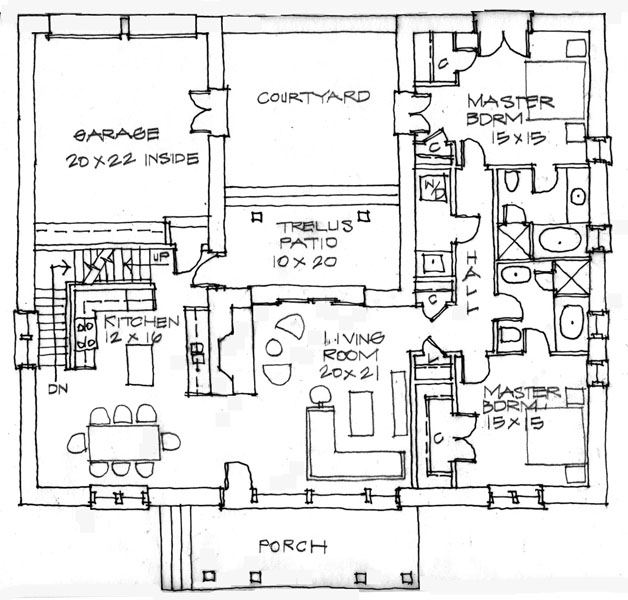
For more information about this plan, and many others, visit our sister site www.dreamgreenhomes.com, where you will find a wide range of plans for sustainable homes, greenhouses, small buildings, garages, and food storage space for sale. Dream Green Homes is a consortium of outstanding architects and designers, who have pooled their talent and expertise for your benefit.


LINKS

earthbuilding.com Earth Building Foundation's informative site.

greenhouse.gov.au An excellent introduction to the uses and attributes of adobe.

adobebuilder.com Adobe Builder Magazine offers media, classes and information about adobe and rammed earth.

Handbook for Building Homes of Earth, published by the Peace Corps, 1981. This PDF reprint covers a variety of earthen building techniques, including adobe blocks, compressed earth blocks, and rammed earth. It also discusses appropriate roofs, foundations and surface coatings.

adobealliance.org Simone Swan's Adobe Alliance promotes earthen architecture, especially that inspired by the work of Hassan Fathy, through information and workshops.

naturalbuilder.com books and workshops about earthen building.

naturalhomes.org lists workshops from around the world related to adobe building.

earth-auroville.com Auroville in India has been working with various aspects of earthen architecture and has much to share.

eartharchitecture.org features information and sponsors workshops on all types of earth building.

davidsheen.com features a wonderful collection of pictures of earthen sturctures from around the world. (If Firefox doesn't work, try another browser.)

mudcrafters.com specializes in adobe floors and earthen plasters, with lots of pictures and descriptions.

fawebster.com Fred Webster Associates has posted some excellent articles on adobe codes, structural defects, and earthquake damage to historic buildings.

swdesertsustainability.org this regional organization's site includes a recipe for "poured adobe" that uses both lime and gypsum.

historychannel.com An article about adobe homes, with a link to sod homes as well.

claymineadobe.com a commercial stabilized adobe brick manufacturer with references for archtiects, schools, etc.

theownerbuilder.com.au an article about a "muddie" or adobe block home in Australia.

terrabuilt.com manufacturer of a compressed earthen brick machine that has a key/lock system eliminating the need for mortar.

loeileelawadee.com making adobes Thai style.

adobebuilding.com describes a unique system for molding stabilized adobe bricks...they also occasionally sponsor workshops.

openfarmtech.org Open Source Ecology shows how their compressed earth block machine operates.

beyondadobe.com features a nice gallery of photos of adobe projects they have built in the Southwest U.S.

lavoutenubienne.org describes an African adaptation of adobe vaulted roof structures.

nzdl.sadl.uleth.ca The basics of building with arches, vaults and cupolas

nzdl.sadl.uleth.ca Compressed Earth blocks: Manual of design and construction

nzdl.sadl.uleth.ca Handbook for building homes of earth from the Peace Corps

sukita.com an image gallery of adobe floors


Disclaimer Of Liability And Warranty
I specifically disclaim any warranty, either expressed or implied, concerning the information on these pages. Neither I nor any of the advisor/consultants associated with this site will have liability for loss, damage, or injury, resulting from the use of any information found on this, or any other page at this site. Kelly Hart, Hartworks, Inc.


Home       Site Map        STORE

For Email contact go to About Us
Established in 2001, GreenHomeBuilding.com is primarily a labor of love. We do receive a small commission when you click through through and purchase books and other products listed on the site. Kelly, and the GreenHomeBuilding team of experts, have answered thousands of questions for readers over the years, and we continue to publish up-to-date information about increasingly important sustainable architecture. If you feel moved to assist us in this work, your kind donation would be much appreciated; this can be easily done through our PayPal account:
Google
 
Web www.greenhomebuilding.com
VISIT OUR OTHER WEBSITES:

[Natural Building Bookstore]       [Earthbag Building]     [Dream Green Homes]     [Solar Car]