Recycling Glass and Plastic Bottles
 Bill Sitkin says, "At the heart of recycling, for me, is a great love for this planet and the awesome natural systems that support life here. I have always been a 'dumpster diver' and developed a used building materials and deconstruction business known as The ReStore in Crestone, Colorado. I look forward to your questions on anything about recycling materials or deconstructing buildings."
Questions and Answers
Q: I work at a winery and I wish to use the discarded bottles from the tasting room to build a shed on my land. If successful, I would eventually like to build a small cottage as well. I've just started to research, but have not found a definitive source for building a glass bottle structure. Can you recommend a good source for this?
A: You have asked the right person. I have experience with bottle walls. In fact the divider wall that I am looking at right now is just that. I made a trip to our local landfill and collected a great many wine bottles and also found some glass bricks. I used mortar mix as the binder and just started to lay out bottles and add the cement in between. I could only lay out about a foot high at a time because I used quite a bit of mortar between the bottles. I have seen other walls with a minimum of mortar and more bottles. I put together a documentary about The City of the Sun (available thru Dirt Cheap Books) that shows quite a few different bottle walls and homes. The larger the project, the more support you will want to have. Building a removable form from recycled tires or wood works great. Another innovative method is to mound up soil and build a bottle dome in the same manner as a wall and then excavate the dirt for a underground hidey hole.
Q: I am designing a wall made out of half gallon wine bottles connected at the necks. These bottles will be placed in an existing barn. I would like to separate these bottles by using 3/4 inch polystyrene foam and some type of caulk type chinking, ie. Permachink, as the binder instead of mortar. What would be the best thing to use for a binding agent to hold them together? Can I insulate around the bottles, with sawdust, without connecting the necks with printers plate or even sheet metal?
A: I have seen so many different ways of working with bottles that offering any advice would make me look stupid. It is all an experiment. You are only limited by your imagination and knowledge of what binding materials can or cannot do. I have been planning a water filled bottle wall for a while now. I think sealing the bottles with wax might work the best but then again maybe corks. I won't know until I try. I will say from my experience that working with bottles vertically is much more challenging. Alignment and balance seem to be the key issues. Patience plays a big role also. Let us know how your project turns out and we will add your information to our growing body of knowledge.
Q: I have recently purchased a 1909 home with a redone foundation (1990). I'm wondering about using bottles as an insulating and soundproofing material against the cider-block foundation. The home is in Minnesota, and cold-weather/hot humid summer insulation is key. We also have a music studio in the basement and for the sake of roommates and neighbors it needs to be well soundproofed. I'm also hoping to use up some of the bottles that are piling up in my garage. So, I guess the question is how do bottles fair as an "add-on" to a home. Could I somehow mortar them to the existing block wall? Do I leave it exposed to produce a colorful glass "brick" effect? Or is it just a bad idea...
A: I am not sure what kind of sound barrier bottles make but they sure look great and are fairly straight forward to work with. Masons Mix Mortar works just fine to hold them together. I would advise attaching metal tabs to the cinder block at regular intervals just like masons do for attaching rock to cinder block. A good book on masonry basics will show you what I am talking about or a trip to your local contractors store with helpful employees works well. One idea I have toyed with is to fill the bottles with sand and seal with wax for extra thermal mass for heat retention may be incorporated.
Q: After bouncing a number of ideas about the skirting (I made a 2' crawl space), I decided the best thing would be to enclose it. I have been fascinated by glass (a glass artist for 20+ years), and specifically intrigued by a reproduction of a building from the desert which I saw at the CA state fair exposition a few years back. So, I thought, since I have all these posts coming up from and out of the ground all around the outer edge of the building (the farthest ones apart are 6', and most are closer), how about if, after putting down a level bedding of rock, I lay wine bottles in between the posts, wiring them into place, and to each other. It would insulate, the crawl space would receive light (cool for repair jobs), and it would be cheap, as I could get the bottles from the local restaurants. So, my question to you is this-would it be best to a)leave them empty (I thought not); b)fill them 2/3 with water(it doesn't freeze often here, but it can happen); or c) fill them with dirt (which would kill the whole light thing, but that'd be ok)?
A: (Kelly) People have used bottles in walls in lots of different ways. I've seen them embedded in papercrete, cob, concrete, etc. I suggest that you mortar them in place with one of these materials, rather than wiring them into place. That way you get a solid wall that will keep out rodents, insects, etc. Place the bottom of the bottle to the outside and the neck inside. You don't need to fill them with anything since they are plenty strong to work as infill, and they will allow more light to enter that way.
Q: Thank you for your reply. Good suggestion re the mortaring of the bottles. The reason I was thinking I should fill them was not so much for strength, but for insulation. I think, empty they will not insulate well. From that standpoint, what would you recommend?
A: (Kelly) Actually trapped air is extremely good insulation, certainly better than water or soil that you might put in the bottles. You might put corks in the bottles to further isolate the air.
Q: Do you know of any body who has constructed glass bottle walls of at least 20"? I would love to know of them. Essentially monolithic walls with incorporated bottles laid in all the known mortar types: earth mixes, sand, cement and so forth.
A: (Kelly) I have not seen any solid bottle walls like you describe, but I did notice that there is one pictured in the new book called HOMEWORK, by Lloyd Kahn, where an older couple built a small cabin in Nevada that way. Otherwise I have seen bottles worked into walls as decoration mainly in many different ways. Rob and Jaki Roy, the cordwood advocates, have used bottles amongst the cordwood, sometimes placing them with their necks facing each other and jammed into a can cylinder, and then cemented into the wall along with the cordwood.
A: I am the executive director for SOL International Foundation, a non profit organization doing work in the Bay Islands of Honduras. At a meeting yesterday there was a woman who is collecting bottles to build houses with. I thought this was a great idea. We are currently seeking land to build a multi-building community center. We had already considered implementing green aspects and are interested in some more options. Roatan, the island we are working on, is developing at a rapid pace. They need other options for building and we could be a model for that new way.
A (Kelly): Using recycled bottles is a nice way to bring light into a building, and I have seen some fine examples of this with cordwood, and earthbag buildings. The best green approach usually incorporates whatever local materials are readily available. I have shown how a simple earthbag dome can be constructed here, but there are many other possibilities.
Q: I have used old plastic bottles to connect like-sized jars. Soda bottles cut into sleeves are like cheap heat shrink sleeves. If you wrap the bottles in aluminum foil and then heat shrink the plastic over a bottle sticking into a jar you get an air tight seal. So why can't you make a rubble wall with glass bottles?
A: It might make a great experiment. The factor to take into consideration would be weight. How much weight could the glass rubble wall handle before breaking up? If the wall was designed to spread the weight across a broad surface area it might work.
Q: I live and work in Brazil and, as in many other places around the world, the need for affordable housing is imperative. I came across a site in Honduras call Eco Tech, run by a guy by the name of Andreas Froese. He is making houses and structures out of 1 and 3 liter plastic coke bottles. After studying his method on the site, I realized its still very antiquated and inefficient to produce even cheap houses for the poor. I have been building with styrofoam (which I don't like) but with the cost of crude skyrocketing, its no longer a viable material.
What is the is reason for companies not using the PET bottles in say panel type construction and then covering with a structural plaster that would coat the bottles thus reducing any fire hazard or environmental pollution? God know we have a million bottles in any given dump that could be used. I know in these poor countries, codes are non existent. I see a lot of glass houses but not very many structures using plastic soda bottles. Is it prohibited? or what is the reason why more green guys haven't availed themselves of this method?
A: Most of the reasons any builder prefers traditional building methods is money and ease of repetition. For those of us that prefer to pioneer into untraditional modes of building there will always be the experimental side of things that demand risk and constant reevaluation.
I have seen plastic bottles used in various ways for building. Not much will be found on the net as the folks that utilize these materials may not be connected or are still experimenting. Commonsense says that any container that can be used to trap air can be used for insulation. It is easy to point fingers and ask why but a lot harder to just get on with your ideas and prove to yourself and others it can work. Let us know how things turn out.
Q: I never knew about glass bottle walls. Would you assist me in getting started to build a partition wall? Can glass bottles be used for thermal insulation?
A: Yes, bottle walls are beautiful. Most are built using bricklayers mortar that can be purchased in 50# bags. Just start with a layer of mortar then lay in the bottles and then more mortar on top. Be careful not to over do it as too many bottles at once tends to get a bit iffy. Let it dry overnight then go for it again. There are other bonding agents from silicon to cob and adobe that can be used. There are no hard and fast rules. Use your judgment and experiment.
Q: We are seeking to build a 2-3' retaining wall around our garden with old wine bottles. We live in Pennsylvania where it gets pretty cold and pretty hot so wonder if we should seal bottles with mortar?
A: Good question. From my experience, and what I have seen others do, the bottles have been left open. The possibility of water seepage into the bottles and then freezing and expanding would be more likely to happen with a faulty seal of the bottles. If you want light to come through then do not seal them. For me, that is the beauty of a bottle wall.
Q: I am thinking of building glass bottle retaining walls in the part of my basement which is dug out and has dirt walls (it also has a dirt floor). I HAD been thinking of casting a cement retaining wall, but then I came across bottle walls and now I am all excited about about casting bottle retaining walls against the dirt walls, since beer bottles are available to me. I could do it piece by piece and take as much time as I needed. The dirt walls are solid, almost like rock, although from time to time a clod of dirt falls off the dirt wall. What do you think? The walls as they are now do not go all the way up to the floor of the first story, but they are about 4.5 to 5 feet high and then there is a crawlspace between the first story floor and the dirt "shelf." I would love to hear your opinion!
A: sounds like you have it under control. Just go for it. You will find inspiration as you play with the bottles and cement. Piece by piece is probably the best way to approach it. have fun.
Q: My neighbors and I want to build a glass bottle wall division between our gardens, 12' width by 6' height. We have put in a foundation of around 1' x 1' but before we start the glass bottle cutting we wanted to take some advice as we have 4 young children between us and want our wall to be sturdy. We are going to tie the wall to our extension on one end and then we will place a concrete post at the other end of the wall to stabilize the structure. We were wondering, however, what would be the appropriate width for our bottles to be cut to. From our research we have seen that the two ends of the bottles can be duck taped together leaving both sides of the fence having the bottom of the bottle as our final finish. We are currently looking at a final width of 6" as our bottle unit length but were wondering if this would be too small for a 6' height. It will not be a load bearing wall but we want to be sure for the safety of our children. We are also considering a central concrete post hidden in the wall but would prefer not to have it as it will effect the final look of the wall we create. Any advice you could give us would be greatly appreciated as is this is the first time any of us have embarked on such a project.
A: Quite the project! Six inches may be a bit narrow for what you have planned. I would go at least ten inches. Glass in the round is very strong because any pressure is distributed equally in a wall. Glass bottles break when there is impact from one direction as in hitting it with a hammer or rock. Depending on how you build it will determine its strength and design. You can stack the bottles with very little cement to bond them and gives the wall a very transparent look but is more apt to be damaged from thrown objects. I recommend using more cement between the bottles for stability and you can actually incorporate bottles that stand up as well as those glass bricks. I have even used glass globes that can be found at garden nurseries these days. Other than that you may want to save yourself time and energy by skipping the cutting and taping of the bottles and just place them by alternating the tops and bottoms facing in opposite directions. The bottles will be stronger this way.
We had just decided to go to 10" and I love the glass ball idea that sounds fantastic! We are also looking at demijohns to create porthole style glass elements. There are 4 of us working on the project and my neighbor's hubby is designated glass cutter and has already cut 100 this morning. I think all of us want to maintain the beauty of the project on both sides of the wall but thank you for the suggestion. I understand that we will need to build the wall in several stages to allow the mortar to dry and prevent putting too much weight on the structure at one time. What height would you recommend us to build to in each stage. Would 2' 0" be too high for our first run of bottles or do we just gauge it as we go along?
By the time you get to one end of the wall your starting point should be ready to go higher. Or 12 to 18 inches at a time.
Q: My mom wanted me to look around on the net for information on building with glass bottles. She is currently building a small building behind her house for some of her pets and wanted to know if there were any drawbacks to using glass bottles on one side of the building?
A: (Kelly) I've seen many building projects that have utilized glass bottles in the walls in various ways, some of them quite attractive. There is the possibility of creating patterns with different sizes and colors of bottles, which can be laid on their sides with cob, cement mortar, papercrete, etc. to hold them all together. If the glass is on the south side, the wall might collect more light and heat, which must be considered...you wouldn't want to cook the pets.
Q: You've noted that trapped air is good insulation; do you have any idea how much insulation trapped air provides (R value per inch)? Secondly, I was thinking of filling up the crawl space under a floor with loose plastic bottles, to provide under-floor insulation. Does this sound like a viable idea to you?
A: (Kelly)This is a good question, and I am not sure of the precise answer. I looked up the R-value of low-density fiberglass, and it is rated at about R-2.2 per inch. It seems that the smaller and more confined are the air pockets, the better the R-value will be, up to about R-8 per inch for some of the new foams. So it really depends on how the air is trapped how good is the insulation.
As for using plastic bottles to trap air for insulation, this does seems to be a low-tech and perhaps effective way to accomplish this. The bottles would have to capped to trap the air. But the trick would be to effectively stop the flow of air around all of the spaces between the bottles as well. This could perhaps be done with a plastic sheet surrounding the bottles. I think there would not be much advantage to filling an entire crawlspace with bottles, but doing this around the periphery of the foundation might be effective. You may need to get under there for other reasons at some point. Some crawl space areas require some degree of ventilation to prevent moisture build-up...so you might investigate what you local building authorities recommend.
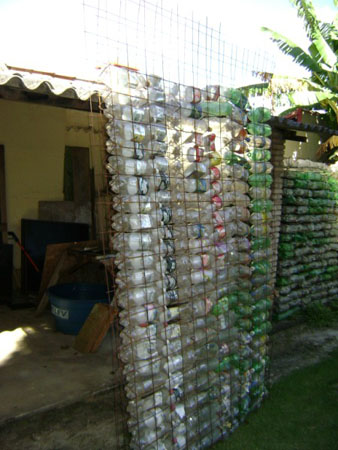 C: I am sending you a picture of the pet bottles panels that I have dabbled in for a possible low cost house. I have a system that puts these panels together in short time and can really use up a lot of pet bottles (2 liters ones) from going into landfills. If they were not used for house walls, they could be used for perimeter walls around people's property, for all Brazilians wall up their property as most countries in the world do.
Q: I have been reading about the schools built in Guatemala with plastic bottles & thought it is a great idea to build a wall, but my concern is: what happens to the bottles when we use heating in winter? Would they melt or have an impact in the construction?
A: Unless you plan to put the bottles in a wall that has a wood burning stove next to it you should be fine. To ease your fears, get a hair dryer and try melting a plastic bottle with it. I would be amazed if the heat you need to heat your home will be close to what the hair dryer can generate. From what I have read, all the bottles are stuffed with plastic and made into blocks with chicken wire then plastered over. Here is the article I am quoting from: http://abcnews.go.com/WN/earth-day-laura-kutner-builds-guatemalan-school-plastic/story?id=10446103
Q: I have an idea for using plastic water bottles, plastic bags foil and thermowrap to create flexible insulation for the bermed portion of an earthbag home. To build the insulation I would start by stuffing plastic water bottles with plastic bag to create small air pockets and then seal the bottle. The bottles are stacked into columns and the columns attached to form a wall. Then aluminum foil is laid over both sides for a radiant barrier and finally the whole thing is wrapped in thermo-shrink wrap film to seal the air gaps and also create a waterproof barrier. The risk of fire would not be an issue since it will be installed between the earthbags and the bermed soil. My question is would this provide decent insulation?
A: We have a saying here in Crestone that innovators need to be fearless. It sounds good and then again Kelly and I have done a few things that sounded good but in reality did not quite turn out as expected. You may want to build a prototype box with a temp gauge inside and place it in a large walk in freezer. What a great use of recycled materials. Good luck and let us now how things turn out.
I liked the idea of testing it first, but I still need some help: I built the test box and tried it out. Inside a thin cardboard box it took 10 minutes to drop from room temperature of 72 degrees F to freezing, 32 degrees F. I placed the cardboard box inside the insulation and repeated the procedure. This time it took 20 minutes to drop from room temperature to freezing. I then tried taking the cold box and insulation out of the freezer and letting it warm back to room temperature. It took 1 and a half hours approximately for the thermometer inside to reach a reading of room temperature. Now, my question is: How do I judge these results? Is this good, mediocre...? Did I perform the test incorrectly? I'd hate to undertake this if the results are not promising.
The next test is to heat two bricks to whatever temp you think you want to keep your home at. Put one inside the box and the other with no box. Put both in the fridge and take temp readings every five minutes. The final test is to wire a 40 watt bulb inside the box as a heat source. Put the warm brick inside the box and let stand for an hour outside of the freezer. Check your temp of the brick. Then put the whole thing inside with the bulb on. Wait an hour and then check the temp. I am just making this up as I go but you should get some good results to base a decision on.
Ok, it took a little while but I managed to do what you suggested. Brick alone dropped from 73 degrees F to 32 degrees F in 40 min. Average of about 5 degrees every 5 min. Brick in insulated box dropped from 73 to 39 degrees F in 130 min. (I got tired of checking it.). Average of 1.5 degrees every 5 min. Brick inside insulated box with light bulb: After an hour sitting on the counter it was up to 95 degrees from 73. Then I placed it in the freezer with the bulb still on. After the first half hour it had risen to 98 degrees and then it slowly dropped. After two hours it was at 85 degrees. Then I stopped the test. Any thoughts?
Now for a comparison test with other insulation types. Use rigid foam board or fiberglass batting instead of your bottles. This will give you a better idea.
Q: Are the glass bottles sealed at the exterior end? Or can air and water enter the bottles? Also, is there an effective thermal break in the wall?
A: I think the option of sealing the bottles or not is up to you. If you do then there is the question of filling them with water (or glycol) or not. Water will freeze, expand and break the bottles. Leaving them empty and sealing them gives you dead air space and is mostly insulation as opposed to thermal mass when filled with water or glycol. Your application either as an exterior wall as part of a home or just a stand alone wall or as a trombe wall will dictate some of your answers.
Q: We built a wine bottle wall, then the Santa Anna winds blew it down. When it broke, we noticed that the cement did not really stick to the smooth glass bottles. We'd love your advice on how to build it stronger. Does mortar really stick to glass? Should we dip the bottles in glue first then mortar them in?
A: Just like any fence there should be posts sunk into the ground every so often. Simple T-posts pounded in about 2 feet and placed every 4-8 feet would work well. Depending on how close together you placed the bottles will vary the strength of the wall. I usually like to place my bottles about 2" apart and place them horizontally. Any verticals are set 2 or three deep to match the length of the horizontal bottles.
Q: I have a question about building an 8x10 bottle house with a living roof. Of course, the frame will be pole/beam. I have learned about the ills associated with thermal expansion in my own home, i.e., a laminate flooring vs the fireplace heat. I am in Reno, Nevada and it can be quite warm here in the summertime. I plan on using the bottle and the binder will be mason's mortar for the bottles. Will there be a problem with using the mortar with the bottles? -> broken bottles from the mortar expansion? Maybe I am overly concerned for nothing, but any insight you could give me would be much appreciated.
A: Mason's Mortar is the preferred medium for bottle walls. For that matter just about all brick walls in all area's of the world use the mortar. You will be just fine.
Tell me, is Mason's Mortar a brand name? What about the Portland Company's Glass block mortar.
Good question about masonry mortar. I think there are several companies out there that make it, but to be sure you are getting the correct stuff ask your sales person if it is used for bricks and stone. You could certainly use the glass block mortar since you will be using it on glass. You may want to do a price comparison if you will be needing mortar in quantity.
Q: I am thinking of replacing my basement windows with bottle windows with the bottles held together with cement. I'm wondering how to keep the bottle window in place though. After I pull out the old windows, how would I ensure that after the concrete dried that the bottle window wouldn't just push out over time? How would I anchor it? Would a frame around the edge of the window work?
A: Put some nails part way into the existing frame before starting the bottle window. Leave about 1/2" of the nail exposed. The cement will use the nails as an anchor and will not allow the bottles to come out.
Q: We built a wine bottle wall, then the Santa Anna winds blew it down. Que Lastima! When it broke, we noticed that the cement did not really stick to the smooth glass bottles. We'd love your advice on how to build it stronger. Does mortar really stick to glass? Should we dip the bottles in glue first then mortar them in?
A: Just like any fence there should be posts sunk into the ground every so often. Simple T-posts pounded in about 2 feet and placed every 4-8 feet would work well. Depending on how close together you placed the bottles will vary the strength of the wall. I usually like to place my bottles about 2" apart and place them horizontally. Any verticals are set 2 or three deep to match the length of the horizontal bottles.
Q: I am a college student from the Philippines undergoing a research class and I've thought about the topic of "Efficiency of plastic bottles as construction materials in infrastructures". I just want to know your thoughts about the disadvantages of having a plastic bottle house. It’s about the time consumed to collect all the plastic bottles needed to build one house. Another is the difficulty of remodeling that kind of house.
A: After doing some research and scratching my head here are some of my thoughts. The thing about recycling is in essence a way to honor planet earth. It is a way to ease the stress we have put on our environment. Building with recycled plastic bottles, wood, metal, etc is time consuming but so what! Time is the one thing we have in abundance. Of course each of us places certain values on our time which are arbitrarily applied according to personal variables. On top of that are the concepts of time usage that are hammered into us from the world around us, i.e - education, work place, parents. It really comes down to you. What is important to you? These are the philosophical questions and pondering's every alternative home builder has to come to terms with. And you have to realize that you will change your views and ideas as you acquire more experience. It is good to question and even better to have the experience. This is the path many of us have taken to get to the point where we can answer some of your questions. Our answers are based on experience. I love the idea of a plastic bottle house or even a greenhouse. Take a trip to your local landfill and see what is there. The landfill will offer you an insight into humanity.
Q: When putting bottles directly into the wall to create extra lighting do you always have the bottom of the bottle pointing outside or do you alternate? I was wondering because if you alternate how do you keep bugs out of the openings but let light in? I have been looking at the school made from earthbags that has a huge tree made of glass bottles, I wanted to do something similar, kinda like they do with earthships, use tons of bottles for added beauty and light.
A: The direction of the bottles does not seem to matter. It is artistic license that decides. If you are concerned about bugs getting in the bottles then use a cork, modeling clay, wax, etc to seal the bottle. The opening to the bottle is not really your light source (unless you cement all the way up the neck). It is the exposed neck of the bottle that allows in most of the light. On the other hand you could place the lights from christmas lights into each bottle.
Q: How to build a retaining wall of glass bottles?
A: Pretty straight forward. Clean your bottles. You will be working in layers, bottom to top. Organize your bottles as to how you want them. Mix up masons mortar mix. Trowel it out onto your surface where the wall will be. Lay in your bottles. Fill the spaces between with more cement. Continue until finished.
A retaining wall will need to be anchored into the ground. Could be as simple as driving rebar into the ground or do a rubble trench with rebar or a footer and rebar. A retaining wall will be pressured from one side thus the rebar. You could also shape the wall with as a steep triangle to counteract the push of soil.
Q: Can you put water in the bottles to act as a reflector?
A: There are quite a few sites now that explain how to turn plastic bottles into skylights. Here is a sample. Here’s a way to brighten up enclosed spaces in an environmentally friendly way. The power of the sun is harnessed using a bottle full of water. Quite simply they’re used 2-liter soda bottles. They’ve been filled with water along with two caps worth of bleach to keep microorganisms out. The cap is then covered with a film canister to protect it from the sun. They are installed through holes in the roof, and in full sun they put out the equivalent of a 50 watt incandescent light bulb.
Q: I am looking to use empty wine bottles, sealed, as an insulation material not for a wall but for a floor at ground level. Thbis project is the refurbishment of old stables for habitation. The idea is to excavate the existing ground floor areas, lay some building paper to receive a screed layer, place the empty bottles, cork sealed, horizontally in the wet screed, .fill the pockets of air with some form of recyclable insulation material, then build a traditional concrete floor with a finish. Questions: a) Any experience in using glass bottles as an insulation layer for a ground floor? b)Can you imagine this use of old bottles contributing to the thermal insulation of the floor? c)Any recommendation on the filling material to fill up the air pockets around the bottles?
A: No experience with this technique just using logic here. Sounds like a good plan. You may want to consider alternating bottle rows with 4" tubing in case at some point you will want to heat the floor with solar hot air collectors. I would recommend sand as it is a pretty good thermal mass source.
Q: I am a high school student and we have a "twenty percent" project. For my project I based it on recycling. I am trying to build a small wall out of plastic bottles, run lights through the wall, and then have it synchronized to music. I started to build a wall prototype, but the wall structure isn't sturdy enough. Do you have any construction advice?
A: Try not to build it all at once. Maybe 2 courses per work period to allow the cement to set. Plastic is not as sturdy as glass so separate your bottles by a few inches of cement side to side and to to bottom. Maybe use some rebar every few feet vertically.
Q: I live in India where a lot of construction workers live in homes made of metal sheets. The sheets are used to build the walls as well as roof for these homes. This material is preferred because it's easy to transport and setup home at the next construction site. However, these homes have no windows. I was wondering if there are solutions using recycled materials which are strong, light and cheap which will allow some sunlight into the homes. Is there a process of flattening and binding plastic bottles to create a sheet similar to the metal sheets?
A: Plastic bottles are a great solution. Cutting off the bottoms will yield discs that can be layered and overlapped like reptile skin. Then cut off the top where it starts to reduce in size and by cutting in a spiral (like orange peeling machines) you will end up with long strands of plastic ribbon that can be woven together similar to weaving flat grasses into walls.
Q: I am currently trying to build concrete floors using glass bottles. The glass will not show once the floor is finished, I am doing this primarily to save on cement and put some glass bottles to use. I have read about several different techniques as far as the best way to do this. Some say put the bottles right next to each other, some say put a layer of cement down before placing the bottles while others just put the bottles on a layer of sand. Do you have a preferred way of using glass bottles in the floor? Again the bottles are not broken and once the floor is finished the glass will not be showing.
A: As far as thermal mass and heat storage sand is pretty good. How about filling the bottles with sand. When you lay the bottles out do one row all with the neck facing one direction then the necks of the bottles on the next row can be placed in between the necks of the first row (if you are using wine bottles or beer bottles). I think filling the bottles with sand will also strengthen them so your cement could be a bit thinner, maybe just 1 inch.
Would the bottles be touching? I have read that you should leave 2 inches between the bottles and have also read that you don't need to leave space between them. Do I need to put down a layer of cement before laying the bottles down? My biggest motivations for doing this are cost savings with cement and the environmental benefits of using "trash" in a productive manner.
I do not think there are any rules here. The more bottles you use means less cement overall. If it was me doing this project I would put down sand first and firmly press the bottles into the sand so they are cradled. Then put more sand on the bottles to fill in spaces then put down metal wire mesh to prevent the cement from cracking then pour about 2" of cement on top. Remember to fill the bottles with sand first.
Most places I have looked say you do not need to fill the bottles with anything. Do you fill them with sand because of an experience or is that just your gut feeling?
Mostly for thermal mass and strength.
Q: We are interested in building a small house. We are planning on using recycled steel for the structure, and are considering what to make the walls themselves out of. We are very interested in making some walls out of recycled glass bottles, but our house will have 2 floors. So we were wondering what the weight-bearing properties of a glass bottle wall would be and if we should save it for places where no weight-bearing would be needed?
A: Are you saying that the framework will be from recycled steel? Will the steel be weight bearing? If so, it does not matter what the infill is. You could use hair or feathers since there would be no weight on the infill material. As long as the infrastructure is built so that sheer and compression are accounted for in the steel frame you should not have any problems with a glass bottle wall.
Q: Do you know anything about buildings with bottle walls? Can these buildings be built in two-story with some special structure such as rebar?
A: Bottle walls can be built into any structure that has sufficient framing to support the structure. Any infill (bottles, insulation, cord wood) can be used between the support members. The wider the space desired for the infill the beefier the support structure must me. Looking at a sky scraper with all that glass one can imagine replacing the glass with bottles since none of the glass is load bearing.
Q: I'm building a 8' glass bottle house on a platform with half bottles. I have cut, cleaned and sanded them but worry that my engineering knowledge is poor and that half bottles won't be strong enough... Please let me know if you have suggestions or know if I will be OK.
A: Wow, that is a lot of cutting! Impressive. I am not sure if the strength of the wall will be affected or not. I usually left the bottles in tact to preserve the integrity of the bottle but I really don’t know if that made a difference. I am leaning toward thinking that the majority of the weight will be taken by the cement. I suppose there are ways to reinforce the wall with re-bar just to be safe. Or maybe build vertical wood pillars just wide enough to fit several columns of bottles with cordwood between those columns.
Q: I'm needing to dig down to build a greenhouse that's at least halfway underground, and wanting to dig under the small house to make a 1 to 2 room living space, Both to escape from the heat and the greenhouse so the plants will survive it. I live very near Death Valley which holds the hottest place on earth temps. My question is about securing the sand, which is the majority of what's here, and improving the structural integrity to prevent cave in's. I'm not concerned with water, or leakage, the only rain we get is rare and about once a year at most. I'm also wanting to build some (a large portion) of the greenhouse with square glass bottles, and would love to have ideas on how I can make it so strong that it could support itself for potentially hundreds of years.
A: Using square bottles for a greenhouse. Interesting problem. They would work well for the walls above grade using portland cement to bond them. They would need to allow for ventilation with window bucks. I remember being at Cal Institute with Nader Kalili and seeing how they made the brick domes. They used a center pivot string (simple method) then laid the first course and continuing with next courses. So the shape of the greenhouse could be either square or round. Square would mean rounding the corners of the roof with quarter round framing. Also at City of the Sun Sean did his bottle skylights (they were round though) however using portland cement can help create the shape to dome up so that a keystone square glass bottle could work. I am visualizing all this so you would have to experiment. The other way is to build a re-bar frame with chicken wire on top then build on that. You would have to allow time to dry before adding more weight.
A: (Kelly) Sand is a shapeshifter, as you know, so it will need to be stabilized somehow. Some cement or lime can be added to bagged sand to solidify it. Another option is various soil stabilizers and there are some suppliers listed at the bottom of http://earthbagbuilding.com/resources.htm#supplies Anytime you are digging under an existing house, especially with sandy soil, it is very important to at least temporarily support the building to avoid any cave-ins and disaster...so be careful!
Q: We have a partially unfinished basement. The room is completely underground with an exposed concrete foundation. However there is framing intact for the load bearing wall which needs to be finished and insulated to make the space more like a room. I am wondering if the framed wall can be finished with an alternative material like plastic bottles?
A: The plastic bottles would be a good place to stash Styrofoam popcorn that are hard to recycle. Along those lines of thought it would be good to measure the year round temperature and humidity in the basement to give a baseline to measure change against. What would you cover the bottles with? What would the final wall covering be? I ask this so that a plan could be made for how to keep the plastic bottles in place as you build. Would you glue the bottles with a hot glue gun?
Q: I’d like to build an 80 foot long 6 feet tall bottle fence. I’m building it alongside my neighbors – it’s for our community garden to keep the deer out. I have no clue how much something like this might cost. Assuming we can get the bottles for free, what kind of a budget should be developed for something like this? I know it’ll be a large structure, but we’re 39 families, and we can spread the cost out between us.
A: There are several factors that will impact your cost. 1) the cost of a bag of Portland cement 2) posts for added support every 10 feet or so 3) labor (which I assume will be volunteer) Mostly though your investment will be time and energy. You will be able to gauge cost after the first several feet when you know how many bags of cement you’ll need for the six foot height.