Moisture Issues with Papercrete
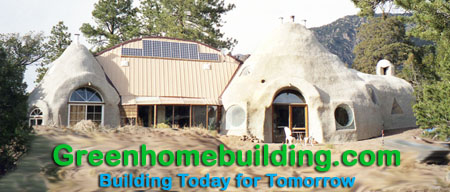
 Kelly Hart, who is your host at greenhomebuilding.com, has been involved with papercrete from the early days of its popularization. He included interviews with papercrete pioneers Mike McCain, Eric Patterson and Sean Sands in the video he produced: A Sampler of Alternative Homes: Approaching Sustainable Architecture. He also chronicled his own use of this amazing material in his video: Building with Bags: How We Made Our Experimental Earthbag/Papercrete House. Kelly has built and used both an electric barrel mixer, and a McCain-designed tow mixer. His house is plastered inside and out with papercrete and can be seen here. He can speak from his experience with this novel stuff, and is frank about both its pros and it cons.
Questions and Answers
Q: If one wanted to waterproof the exterior, what do you use?
A: There are several possibilities. Silicone-based water-proofing formulas that are absorbed into the papercrete seem to work well.
Q: If you made two papercrete domes. one inside the other and separated by say 6".. would the one inside remain dry? It seems as if paper crete does not drip but just absorb. If there was no direct contact would that inner dome get wet?
A: I suspect that you are right about the effect of having two domes separated by a space without contact: the inner one would remain dry. This would be an interesting experiment, which could be done on a small scale. Let me know the results if you try it.
Q: I am very excited about papercrete. Unfortunately, I am worried that it isn't suited for me. I am building a mini mountain up on my land at Mt. Shasta. It will look just like the mountain. It will be about 22 feet high and 20 feet wide. I want to form it with rebar and chicken wire and then paste on lots of papercrete. With all this info about how absorbent papercrete is, is their anything I can waterproof this with? I heard a thick coat of tar would work? For about 6 or 7 months this will be under about two to three feet of snow. Also, can I slowly add layer upon layer until it is the desired thickness?
A: I am familiar with the climate around Mt. Shasta, since I lived on the Siskiyou Summit just into Oregon, overlooking Mt. Shasta, for about 7 years. You're right about the snow. A papercrete mountain would definitely need to be sealed very well in those conditions. I have seen tar used in an attempt to seal papercrete, but without real success; the tar just forms a coating on the outside, not really penetrating into the papercrete, so that when it eventually cracks, which tar will, it will allow the moisture in and at the same time prevent its evaporation. Perhaps a better solution would be a silicone product that would be absorbed into the fiber of the papercrete; this was done in New Mexico, and then it was painted with elastomeric paint. Of course New Mexico and Mt. Shasta have very different climates.
 C: We are in the process of building a large 4 dome home totaling a little over 2000 square feet. We framed it with rebar (For shape), 6X6 remesh and lined the entire inside with stucco lathe. We did this entire frame for a little less than $2000 and we are now spraying/shooting Papercrete onto this frame structure with a mixing/pumping station we built. A 55 gallon drum scissors mixer (Idea from Mike McCain) is mounted above our older tow mixer with the 200 gallon vat. We have an air motor driving one tire (Jacked up of course) to stir the mix so can run continuous. It gets picked up by the air powered diaphragm pump (One inch) and delivered to a shotcrete style nozzle we made out of PVC.
A: Sounds like you are moving along pretty well with your project. The main reservation I have about using solid papercrete for domed structures is the potential for wicking moisture through to the inside, where it can eventually cause mold to form. Finding some way to completely seal the PC is not easy; in fact I am not sure anyone has successfully done this...but that doesn't mean it is not possible. In my experience, PC seems to be a good substrate for mold to form, if conditions are right, and this is a very serious health risk that people should be aware of. The conditions that promote the growth of mold are available moisture and warmth. Elastomeric paint and tar must be monitored regularly to assure that no cracks appear, and these could be so minute as to not be noticed, until moisture has wicked into the roof and mold has already taken root. Once the mold is there it is not easy to eliminate, nor is it easy to dry the roof out because that very same moisture barrier keeps it from doing so, at least upwards. I view it as a risky business to use solid PC as a roof under any circumstances, except where another kind of material (such as a metal roof) is assembled over it, and the PC can breath to allow any possible leaks to air out. This approach is also much more healthy for the inhabitants of the structure, since breathability has been established as desirable for a "healthy" house.
C: We were very concerned with the moisture issue as well. We have been experimenting with some sealers on the doghouses we have built for almost the entire year and feel we can control it. We have no mold or mildew growth on them so far. We had also considered trying to add copper sulfate to our mix to try and deter mold and mildew growth (The liquid type used to control growth in pools) But haven't experimented with it yet. Charmaine Taylor said lime will help too so we also are adding it to our mix and the cement content is double what most recipes recommend. Final thickness on the Papercrete is to be 1 foot so we are hoping most moisture won't get all the way through under normal circumstances.
Q: Could problems with moisture in papercrete be addressed with hydraulic cement? If it sets up underwater, well, that is a pretty hopeful sign! <smile> I am interested especially in using it as plaster/stucco on my old basement walls which appear to be whitewashed (limed?) mud over native fieldstone. During heavy rain, water comes through the wall in a couple places 3 to 5 feet below grade. The floor is not level, but rolling, and is... does the phrase "a thousand springs" give you a picture?
A: I don't believe that using hydraulic cement when making papercrete would make much difference in how absorbent it is; the cement just loosely binds the fibers together, but the web of fibers would still act like a wick. I would not recommend using papercrete in the situation that you describe.
Q: I plastered my earthbag building with papercrete. Then I left it for one year without roofing it. I am from Dar-es-Salaam in East Africa. My building is under the shade of big trees. After an annual rainfall period, I found out that the papercrete turned black in colors. I have some knowledge in mushroom substrate science. Once the cement is set it becomes hard and it is no longer cement and when the paper in in the composition stay wet for long time it become good medium for fungus growing which decompose the paper as a result the paper crate deteriorate and became unsuitable. Please advice me on this problem.
A: I am very sorry to hear about your problems with the papercrete. I do not advise people to use papercrete in damp or humid conditions, because of this very problem. I had a little mold form inside my earthbag/papercrete dome, which I then plastered with a thick layer of lime plaster, which took care of the problem. Another possibility would be to kill the mold with bleach or something, and then replaster your walls with a cement stucco.
Q: I am building a mushroom house which both side of the wall should be wet at all time for evaporative cooling on the out side and for moisture on the inside. The Humidity inside the house should be around 85%. Since the temperature in the house should be kept at 24 degree Celsius, and papercrete absorb water like sponge, so I think could it work as evaporating pad to decrease the outside temperature of 35 degree celsius to 24. I would mix some borax to keep away the mole from growing on the wall. My questions are: 1) Would the papercrete wall be appropriate for this job?
A: It seems possible to me that papercrete would work for this application, as long as you can inhibit the mold (and I have heard that borax has been used to do this). Certainly the papercrete will absorb and hold the moisture effectively.
2) Would the wall collapse? How much concrete should I use to keep it standing even I have to spay water on the wall hourly to keep the house cool?
A: Wet papercrete is not as strong as when it is dry, but it does not tend to collapse under its own weight, even when wet. I would suggest a rather high ratio of cement to paper in your case, perhaps twice as much cement as paper (dry weights).
3) How thick should the wall be? The wall would be 2 Meter high and 7 Meter wide with water absorbing, sack roof.
A: I would suggest making the wall at least .3 of a meter thick...the thicker it is, the more moisture it will hold and the stronger it will be.
Q: I am interested in papercrete for a hot humid area of the deep south. I would like to explore methods of forming it that would be raised on pylons like traditional timber-framed houses of the area. Any ideas? I am also concerned about how much breathing is advisable in this climate and where to apply damp proofing and if none is applied how deep the eaves should be. It rains a lot and there is a lot of wind with the thunderstorms which drive the rain into the walls. Are there any books which address using this material in this subtropical climate?
A: Hot and humid areas present a severe challenge to papercrete, because of the possibilities of mold forming on it. My experience is in the arid Southwest. It might be that with substantial eaves (say two feet) and some sort of damp proofing on the outside, it would work. Certainly keeping the walls well away from the soil (as with pylons) would be a good idea. I would suggest an experimental trial with a small project first to see if this works. There are no books on this subject that I am aware of.
Q: Papercrete query. I'm reading a book right now by Leopold Klein, "100 pounds of Tomatoes out of an inexpensive foam box". Styrofoam board no longer being inexpensive; $12 plus, locally for a 1" x 4' x 8' sheet (2-inch thick called for in book) (planter is suggested as 2" x 22" x 22", makes a 24" square planter, overlapping sides). From what I understand so far, the premiums is based on insulation from the outside environment, excessive heat and cold to get a jump on the growing season in the early spring, and to keep heat out in the summer by the use of mulch, and thick foam board (expanded polystyrene ranges in R value from 3 to 5 per inch). Do you see PC as an alternative?
A: Possibly, but it would be tricky to keep it dry enough to last very long, not support mold, and effectively insulate the growing space.
How thick would it have to be to be of a comparable R-value?
Papercrete is usually about R 2 1/2 per inch.
What kind of mix, if any, would be suitable for planting (added Borax, of pest control)?
A mix that is high in cement would last longer, but not be quite as insulting. The Borax might help inhibit mold.
The book does call for a 4-mil lining, so direct soil, and moisture contact may not be a direct concern, but outdoor weathering definitely is a concern.
Such a lining would be essential for success, but even with this the chances of failure are significant. I would suggest using the commercial insulation...but not styrofoam...go with blueboard or other foam panels that are designed for direct burial.
If papercrete won't work, then what about aerated concrete (say free form, not autoclaved), or Pumice-Crete, would they be sealable, light, and insulative? Granted here would be an added increase in thickness, but the increase in aesthetics is why I originally posed the question of Papercrete.
I would say that either aerated concrete or pumicecrete would be better choices than papercrete for this application. They are both somewhat insulating, but not as high an R-value as papercrete or foam panels would be. You will also want to waterproof them on the inside to keep moisture from wicking through.
Q:Will papercrete get soaked in heavy rains and then start to leak?
A: Papercrete will get soaked with water when exposed, and it will go all the way through to the inside if it is a solid PC wall, but it will not likely drip water...it holds it like a sponge. You don't want this to happen, though, since you lose the insulation value when it is wet and it could start to mold if it stays this way.
Q: If papercrete soaks through. How does one seal this material to keep it from soaking like a sponge?
A: There are various commercial products that will probably do the job. One approach I have heard of is to dissolve as much pure silicone caulk in paint thinner as you can and then apply this. It might take some experimentation.
Q: I am a builder working (volunteer) with an NGO for environmental protection and bio-reserve in North India. It is called Taru Mitra. Our web site is www.tarumitra.org We have received U.N. Consultative status. I experiment with and build a lot of buildings that are environmental friendly. Now I have built three buildings with paper (Recycled) pulp roofs. I use paper pulp with an oilseed binder and waterproof it with commercial waterproof chemical. Would you kindly suggest ways to improve it for durability and waterproofing?
A: I find it quite interesting that you are using the paper pulp to make roofs. My experience has been that roofs made with paper pulp are vulnerable to harboring mold, which can be quite unhealthy...but my only experience is with papercrete, a mixture of paper pulp, Portland cement and sometimes earthen materials. Without any waterproofing, papercrete absorbs water like a sponge, and attempts to render it waterproof have not been very successful. It may be that your oilseed binder with other commercial waterproofing agents works better in completely shedding moisture. The waterproofing that I know about is silicone-based, and I have heard that ordinary silicone caulk can be mixed with mineral spirits to make this.
Q: I am planning on building a three vault home using earthbags for the walls and rebar with papercrete for the arched roofs. This would be in the northwest Arizona desert. My question is if I made the walls 6 ft high, would 3 ft down in the earth and the other 3 ft earth bermed would this be deep enough to get a decent enough cooling effect in the summer? I plan to insulate between the wall and the ground and also the ground at ground level for about ten ft out. What do you think?
A: Yes, I would say that 6 feet underground, with an additional 3 feet of berming, and the amount of insulation that you indicate, would definitely create a fairly comfortable living space. My only concern with what you describe is the use of papercrete below grade, or in direct contact with the earth. Even if you use a moisture barrier over the papercrete, the potential for failure is very real. All it would take is a small leak somewhere and the papercrete will absorb that moisture like a sponge, and without it being able to breath outward, this could create a perfect medium for mold...a very unhealthy situation. I don't think it is worth the risk. Make your upper vault out of some other material (such as light-weight concrete) that is not vulnerable to this problem.
Q: I am a freelance design engineer from Germany in the environmental technology field, and I am developing the idea to fill special modified concrete or mortar completely with water, and use it as a heat storage system for solar energy and other waste heat sources right beneath houses or buildings. This material must have the condition to keep the strength for to be overbuilt and to get saturated with water as much as possible, and be able to be up- and down-loaded with changing temperature levels between 1 and 90 °C. At the moment we are testing cellular/foam concrete with portland cement or hydraulic curing lime. But this method needs too much cement or lime and is therefore too expensive, and we would like to store more water into the materials porous and/or capillary structure. And so I would like to ask you if possibly papercrete will fit for that purpose, if enough cement is added to keep the structure strong enough. I think this might work, because the papercrete will be completely embedded into closed dormant water without air in it, so no corrosion or fouling or rottenness of the water and absorbent fibers will happen. -What do you think about that?
A: This is certainly an interesting idea. Papercrete does have the capacity to hold an amazing amount of water. I once made a papercrete bowl that was about an inch thick and filled it with water (about one gallon); the water soon was absorbed completely into the papercrete with only a small damp spot on the table where it stood!
You may be right that the papercrete would not suffer ill effects from rotting or mold if there were no air entrainment. Where I think the system would likely fail is that papercrete is rather spongy, especially when saturated, and so it would probably not be able to sufficiently support any significant weight from above. Another concern would be getting the papercrete to cure in the first place, since it needs to be able to drain or evaporate all of the original water in order to cure properly. You could certainly perform some tests to evaluate your idea, but my guess is that it would ultimately not work out.
I might suggest another approach, such as filling a contained area with crushed lightweight volcanic stone or even gravel to provide the interstices for the water and the needed support for structures above. This could be utilized immediately without the need for curing and without the need for much cement, or other industrial materials.
C: Thank you for the prompt feed back. I think it is only a matter of formulation. If I increase the cement percentage and add some sand I can hopefully make the papercrete strong enough to carry the given weight from above. I will do some tests in this direction, and keep you informed. Regarding your suggestion with gravel, this method was and is still tested in huge R&D projects in Europe, but it is too expensive because it needs a heavy-duty and absolutely watertight basin, tank or reservoir construction. And the percentage of water volume between the gravel is only 37 %. Volcanic stones are too expensive and there is no control and guarantee that they get completely filled with water.
Q: I live in a pier and beam house in Corpus Christi, Tx. The house had to be gutted due to water damage from the roof. I would like to inexpensively insulate the walls with poured in place papercrete. The walls are 2x4 and have about four horizontal nailers for the 1x12 vertical exterior wood siding. I thought that forms could be placed inside the house to make 7"-10" thick walls (3.5" would be inside the existing wall cavity). If needed, plastic sheeting could be placed on the floor to allow the papercrete to drain while curing without damaging the hardwood floors. The tar paper vapor barrier is no longer present between the studs and the siding, and could be replaced if needed. The roof is a brand new standing seam galvalum roof with 3/4" foil backed styrofoam under it. The roofers did not install any vents in the roof, but there are vents under the eaves. Should I continue papercreting past the top plate and cover the vents? I thought that doing this I could then insulate the underside of the roof by flinging papercrete up at the bottom of the roof deck. The house has some vaulted ceilings and not even enough crawl space to install A/C ducts. I thought I might even completely fill the "attic" space which would vary in thickness from 5-1/2 inches to 24 inches or maybe even 30 inches. What do you think about these ideas?
A: I actually would not advise you to use papercrete in this way because of the risk of further water damage to your house. A slurry of papercrete thin enough to pour will have a tremendous amount of water that will need to both drain and evaporate, and it is hard for me to image how you could possibly contain this mess from leaking onto areas that would create real problems. The wood framing and siding would become saturated with moisture in the process, and it would be hard to know if it ever really dried out, which could lead to eventual rot. There are many other safer ways to insulate your home with both natural and industrial products.
Q: My country, the Philippines, has only 2 seasons - the dry and the rainy. It is visited with typhoons at an average of 19 typhoons/year. Therefore strength is given more emphasis rather than insulation in low-cost housing with larger window openings in its design. Would you advise the use of papercrete here? The traditional materials used for low-cost housing here in the Phil. are 4x8x16in concrete hollow blocks (1cement:8-10 sand) in which a sand-cement mortar (1:4) is used as filler. Steel reinforcements are also provided at certain spacing. Is it feasible to construct papercrete structure in this manner?
A: I wouldn't recommend papercrete in such a wet environment. A stronger, less expensive, more durable approach might be with earthbags.
Q: I want to build using a stemwall outside and fill the inside with papercrete for the foundation. Will this work if I use insulation and a water barrier on the ground first? I want t fill to 4 inches below top of stemwall with papercrete, then rebar and solar radiant heating lines; then cover all this with self leveling concrete. Then stain that and use for flooring. Would this work or is there a better way?
A: I hesitate recommending the use of papercrete in any situation where it cannot breathe, because first you have the task of getting it to cure thoroughly and be absolutely dry, and then you you have to keep it that way over time. Papercrete is so absorbent of moisture it will attract and hold any moisture, unless it can release it easily back to the air. Damp papercrete does not make good insulation. I would suggest other forms of insulation for your project, such as crushed volcanic rock or commercial closed-cell foam products.
Q: For water and fire proofing paper-crete walls has anyone tried sprayed on Grancrete: www.grancrete.net If you made the footings out of Grancrete it seems you could build the paper-crete wall right on top of it, then spray the walls in and/or out with Grancrete to seal it up. It might also work as a top or bottom coat for a paper-crete slab as well.
A: I don't know of anyone trying this, but it might work just fine. Let me know if you explore this further.
Q: What is an effective way of avoiding mold?
A: The best and most effective way to avoid mold with papercrete is to keep it dry most of the time. I don't recommend using papercrete in situations where this cannot be the case.
Q: I have just been sitting here reading your article about sand bag building. In it you say that papercrete might not be a good idea in warm or humid climates because of the possibility of mold. We are looking at property in Honduras on a tropical island where the temperature is very humid and hot. If papercrete were stuccoed outside and a lime plaster used inside the house would that take care of the problem of mold ?
A: The main thing with papercrete is to keep it dry and off the ground; under these conditions it is a fine building material. One way to keep it dry is to keep it breathable, so that if it does get damp, it can dry out. Cement-rich stucco does not breath very well, but the lime plaster does. A stucco that is lean on cement breathes better. If you treat the walls like people do with strawbales, using wide eaves and keeping the foundation well above grade, you should be fine.
Advice to a friend who built a papercrete home: I stopped by your place this morning to check out the problems you have been having with the papercrete holding moisture and promoting mold or other problems.
I am convinced that the only long-term solution to this problem would be to completely remove all of the elastomeric coating on the exterior, and any other moisture barrier that may exist up there. This will allow the papercrete to dry out from the outside, which should happen within a couple of weeks. Then leave the papercrete as breathable as possible from both the inside and the outside.
To keep more rain or moisture from entering the building, you will then need to construct another permanent roof over the structure. I recommend a simple metal roof attached to a 2X6 framed rafter arrangement, with stringers of smaller dimensioned wood to attach the metal roof to. The shape of this new roof structure could roughly conform to the shape of your vault if it were made as a simple "hip" roof. This new roof should extend out beyond the walls of the building by at least 18" to keep the water off the walls as well. This may require some simple vertical posts to help support the new roof.
There should be air circulation under the new roof so that the papercrete can always breathe. I know that this sounds like a lot of work and expense, and it is true; but this is the only way that I can think of that will likely save the wonderful home that you have created there for future habitation. It would likely make it more saleable in the future, if you should choose to do so.
Q: Gigacrete or Grancrete is supposed to be strong and crack resistant, as advertised; wouldn't it make an ideal 'ceramic like' skin for papercrete and domes?
A: The concern that I would have in using this material as a shell covering over a papercrete dome is that if it ever does crack or fail in some way, then any moisture that might enter the dome would not be able to exit because of the general unbreathability of the system. I just advised a friend who had made a lovely papercrete dome home and had painted it with elastomeric on the outside and then spent the winter in a humid, molding mess because the papercrete could not breath after some water found its way through the paint, that he would best remove all of that elastomeric paint and put another metal roof over the whole thing so that it could breath in order to save his home!
Q: How can one cheaply deter mold and mildew in papercrete? (I have made 2 roofs out of papercrete on out buildings. I love papercrete, except the moisture factor.)
A: I have heard of various theories about additives such as lime or borax in the mix, but I am not convinced that they work. The only way that I know to keep mold or mildew from being a problem is to assure that the papercrete does not routinely get wet, and to leave the papercrete breathable, so that if it does it will not stay wet.
Q: My husband and I own 6 acres in a small subdivision near Kremmling, CO. We are considering building a home there out of papercrete (just the walls, the foundation would be concrete footings and the roof would be trussed). I am concerned about your mention of mold. Our property gets a lot of rain, snow, freeze, thaw, and wind.
A: I think that with a good foundation that keeps the papercrete well away from the ground and drifted snow, and with a roof with substantial eaves to keep most of the rain off the wall, that you should be just fine. Under these circumstances I know of one home that was painted on the exterior with elastomeric paint, and it seems to be holding up fine; other homes have left the papercrete breathable, and this has worked out fine as well.
Q: How can one cheaply deter mold and mildew in papercrete? I have made 2 roofs out of papercrete on out buildings. I love papercrete, except the moisture factor.
A: I have heard of various theories about additives such as lime or borax in the mix, but I am not convinced that they work. The only way that I know to keep mold or mildew from being a problem is to assure that the papercrete does not routinely get wet, and to leave the papercrete breathable, so that if it does it will not stay wet.
Q: How do you think UGL Drylok (the crystalline waterproofing product that typically gets painted on
the surface of cinder block basements, etc.) would work when applied directly into the wet matrix for complete waterproofing?
A: Whether this would waterproof papercrete or not could be found out through experimentation. I doubt that it would be effective if mixed directly with the wet papercrete, or at least it would require a prohibitive amount of the paint to be effective.
Q: I would like to put papercrete walls in a bathroom and I wonder if I can plaster over it with clay plaster, without a moisture problem?
A: You can put a clay plaster over papercrete, but this would not be my first choice for a bathroom, since neither of these materials do well in moist situations.
Q: My husband and I are preparing to build a papercrete dome home with a steel and rebar infrastructure. We would like to insulate it with 2-4 feet of earth. We live near Pensacola, Florida so we have a lot of sun, but we get some real toad strangling thunderstorms that produce flooding. Realizing that water absorption is an issue, we were going to seal the dried papercrete with 3 coats of elastomeric seal. Is this viable? We were going to use the earth sheltering in place of air-conditioning and a concrete radiant floor with solar collectors for heat. Your thoughts and ideas would be greatly appreciated.
A: If you actually were able to keep that papercrete absolutely dry, your concept would likely make a very comfortable home...but that is a very big IF! I have yet to see a solid papercrete roof that has managed to do this, and I've seen both elastomeric paint and tar tried for this. In both of these instances the roofs eventually failed because minor cracks developed somewhere that allowed enough water to enter the papercrete and spread by osmosis. Once this happens, it is very difficult to reverse, because the moisture barrier that was intended to keep the water out, is now keeping it in and the papercrete cannot breathe to dry out. This then becomes a perfect medium to harbor mold, which can have very dire health effects. In one case the home had to be abandoned as unlivable; in the other case, the elastomeric paint was stripped off to allow the structure to breathe, and a whole separate roof was erected over it to protect the papercrete from further damage.
In a situation like you are proposing, the potential problem is magnified, because if there is a leak, then finding and repairing it becomes quite difficult. Because of the nature of papercrete to soak water up like a sponge, the leak could actually be quite some distance from where the moisture inside is noticed, and you would have to remove all of that earth to even begin to search for it.
If I wanted to bury a dome, I would probably build it with a lightweight concrete that would provide some of the insulation of papercrete, without the risk of mold. You would still need to waterproof it well, but this can be done to some extent with plaster with a high ratio of cement and waterproofing additives, as well as other coatings or plastic.
Q: My wife and I have recently purchased 24 acres of Texas wilderness. On the property is an old 24' x 36' pier and beam frame construction stucco finished farmhouse. It needs a lot of work and I was wondering if it would be a good idea to encase the whole house in 10" of papercrete and make it look like a little adobe hacienda. I would dig around the outside perimeter of the house and lay a gravel based concrete footer and one course on concrete block on which to lay my 10" papercrete blocks. Because the existing house is stucco would there be a moisture problem with the papercrete?
A: What you propose to do sounds feasible to me, as long as the PC blocks would be sufficiently protected by the existing eaves to keep it out of most of the weather. It should probably be left unsealed so it is breathable and can dry out if it gets wet. The existing stucco and moisture barrier beneath it should keep any moisture from migrating into the house. You might start with a test area somewhere on the house and let it go through a season to see how it works. It will definitely give the house better insulation.
Q: I am adding a composting toilet onto a studio I built of papercrete blocks (70%paper, 30% portland cement). I plan on using the same blocks to build the holding tank, therefore I need to completely waterproof the inside of the box which is 3 feet wide x 6 feet long x 3 feet high. The slanted floor is a poured concrete slab. My question is what material should I use as a "plaster" to adhere to the papercrete walls???......(an effect like gunite does for a swimming pool)
A: My immediate reaction is to advise you not to do this, because PC generally doesn't do well when subjected to moisture over time. I realize that your plan is to seal it so this is not the case, but it is hard to guarantee that you will succeed. I have seen failures with elastomeric paint over PC and tar over PC. The safest approach might be to line the tank with a substantial pond liner, which might have a better chance of success. Cement stuccos can be made virtually waterproof if they have enough Portland cement added, but there is always that chance of a crack leaking into the PC.
Q: I live in the central Atlantic region and was thinking that if I were to try making papercrete I would have to prepare some type of drying shed for the poured blocks. Since most of what I saw in your videos was done in the dry southwest, it seems an illogical choice for the more humid and rainy areas here in the mid-Atlantic region. What are your thoughts on this?
A: It does take awhile for PC blocks to dry, so in a wet climate they may require some protection while drying. Also, in a more humid climate I would recommend treating PC block walls much the same as strawbale walls, where they are placed on a good solid masonry (or earthbag) foundation well above grade, and provide the roof with large eaves to keep most water off the wall.
Q: I'd like to know if using papercrete as insulation inside metal building a good idea? I'd like to know drying time expected in south texas hot summer days?
A: I can foresee a couple of possible problems with this. One is getting the papercrete to dry in the first place if it formed right next to the metal. If blocks or panels were formed and cured outside, and then put into place, this might work better. The time it takes for it to cure depends on many factors, but I would think that about a week is the shortest time, even out in the hot Texas sun.
My other concern is the potential for condensation forming just inside the metal in cold weather, and then moisture being absorbed into the papercrete, lessening its insulating value and tempting mold to form.
Q: I am making papercrete panels with steel mesh covering each side, but welded to each other through the papercrete. I will then cover them with stucco and paint them so they are not exposed to rain. What is your advice about this? These will be traditional built houses, we 're trying to get away from the expense of styrofoam and using papercrete panels instead. Do you think I would have any moisture problems seeing that panels are attached to concrete floor and stuccoed and painted, and with a regular tile roof?
A: As I'm sure you know, papercrete is extremely hygroscopic and will absorb or wick moisture if there ever is an opportunity to do so. Relying on stucco and paint to seal the papercrete is a bit risky; this may do the job for some time, years perhaps, but as with any building system there is always the possibility of failure to keep out moisture. And of course once this happens that moisture has little chance of being released. Wet papercrete is not very useful as insulation and can eventually mold, which can have a negative health impact. I always recommend that any papercrete used in buildings is allowed to breath so that it can dry out if it does happen to get wet. You are better off using a breathable plaster over the papercrete in my opinion.
Q: I live in Michigan, by Lake Michigan. I am looking for low cost insulation solutions for use in houses. (My understanding is that Papercrete was easier to get approved for using if it was a filler in a load bearing frame.) I would like to use papercrete, but I have found little on what would be best to use for a foundation, and to keep it dry. Any suggestions?
A: Papercrete is pretty good insulation (estimated about R-2/inch) if it doesn't have mineral material added. It does require a foundation that won't wick water up into it, and this could be a standard concrete foundation, a rubble trench with a concrete cap that is high enough to raise the papercrete level about a foot off the ground, earthbags filled with gravel, stone, brick, etc. Some sort of moisture barrier between the foundation and the papercrete is probably a good idea to further avoid moisture wicking upward. Substantial eaves to keep the walls as dry as possible is good.
Q: I was wondering if waterproofing only on the inside of a papercrete building would allow the papercrete to breath and dry out and thus prevent mold growth? I live in western KY where it is very humid and I am thinking of building a small experimental structure. I would like your input on this idea. Also would spraying a mixture of bleach periodically on the outside prevent mold from getting a start in the first place?
A: I suspect that you would still run into problems with this approach, but you would certainly learn something from experimenting. I used papercrete as an exterior plaster on an earthbag dome and it was not waterproofed on the outside. This worked fine in my rather arid climate, but might not have in a more humid one.
Q: I am living in a house that used PAPERCRETE for insulation. I am chemically sensitive. I was fine in it until monsoon season started. I learned from the owner there is a roof leak. I can see stains on the ceiling from the water damage. The other thing I notices is in certain rooms the smell of the raw materials is so acrid that it burns my sinuses. Yesterday during a rainy day I smelled the various walls. Not all have that strong smell. She is under the assumption that PAPERCRETE does not mold. I have seen posts that claim otherwise. I usually get stuffy from mold and I do not know if it is mold or perhaps the fact that it is recycled paper is bothering me. Would love your thoughts.
A: Well, papercrete is certainly susceptible to mold problems, and I have discussed this at some length here. The recycled paper in the papercrete is not likely to be a problem for you because it is encased in cement and doesn't really off gas much. I would guess that you are reacting to mold, especially since there has been a history of water damage and you notice the smell after wet weather.
Q: I have been reading about using ollas and clay pipe for irrigation and I began to wonder if I could use papercrete to form either ollas or lengths of pipe instead of using terracotta clay which would be very expensive. The papercrete pipe would remain full of water and be buried underground for the whole summer to provide water for plants. I would be interested in your thoughts on this idea.
A: Papercrete is like a sponge and will certainly turn to mush if left soaked in water for too long.
Q: Is there a recommended sealant for papercrete you might have used on one of your homes? Waterproofing etc.
A: I have never tried to seal any of the papercrete that I have done. In many ways I think that keeping it unsealed is preferable, but it really depends on the specific application. In general it is best to keep water away from papercrete with good roofs or eaves, and then allow the papercrete to breathe.
One of the inventors of papercrete told me that he has successfully sealed papercrete by soaking it with a solution of paint thinner that had as much clear silicone caulk mixed into it as it would take. Another possibility might be Thompson's Water Seal, but I have not tried this. I know that some people have used Elastomeric paint, or something similar, but this does not get absorbed into the fiber and there is the danger of it separating or cracking which would allow moisture to enter and cause problems.
Q: I have been doing more experiments with papercrete for my out door sculpture. When it is wet do you find that it get softer and if you scratch strongly, some crums can come off? It had been my case even after waterproofing my samples. It still is impossible to avoid the moisture going into the piece totally. When dry, my sample seems to be more or less stable but if I force I can break off the thin area.
A: What you describe is typical in my experience. Papercrete is vulnerable to erosion, especially if it gets damp and stays that way. I'm afraid that this is the nature of the material. The more sand and cement that is included into the mix, the stronger it becomes.
Q: I was wondering if you would recommend papercrete for tropical climates that have occasional monsoons?
A: Papercrete needs to be kept dry or it can support the growth of mold. For this reason it should only be used in situations where it is well protected from the weather, such as walls with large roof eaves. If it does get wet, it needs to be able to breath fully so that it can dry out quickly.
But, assuming I am able to provide ample methods of keeping it dry (or at the very least kept from direct downpours), would this affect the building itself as a whole in terms of structural integrity? I'm just preparing for a worst-case scenario of at least a week of constant rainfall with little to no periods of sunlight.
No, damp papercrete is still very strong, so you don't need to worry about it failing in that regard.