Green Home Building and Sustainable Architecture

Sustainable architecture is an exciting and important field, with many people reviving traditional methods of building and others creating innovations to established practices. Kelly Hart, webmaster of the popular website www.greenhomebuilding.com, posts text and photos featuring what he discovers from around the world.

My Photo
Name: Kelly Hart
Location: Crestone, Colorado, United States

Kelly Hart has been involved with green building concepts for much of his life. He has also worked in various fields of communication media, including still photography, cinematography, animation, video production and now website development. Kelly has lived in an earthbag/papercrete home that he built (but is now mostly living in Mexico) and consults about sustainable building design.


Visit my green home building site and ecological house plans site.

January 21, 2010

Responding to Catastrophe

The internet has been reverberating along with Haiti since their big earthquake with lots of discussion about how the rest of the world might respond. I have gotten a number of emails related to this, and here is one that I thought was particularly thoughtful:

“I would like for you and your colleagues together to present our president (probably through USAID) with a proposal for rebuilding Haiti with earthbag and other environmentally sustainable technologies. Such a project would serve the dual purpose of providing affordable, earthquake/hurricane resistant housing for Haitians as well as to advance the global shift toward a more sustainable green paradigm by example. Due to this humanitarian catastrophe, both the monies and the political will for such a project are at their peak. No better opportunity exists for the Haitian people to receive durable, affordable housing in the wake of this disaster and no better opportunity may be seen in our life times to demonstrate the utility and affordability of earthbag construction to the world and our posterity.”

In response I wrote:

The plight of Haitians in the wake of the earthquake is heart-wrenching in the extreme. These long-suffering people must now endure even greater hardship. It doesn’t seem fair, but life rarely does. How can those of us who are more fortunate in other parts of the world assist them?

I have been following the blog of Father Marc Boisvert (pwojeespwa.blogspot.com) who runs an orphanage outside of Port-au-Prince, where their facility was undamaged, but they must deal with lack of fuel, electricity, adequate food, and the suffering of friends and family members. They are expecting over a hundred new orphans to arrive from the city. Of course they can use all the money that might be sent to them (and I encourage you to visit their website www.freethekids.org and make a donation). Marc often ends his blog posts with “Keep us in your prayers.”

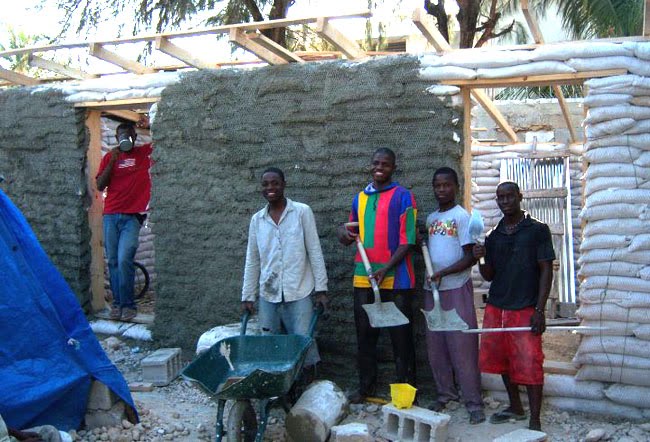
I first found out about this orphanage because they had built an earthbag house and were promoting this ecological way of building. You can see a description of this at earthbagbuilding.com. There are many reasons to recommend earthbag building in this impoverished country, and resistance to seismic events is among them. Just how resistant earthbag housing might be to earthquakes is not known for sure. Very little testing has been done to prove this one way or another. This initial seismic tests done at CalEarth and other places are encouraging, but not conclusive (see earthbagbuilding.com/testing). Some members of Engineers Without Borders are currently gearing up to do some more testing, so we will hopefully know more in awhile. This technology is still in its infancy, so there is much more to learn about its potential.

Earthbag housing can be used for emergency shelter, and we have posted a number of possible options at earthbagbuilding.com/emergency, including one proposal that Dr. Owen Geiger and Patti Stouter assembled to present to the UN. This sort of emergency housing has the advantage over tents and other immediate structures that it can often be used and improved over time to become more permanent.

Another kind of housing that can withstand practically any sort of catastrophe are shipping containers that are converted to dwelling places. These steel shells have become surplus items at many ports around the world because of trade imbalances. There have been some very innovative designs for incorporating these modular units into quite livable spaces (see an article I wrote at www.greenhomebuilding.com). I participated in assembling a proposal to the UN for arranging this concept to be employed in Haiti. Here is another proposal in the same direction: www.clemson.edu . Such structures do need to be insulated to make them livable in most climates, but this is possible and can be done with earthbags filled with a variety of materials.

I agree with you that in some ways the devastation in Haiti does present an opportunity to rebuild with green sustainable principles, and I hope that this can be manifested. We each can do our part.

December 11, 2009

Global Warming Denial is Alive and Kicking

Every year I look for new books that have been recently published in order to keep www.greenhomebuilding.com as up-to-date as possible. I had been under the impression that the controversy over whether global warming is really happening as a result of human activity was finally dying down, and that even the nay-sayers were beginning to accept the overwhelming science that proves this is the case. I was shocked to see how prevalent and vociferous the global warming deniers still are.

Out of 24 books I reviewed that were published in 2009 and relate to climate change and global warming, 9 of them (more than one third) were clearly denying the consensus of scientific opinion. With titles like "Global Warming False Alarm," "Global Warming Science They Don't Want You to Know," "Red Hot Lies: How Global Warming Alarmists Use Threats, Fraud, and Deception to Keep You Misinformed," "Global Warming: Manmade or Man Made-Up?" it is clear that there is a significant emotional charge behind this writing.

So who is publishing this denial literature? Two of the publishers appear to general trade publishers, two are highly conservative publishers, two are religiously oriented, two were self-published, and one was came out of the Cato Institute, self-proclaimed as "libertarian."

Fortunately, there are also many well-researched and thoughtful books that are intended to be more constructive, evaluating the options available for mitigating global warming. I counted 7 in this category, along with 3 more that delve deeply into the science confirming global warming as human-caused. One book, "When the Planet Rages: Natural Disasters, Global Warming and the Future of the Earth," takes a long-range historical perspective.

Another hot topic seems to be the controversy itself, with books like "Climate Cover-Up: The Crusade to Deny Global Warming" and "Lies, Damned Lies, and Science: How to Sort through the Noise around Global Warming..."

And then there are some books that point out how businesses are taking advantage of the frenzy over global warming for economic gain. These include "Global Warming Is Good for Business: How Savvy Entrepreneurs, Large Corporations, and Others are Making Money While Saving the Planet" and "The Plot to Save the Planet: How Visionary Entrepreneurs and Corporate Titans Are Creating Real Solutions to Global Warming."

Climate change and how we should, or should not, deal with it is clearly one of the major issues of the day, and probably of this century. I encourage everyone to become fully informed and make choices from a position of sober analysis rather than from emotional reaction.

November 23, 2009

Small Cob Buildings without Permits!

I would like to introduce you to a new member of the team of architects and designers at www.DreamGreenHomes.com: John Fordice. He is presenting a series of small (under 120 sq. ft.) cob homes or studios that can be built in most localities without the need for a building permit, because they fall below the minimum square footage that is set by the standard International Residential Code.

I met John at the 2008 Natural Building Colloquium in Santa Barbara, California, and instantly recognized his gentle soul and passion for designing and building small cob structures. I invited him right away to join the DreamGreenHomes team, and am very pleased that he has climbed on board. John combines his architectural expertise with his sculptural experience in presenting unique plans that will satisfy on many levels.

John says, "Ever since I can remember, I've always loved making things. I've been around building in one form or another for most of my life. I first studied building technology, followed by architecture, then finally fine arts and sculpture. My working life has been in construction, architectural drafting, hand crafts design and production, and for the past almost 30 years professional architecture. About 10 years ago I discovered cob and absolutely fell in love with the mud. Cob is an amazing material which allows an unparalleled simplicity and freedom of design. So here I am offering cob building designs to you. Cob has so much to offer."

The first plan in this small cob series is his Solar Oval One. This plan is a compact passive solar design with a loft. It has many valuable and green/sustainable features:
  • A South facing wall of windows and french door for passive solar heating
  • An earthen floor for solar mass and economy of construction
  • An interior cob bench for built-in seating and rocket mass heater
  • A built-in desk or kitchenette area with side storage niches
  • A north wall closet for storage space and insulation
  • Small East and West end side windows for views & area lighting
  • A sleeping loft accessible by a built-in ladder
  • Roof framing which needs only minimal small dimension lumber
  • A corrugated sheet metal roof
  • The structure is designed to include seismic stability components
  • A pleasing curved design
  • Low cost if you build it yourself

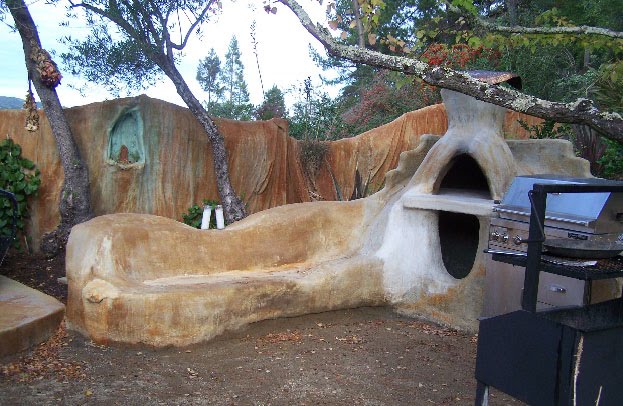
Building with cob allows the use of local sustainable materials. In many areas the earth at your site can be used and only water, sand and straw will need to be brought to your site to make your cob. The cob is mixed right where you are building and stacked up on an impervious foundation. There are no forms needed to make a cob building. Curving sculptural walls are easily created. Your imagination is set free when you build with cob.

The cost of creating a small cob building can vary greatly. If you have an experienced cob builder provide both the labor and materials to construct it for you, the cost should be about the same as a simple stick framed building of similar size. Another possibility is to have a builder do the foundation and roof construction, while you build the cob walls. Cob is easy to build, but foundations and roof framing are more technical work which will benefit from expertise. Building your cob structure yourself is by far the most economical. If you can provide the labor to build, and are resourceful in your acquisition of materials, it may be possible to create your cob building for one tenth of what it would cost to have a builder do the construction. It's a big project, but cob is forgiving, and can be done slowly.

You can find out more about this specific plan and the advantages of small cob buildings at www.dreamgreenhomes.com.

November 19, 2009

LEED Credit Tracking Software

Software Advice has released the first in a series of "state of the industry" reports to share their observations on construction software trends over the last year. One of the major trends they reported was the increased demand for software to track LEED credits.

Just as LEED certification has grown in popularity; so too has the need to track the detailed documentation requirements related to earning LEED credits. At their core, projects seeking LEED certification need document control and efficient communication. This is the key functionality that project management software (e.g. EADOC, Procore, e-Builder) offers. Consequently, Software Advice has noticed an increase in adoption of software for LEED projects. Additionally, a number of software companies are now building specific LEED credit tracking modules right into their systems.

October 21, 2009

Living Walls

We have all heard about green roofs and know about their environmental advantages, but there is a new concept that is taking root, especially in urban environments: green walls or living walls. Better than the old ivy-covered buildings, which can be adversely affected by the vines, these walls are designed to feature a variety of different plants in a vertical environment, and provide all of their needs for moisture and support right on the wall.

These walls can be either exterior of interior, and they provide advantages in both situations. On the outside they will shade the wall from the intensity of the sun, and thus moderate the temperature considerably, as well as provide lovely textural contrast and beauty. Plant surfaces, as a result of transpiration, do not rise more than 4–5 °C above the ambient and are sometimes even cooler. On the inside they will filter and oxygenate the air, providing a healthier indoor environment, while also creating the calming effect that natural plants tends to have on most people.

Vertical gardens can be grown on just about any type of wall, with or without the use of soil. Many living wall kits come with modular forms that are assembled and applied to a frame that then is affixed to the wall. The most common frame for sale today is a panel that is self-supporting and can be set up independently or attached to a real wall. It is then filled with soil or a soil-less medium and planted. Once the initial panels are in place living walls require little maintenance. They are designed so that their upkeep is about the same as a landscaped garden.

When you combine the obvious environmental benefits of living walls with their sheer beauty I anticipate that we will be seeing many more examples of this wonderful art form. For more details and photos see greenhomebuilding.com.

October 17, 2009

Super-Insulated Houses


I am pleased to introduce a new "expert" panelist at www.greenhomebuilding.com. Robert Riversong has created his own form of the Larsen Truss building system, and specializes in super-insulated houses. He teaches these techniques, and many other subjects, at the Yestermorrow School in Vermont.

In an article about his work, Robert states, "I've been using and modifying the Larsen Truss super-insulated wall system for 20 years and can build a 12" thick wall (R-40+) with no more lumber than a conventional 2x6 house, in part because I eliminate exterior wall sheathing and use t-braces and full 3/4" drop siding over housewrap. And, with the air-tight drywall system instead of vapor barrier and dense-pack cellulose, there's almost no thermal bridging and a 3 bedroom house can be heated with less than a cord of wood per year here in New England.
"I also use native, rough-sawn green full-dimension lumber, rough-sawn subfloor and roof deck, and rough-sawn exterior trim. The load-bearing wall is 2x4 24" oc and the exterior chord of the parallel chord wall truss is a 2x3, extending from sill to rafter tail and attached to studs with rough-sawn 1x4 gussets 24" oc."

"The open wall cavities makes the installation of mechanicals simple, since there is little drilling necessary. The three air barriers (drywall, dense pack, housewrap) make the walls virtually impermeable to infiltration. The dense pack cellulose makes the walls highly fire resistant and extremely quiet. Insects and rodents don't like the boric acid used as fire retardant in the cellulose, so these two universal problems are minimized or eliminated. The cellulose is more hygroscopic than wood, so it not only can absorb and release any diffused moisture that might get into the wall cavities but also draws any potential moisture away from the wooden frame, thus protecting it (foam insulations will do the opposite)."

"The only plywood in the house is for door and window boxes, as this makes a better air-tight seal than boards, and for a couple of interior shear walls. Let-in metal t-bracing in exterior and interior load-bearing walls and wooden under-rafter diagonal bracing sufficiently stiffens the structure, particularly once the sealed drywall is installed."

"I find that going from conventional construction to superinsulation adds no more than 5% to the cost of a house and the payback is enormous, both in energy savings and comfort. Some banks are offering higher debt-to-income ratios to mortgagees who buy or build highly efficient homes, since they need so much less income to operate it."

If you have any questions about the Larsen Truss building system or super-insulated homes in general, Robert is happy to answer them. Go to greenhomebuilding.com/ask_the_experts to send your question.

September 16, 2009

An Alternative Home Tour

This year’s Twentieth Annual San Luis Valley Energy Fair held in Crestone, Colorado featured three different concurrent homes tours on a Sunday afternoon. It was hard to decide which tour to take, since they all were intriguing. Ultimately the impulse toward simplicity and sustainability won out and I chose to join the walking tour in Crestone to avoid driving and to get some more exercise.


We met our tour leader, Jeremiah, at Crestone’s Town Park and hiked the few blocks to visit Carmin’s passive solar strawbale home. I remember going over her evolving plans several times with her as she approached the actual building phase. I’m sure that this planning has paid off for her, since there is very little that she would change about the house.

The passive solar aspect has been most rewarding, in that the average floor temperature during the winter has remained at 65 degrees F. This means that she only really needs supplemental heat during periods of gray days. In fact, she says that the upper clerestory windows provide too much direct sun in the winter, so she has added scrim cloth to soften the glare from these windows. One other thing she would do differently is to shed the roof towards the south instead of the north, so that the snow wouldn’t pile up so much, but would melt off instead.

A short hike through the woods brought us our next stop: Annie’s new strawbale yoga studio and home. Annie announced that the most sustainable aspect of her place is the location; she and her students can easily walk into town, which eliminates much driving.

First we inspected the yoga studio, a lovely, invitingly open space with floating bamboo floors and vaulted ceiling. There is a mechanical room that houses all of the equipment associated with her photovoltaic electrical system and the active solar water and space heating system, which serve both the home and the studio. Solar heated water is pumped through hydronic tubes embedded in the floors, and these heat the areas above them. The solar water heating panels on the roof of the studio have a drain-back arrangement to avoid freezing problems. Annie’s residence does have some passive solar heat gain, which is augmented by the adobe floors that act as thermal mass.
The PV panels are mounted on a pedestal south of the studio, and the rack can be manually repositioned seasonally to optimize their orientation. She has a net-metering arrangement with SLV Rural Electric, so that any excess electricity that is produced will actually run her meter backwards! For backup electricity, in case the power grid goes down, she has a battery bank, but this rarely gets used so she expects that batteries will last a very long time.

A short walk down the street brought us to the compound where both Jeremiah’s and Adam’s families live. They are proud of the work they have done on the property to advance various aspects of permaculture design, in terms of rain-water catchment and grey water reuse. There is a lovely pond that Jeremiah constructed that collects water that can be used for plants and livestock.

Adam’s house is nearly finished after several years of hard work. It is a hybrid structure, consisting of a central core cylinder of strawbale walls with appendages of wood-framed walls. The insulation for the wooden portions is sprayed soy-based foam. Much of the interior plaster is of earthen materials. There is an interestingly designed passive solar greenhouse attachment to the south. Adam admits that his lack of planning for his house has cost him some difficulties with lost time and money.

Just up the hill from Adam’s home is Jeremiah’s work-in-progress: a partially underground dwelling that he is building mostly on his own. He started out with having a large hole excavated with a backhoe. Then he carefully sifted through all of the excavated soil and threw the larger stones back into the hole. Next, he constructed a heavy timber-frame supported roof that is covered by thick EPDM waterproof membrane. Originally he was planning to turn this into a green roof, but later decided to fashion it for water catchment instead, so there will be a mat of gravel over the membrane to protect it and help filter the water.

The entire southern wall of the home is wood-framed for glass and passive solar heat. The rest of the walls are finished with stonework (using all of the stones that he threw in earlier) as infill between the wood posts. These walls are insulated on the outside with several inches of foam, and then protected with a moisture barrier before being backfilled. A room in the far back will serve as a cool pantry/storage area and the walls here were fashioned like those that the famous $50 underground house book advocates, with wooden slats attached to wooden posts, protected with plastic and then bermed with soil.

Jeremiah’s house is likely the most economical of all the houses we toured, since he claims that he will spend under $20,000 for the entire project. Being substantially underground and rather small, it will also likely be one of the most energy efficient homes.

It was threatening rain when we hurried over to Keith’s home, with Jeremiah leading the way on one of his ponies. This is another hand-made labor of love, with Keith doing most of the work. He is obviously a master at timber-frame construction, as the expansive vaulted cathedral ceilings proudly demonstrate.

Sandwiched between the massive timbers are thick, home-made structural insulated panels. The roof panels are a full foot thick, constructed of OSB skin with custom TGI ribs and partially soy-based foam (he has his own foaming machine). He claims that these panels provide R-65 insulation, while the thinner wall panels provide R-32. All of this insulation helps hold in the passive solar heat from the southern glass. Most of this glass is not protected from the summer sun with shaded overhangs, but with such a high vaulted interior, overheating in the summer may not be an issue…it was certainly comfortable inside the day we were there.

There is a full basement in this house, and some of this space is devoted to the equipment for regulating and distributing both the solar water and solar electric panels on the roof. The rusty color of the roof is intentional: he used tin-core metal roofing that is designed to provide a natural rusty coating, while keeping the metal from corroding all the way through.

As we left Keith’s impressive abode, the threatening rain was beginning to materialize, so I scurried along the side of the road to seek shelter in my waiting car. It was an afternoon well-spent, with much camaraderie and learning. I certainly have a better sense of the sustainable wonders that are harbored in unique Crestone.