Compost Toilets
 Graham Bell has lived in Scotland since 1988, having previously spent ten years in London. His work has taken him around Europe, Africa, the Middle East and the USA. He has a Master's Degree in Old English & Linguistics from Oxford University. It took him many years to actually make the connection that most of what he does is dependant on the use of language, and to revalue that educational start point. Graham teaches sustainable design, and has written two books on the subject The Permaculture Way and The Permaculture Garden. He frequently contributes articles to local, national and international media. He is actively involved in the cultural scene of Scotland, including Scottish Traditional music, song, art and woodwork. He enjoys his garden, which supports a historic collection of Scottish apple cultivars and a wonderful range of bird life. "Family is the most sustaining thing in my life. After that comes the valuable network of people that I draw on for creative progress, both for myself and the people I work with. Home is where the heart is." For more about Graham and his work visit www.grahambell.org.
Questions and Answers
Q and A (Kelly): We are a small company working with an small architectural office to design and produce a full-size working model of a short term shelter (approximately 4-6 months maximum) for FEMA. Our approach is to produce palletized components that can be delivered by helicopter into a disaster area that is without power and quickly assembled into cabin-like homes meant for approximately 4 persons (2 adults, 2 children). The shelters must be light, small, and self-sustained. We have no specific knowledge of composting toilets beyond the thought that they could fill our need, so I was pleased to find your site. The fact that you have objective experience with them is thrilling to hear! We would, of course need an on-the-floor model instead of a model that requires excavation of a cellar space (WAY too expensive and bigger than the shelter itself!). Any thoughts you might have on the subject would be greatly appreciated. For example, does this sound like a viable idea?
Yes, I would say that it is viable, with some reservations, expressed below.
Are on-the-floor models really self-contained and really functional?
Yes, they are self-contained and how functional they are depends on the design and how well they are maintained by the users.
Do you have favorite brands?
We have only had experience with the Sun-Mar brand (made in Canada). The model that we put in our bus conversion motorhome was actually too small to work well for more than one person full-time. (It was their smallest, marine model). Their larger models may well have worked better.
Are they simple enough to operate that a wall-mounted instruction sheet would be adequate?
This is a good question. Keeping a compost toilet in good working condition is a bit of an art, that requires an understanding of composting practices and some monitoring of conditions, etc. It is not like just flushing the toilet and forgetting about it. The composting material must be kept warm and moist enough, turned occasionally, and periodically emptied. Many people do not have the stomach to deal with all of this. Also, the organic world includes flies and other insects that can become a problem, so it is not necessarily easy, or for everyone.
Alternatively, instead of supplying each shelter with toilets (& showers, for that matter), perhaps a communal facility per every so many shelters would be better?
I think that this an excellent idea. The larger the system, the more successful it might be, but again, getting everybody up to speed on how to use it might be a problem.
Another, much less expensive and simpler approach is the "Humanure" system, explained in a book by that name. It it basically a bucket with sawdust and a toilet seat that is emptied periodically into a separate, outside compost pile. This approach has been quite successful in many places.
Q: My boyfriend and I bought some land in the Big Bend area of Texas and plan to build a home and small farm there. We are in the planning stages and will soon be drilling a well. We would like to avoid septic altogether by using (1) a gray water system and (2) something like composting toilets or incinerator toilets. Can you describe the merits and pitfalls of composting toilets? We probably won't have much space, if any, under the buildings (house, shop, guest house). Of course we don't want a smell at all.
A: (Maya Madrigal) Composting toilets come in many designs and sizes to fit your style and household needs, most require a ventilation system and/or electricity. Some composting toilets are self-contained, needing little more space that what they use, comprised of several chambers that rotate around the intake feed so that prior waste is being composted is kept separated from new waste. Every so often you remove the chamber that is complete, it is benign and should not smell any less sweet than compost. Other indoor compost toilets have separate composting chambers that are kept in some utility or basement space connected to the toilet by plumbing. These are more space consuming, and may not suit your spaces needs. Some types of composting toilets, like pit-vault out-houses, may be too big for your space, are usually situated outside and use the addition of a scoop of sawdust to any waste to help in the composting process. One design by permaculturalist John Cruickshank called the "Sunny John" uses passive solar design to ventilate, and two side by side toilet chambers for collection. Urine is separated from waste by gravity feed and the waste/sawdust mixture composts in place by smoldering. This out-building is made from strawbale/or adobe with southern exposure windows, additionally you can make a living roof. It is beyond the scope of this short answer to give greater detail into his work, but if you are considering an outhouse composting toilet his published designs can be ordered at hobbithouseATcompuserve.com
There are many suppliers of composting toilets, and some computer research will show you the variety. I have seen simple systems where humanure is fed from the toilet to a chamber by gravity, urine is removed the same way, and compost is activated by red wiggler worms. A very rich fertilizer comes from this synchronistic relationship of worm and waste. Of course, the legality of these alternative systems may be questionable where you live, please check with your local authorities on what is appropriate in your community. For example, where I live it is fine to use a composting toilet indoors if you also set up conventional plumbing, outhouses are not acceptable.
Q: I'm in massachusetts and shopping for an appropriate composting toilet for 1 -2 people in a permanent residence. My preference would be not to use electricity if that can be done and still have no odor problems.
A: (Kelly) It certainly is possible to have a compost toilet inside without undue odors. I have lived with them on several occasions, and they have generally been substantially odor-free. I would recommend installing one where you have the option of running a small fan in the venting system, so that you can always turn this on if necessary. My last compost toilet (a Sun-Mar) had both one of these, as well as a heater within the compost chamber to assist with keeping the compost warm enough to do its job. Such a heater is theoretically not necessary, since a well-functioning compost pile will generate its own heat...but this is rarely a perfect world. I generally caution people that they should be rather comfortable with the whole idea and practice of nurturing compost piles if they expect to be content with a compost toilet. If you are squeamish about these things, then such a toilet is not for you! My other bit of advise is to buy a system that has plenty of capacity, so that you are not forced to empty the contents too soon; we had this problem with the little one we installed in a bus motorhome conversion, and it was no fun.
Q: I saw an article about treebogs in the Ringing Cedars of Russia newsletter but I can't find any info on it on your site.
A: Ringing Cedars of Russia is very interesting as a site: "...profound ideas about the education of children and the importance of communicating with living Nature - ideas ranging from nutrition and health to spirituality and sexual relations. With their practical wisdom on matters of everyday life, the books have become the basis for a number of sociological studies and scholarly papers..."
Here we're rather more interested in practical solutions, and treebogs might just be one of them. I recommend a visit to: http://en.wikipedia.org/wiki/Tree_bog "A Treebog is a form of compost toilet which has willows, nettles and other nutrient-hungry plants planted around it. The faeces are held in a chamber open to the air which allows it to decompose rapidly, feeding the trees around it. Unlike a conventional compost toilet, a treebog should never need emptying. Effectively, it is a system for converting human faeces to biomass."
Jay Abrahams (not to be confused with the Jay Abrahams who pops up on Google telling you how to make millions) is a genuine UK permaculture person, and I see no reason his design suggestion shouldn't work in a reasonably humid climate. The advantage over enclosed systems is they take less work. The disadvantage is there is no containment of pathogens (and the system will not exclude rats for example, a prime vector for disease transmission). So possibly OK for temporary locations (e.g. camping in the North of Canada) or remote locations (homesteading miles from the next neighbour) but not a good idea where most of us are....Only I hope you have better weather for outdoor defecation than we do right now...
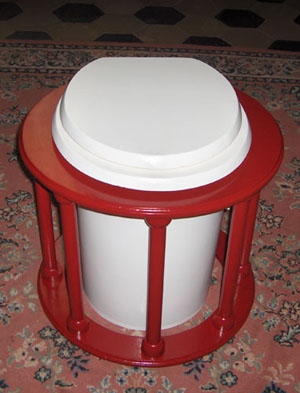 Q: Thank you for sawdust compost toilet info. I am very excited to build one and share this info. Where did you get the cute RED wood one? If you built it yourself would you share the building plans? Also where did you get the lid that looks different from a regular bucket lid?
A: (Emma Holister) That was made with two simple rings of wood for the base and top, the hole in the top being smaller than the bottom one so that it fits snugly around the rim of the bucket (just trace the rim of the bucket on the wood to get the exact diameter of the hole necessary). The bottom ring being bigger so that the whole structure can be lifted on and off the bucket without getting stuck on the swing handle. The two rings are joined by the vertical columns that are simply cut up wooden curtain rails attached to the top and bottom with the curtain rail wall fixtures that came with the rods. Attach a toilet seat to the top of it all, and hey presto, you have a very fancy compost toilet throne. They are food grade buckets so they are pretty good quality, but you can only get white, which is a shame.
I guess really what I am wondering about is how tight of a fit with the toilet seat lid do you need so as not to have odors leaving the bucket? And how to keep the wood edge clean as usually there is porcelain under a toilet seat? You use a regular toilet seat over the bucket on top of the wood? Does the bucket come right up level with the top of the wood? I am seeing that as the only way to keep the wood clean. Is that correct?
There is no odor with a compost toilet if you do it properly, even if you leave the toilet seat totally open all the time, which often happens at my place, the toilet is even in my bedroom sometimes, and it's never smelly. So designs to avoid odors, tips on special construction methods are irrelevant and just give compost toilets a bad name. You just need to use the right cover material, we use a fine sawdust. If your cover material is not fine enough then odors can escape, that's why wood chips are no good, also they won't rot in the compost bin. If you don't cover your doo daas with enough sawdust/dead leaves, it can get smelly too, so it's about how you use your toilet rather than how you construct it.
For doing a proper compost toilet see The Humanure Handbook by Joe Jenkins. He also has a website with forums where all these questions can be asked. For the basic principles of making a compost toilet and the bucket rim issue, just do a search on YouTube for videos on how to make a compost toilet. Basically the rim of the bucket only rises a few mm above the hole in the toilet rim.