Timber Frame Questions and Answers
 Brice Cochran has been working in the timber frame industry for over 14 years as a timber framer in the shop, project manager, and designer. He finished his own 3,000-square-foot timber frame home near Mountain Rest, SC while working in and on his timber frame design business Whetstone Designs and Timber Frame HQ. At the University of North Carolina, he studied Philosophy and Mathematics. He is an active member of the Timber Framers Guild and the Timber Frame Engineering Council. He is married and is the proud father of two children.
Q: How does timber framing fit in a green building environment?
A: (Will Beemer) Use local materials. That to me, is one of the major components of a sensible building system. In New England, where I live, our forests are mature again and we have plenty of good timber that can be sustainably and selectively harvested and processed at local sawmillls. Portable sawmills are also very popular that can go right into the woods. All of this avoids the transportation costs, embodied energy and fuel associated with materials shipped from far away, and it supports the local economy. Even with certified timber I would hesitate to buy it if it came from across the country. So for you folks out in the desert or plains without trees, I suggest you look to one of the earth based building systems using local materials, at least for the walls, if you're trying to be truly green.
Timber frames also are valued more highly, are usually inside the building envelope, and are thus cared for better than a light-framed house. So they will generally last for centuries, as opposed to less than 100 years for a typical modern house. Thus, for about the same amount of framing wood, you get a house that will last 2-3 times longer.
Q: How are timber frames enclosed?
A: (Will Beemer) The majority of contractor-built timber framed homes use Structural Insulated Panels (SIPs) that get nailed onto the outside of the frame. (SIPs can be the subject of a lot of debate - they have some advantages from a green standpoint - but we'll save that for later.) These go on very fast, thus saving labor (=money), and make a very energy-efficient envelope. But if you're doing your own labor, there are other alternatives such as light framing and Larsen trusses nailed outside the frame that allow you to use conventional insulation or sprayed-in systems, or you can use strawbale or slip-formed earth systems. One thing that is common to all of these systems is that they are outside the timber frame, thus keeping the frame exposed to the warm interior where it is protected. This is important in a cold climate; burying the frame in the wall could cause condensation and rot if the sealing details are not done well. This is not as big an issue in a dry or warm climate, but you still have the problem of finishing your infilled wall up against the sides of the timbers that you avoid by putting your wall outside the frame.
Q: I'm looking for a primer on building with roundwood. That is, I would like to learn how to do framing with non-milled poles. You will occasionally see beautiful natural buildings (cob, strawbale, slipstraw, etc.) that are supported in this way. I have yet to find a guide that addresses joinery and design.
A: (Will Beemer) Log Construction Manual by Rob Chambers, available from the International Log Builders Association. And the three part series of articles on scribing that appeared in the quarterly journal Timber Framing from the Timber Framers Guild.
Q: I am currently in my final year at Kingston University London, and am undertaking my Degree in Residential Property. As part of my final year project I am compiling information for a dissertation. The title for this dissertation is, "Timber Frame Housing, a time effective solution?" The research looks into the time comparisons between timber frame and masonry construction. In order to undertake this research, I have decided to compare two case studies, one of which looks at Masonry construction and a similar one which used Timber Frame.
A: (Will Beemer) The term "timber frame" outside of North America generally refers to any form of wood framing, and usually means light framing with lumber (2-4 inches thick). In North America our term "timber framing" means framing with heavy timbers (5" or more thick) and traditional wooden joinery. "Post and beam" can use heavy timber and metal connections. So I think the timber framing you are studying in Britain is really light frame construction.
I am not familiar with any case studies on our Timber Framers Guild website (www.tfguild.org), but there are a number of papers and consumer guides you can find at the Timber Frame Business Council website (www.timberframe.org).
I suspect there are some inherent problems in comparing masonry to wood construction that go beyond the bottom line of time and materials costs. It's literally like comparing apples and oranges. In our area of New England wood construction is preferred because of availability of local materials, energy efficiency and performance, the local skills pool. In areas like Florida (with termites and hurricanes) or the desert Southwest masonry is preferred. From a green standpoint, my priority is to use local materials and local skills, and support the local economy. I suspect the scarcity of wood in Britain led to the predominance of masonry construction there.
Q: Several years ago I was offered a very unusual gift, a free cottage. The owners of the neglected structure were elderly and were glad to pass it along us. It's quite a charming little place, although there is no foundation (the north end has a cinder block in each corner; the south end was likely on a tree stump at one point, but now is slowly settling into the ground.) There is virtually no insulation (nor furnace or A/C, either) with 1/4" gaps surrounding some of the windows. Obviously, attempting to make this northern Indiana structure a year-round residence is well beyond my ability and hiring professionals is beyond our budget (and likely significantly more expensive than rebuilding.) However, it is built with old-growth actual-sized lumber. I came up with the crazy ideal of recycling the entire building. Literally, taking it apart and rebuilding with as many existing materials as practical.
Potential recyclables: studs, flooring, roof planks, interior appointments. Required replacements: foundation, roofing, windows, insulation. I have talked to several people familiar with the building trades and the unanimous advice has been to tear it down. My goal would be to make this 1920's 20' x 40' structure in northern Indiana a year-round residence.
The floor joists have rotted and the floors are soft in many places. In the late 1960's the previous owner dealt the the problem by placing plywood on the floor. This distributed the weight but did not help things in the long run. The building is Kellastone, a forgotten style where a stucco-like finish is applied and small stones (or in some cases glass) are embedded into the mud. This made for an economical, durable and attractive finish. Some of the interior walls are intact and remain quite nice. The building is framed in old growth actual sided lumber, although the studs and rafters are 2x4's 3' oc. When looking into the attic it looks like it should not be sturdy, however, the building has been sitting there nearly 90 years and a straight roofline remains. To preserve the structure I would need to replace a significant amount of the low-lying lumber, jack it up and pour a foundation under it. Then insulate and replace the many windows with energy efficient replacements.
Is this practical? What is a good next step?
A: (Will Beemer) If the wall framing and roof framing is good and straight, it still seems to make sense to me to preserve the structure, support it on cribbing and pour a new foundation and frame a new floor, then lower the existing frame onto it. This would preserve the Kellastone system, which seems of great value, although it doesn't address the lack of insulation, which sounds like it would have to be blown in. Someone knowledgeable would have to visit the site in person. Not being familiar with the stucco system you're better off consulting with someone local who is.
Q: I would like to build a new timber panel /or beam house. I read about insulation material "neopor" and I would be glad, if you would give your opinion about this synthetic material.
A: (Will Beemer) I am not familiar with this material so have no opinion. Our material of choice for insulation in Massachusetts is blown in or wet spray cellulose, with Structural Insulated Panels (SIPs) second.
Q: What is the best way to get the bark off of timber and why is it advisable to do this?
A: (Kelly) It is easiest to debark trees when they are still wet with sap, since the bark will often peel off by just pulling on it; once they are dry, it is often necessary to use a draw knife, or some similar tool to debark them. Leaving the bark on can provide a place for insects to reside, either living there before or after installation. Also the bark is much more likely to shed debris over time.
Q: Why do you ignore log home structures as a natural alternative? Built with standing dead wood the structure is masssively energy effecient, is a huge carbon sink, and left to to decay in the forest re-emits the carbon it absorbed when living. I would love to know why a sip panel is promoted and a log wall is not. A sip carries a huge carbon footprint during the manufacturing process. The efeciency of both walls are the same but the log wall is purely a natural fiber and a sip is a massive synthetic. Don't understand your rational.
A: (Kelly) I like log homes, and in some circustances it makes a lot of sense to build them. This is generally true when there is a local source of surplus logs that need to be thinned sustainably from the forest. Otherwise, to harvest logs just for a log home when it is necessary to either cut down productive forests or to ship the logs much distance it doesn't make sustainable sense. It takes a lot of logs to build a log home. Another issue with log homes is that they do not naturally provide very much insulation, compared to many other materials.
I feel that too often log homes are promoted as natural alternatives without attention to these factors, so in the interest of saving our forests (which sequester much CO2 and provide needed habitat), I have not devoted much attention to them. I do adovocate the use of logs for timber framing under similar circumstances. I don't really promote SIP's; I only recognize that they have a place in the realm of sustainable building, just as log homes do.
Q: My two sons and I are building a triplex in Crystal Beach Florida. We want to go as green as we can and stay within a budget. What is the best product to build with in Florida? We are in a flood zone area and need to build 12 feet above the ground.
A: (Kelly) If you need to build that high off the ground, probably the best approach is to build with tall piers or poles so that any flooding that does occur will not adversely affect the structure. I would recommend a wood pole or timber frame structure, since it can easily be adapted to this need.
Q: I'm having a hard time locating a 16 inch post. Even the used telephone poles are only 12-14 inches .....got any ideas where else to look?
A: (Will Beemer) Try a sawmill or a logger. There are plenty of 16" trees out there.
Q: My wife and I intend to build a number of timber framed structures on our homestead 15ac in Georgia, and are examining different techniques for doing so. We have considered both traditional timber framing and pole framing with embedded poles, and we're exploring a variety of infill methods as well. In the square timber world, the extreme cost of large dimensional lumber worries us. However, it occurred to me that composite box posts or beams could be made from "normal" 2x stock that might serve well. If the joints were both glued and screwed, it seems to me that such a member might be quite strong - perhaps even approaching the strength of a solid single member. Furthermore, since it is essentially a pair of L-girders joined together it might span space well when used as a horizontal beam. The additional side piece would make it less efficient perhaps than an I beam, but it should be similarly strong or stronger. Also, if the joints between the ends of the 2x stock pieces are staggered along the length, in theory, a beam of virtually any length required might be constructed. Finally, one might be able to use the center channel as a race for wiring. Does this seem to you like it would be a practical approach?
A: (Will Beemer) You can't approach the strength of a solid timber using the methods you describe. Glue-lams can but only when they are made in a controlled environment with strict quality control and proper arrangement of the "plies". If you stagger the joints you have still severed the grain in each piece and that cannot be considered a structural continuous beam, even if glued and screwed. When you consider all of the extra labor required to assemble these built-up members, and the cost of the glue and hardware, it's hard to imagine it would be worth it. But mostly I question your assumption of the "extreme cost" of large timber. Local timber purchased from a sawmill will almost always be less expensive then buying the equivalent volume of dimensional lumber at a lumberyard; less sawing required. (By the way, "timber" is anything 5" or larger in both dimensions; "lumber" is 2"-4" in either dimension.) I can only think you are looking for timber from a lumberyard rather than going to a sawmill, of which there should be many in Georgia.
All lumber will have some degree of twist, crown or cupping. No matter how slight, this will fight you during assembly and probably prevent a bomb-proof glue joint. When they build a gluelam in a factory, the material is all jointed straight and true and then immediately glued together under immense pressure. Small built-up beams of say, 2-2x4s or 2-2x6s in an 8-10' length might be doable with little fuss, but bigger than that....
If you were somehow able to calculate the strength of the built-up beam (and some of that, in smaller sizes like 2-2x8's, is in the building code), you would need to have a bigger beam than one using solid timber to reach equivalent strength. And then there's aesthetics (if you care about that). It's hard to make a built-up beam look as good as solid timber, in my opinion. Also, consider all the metal you'll have to avoid when doing any drilling, sawing or fastening of finish materials. Your building inspector, if you have one, will be the final word. Try contacting the Holder Brothers in Georgia if you want to source timber. www.holderbros.com. They may be of help.
Q: What would you go with for natural insulation for walls with Timber Frame roofing? What is your take on earth walls vs straw/clay walls (especially in hot and humid weather) and which one will do very well in humidity? I plan on getting an AC/Heater central system but will the use of it decrease significantly with earth or straw/clay walls? Is there an alternative to AC/Heater central system I should look into?
A: (Will Beemer) I only have experience with straw/clay, and it seems to work well for this northern climate. You should contact natural builders in your climate to find out what is time-tested there. I think any kind of high-mass wall would help moderate temperature swings, and the use of any AC/Heater system would decrease with increased r-value. But the key is to get the mass heated up (or cooled down), and I don't recommend high-mass walls unless you have extra solar gain to store. In our new england climate, I prefer high r-value over mass, and thus thick walls of cellulose. Alternative AC/Heater systems is a pretty broad question. Again, high r-value can decrease the need to think about alternatives. It's possible to design a house so well insulated that you don't need a system.
Q: I'm having a hard time locating 16 inch posts. Even the used telephone poles are only 12-14 inches . Got any ideas where else to look?
A: (Will Beemer) Any sawmill or logger ought to be able to get you a log this size. It's difficult to imagine what the problem would be without knowing where you are. Around here there are lots of trees this diameter or bigger.
Q: I am building a timber framed home with SIPs. I am looking into interior finishes. I would like lime plaster on the interior walls. Is there a way to meet fire code and put the lime plaster directly on the OSB or would I need to install drywall and then the plaster. If this is possible is there a way to get it 90% done on the ground before the sips even go on the roof. Do you need mesh to hold the plaster? I was thinking: mesh each panel and add 1 or two coats plaster, then install the panels and touch up the messed up spots and maybe put the last coat on. Any suggestion would help.
A: (Will Beemer) OSB is not made to accept plaster, so you would need to put either lath or drywall up afterward. There are a number of very good plasters, such as American Clay, that can go right over regular drywall. Other plaster may require Rocklath or a similar drywall with special paper to accept the plaster.
I would certainly do your wall plastering AFTER the panels are up, and understand the difficulty doing the ceiling. If you could have all of your joints covered by timbers you could put your pre-plastered strips of drywall up ahead of time and then install the panels over them. HOWEVER, any flexure while installing will result in cracked plaster, and I don't see how that could be avoided unless you apply the drywall to the SIP before plastering. Again, you won't be able to finish any joints between panels on the interior. If you use purlins in your roof framing, at least your drywall and SIPs can run the same direction (horizontal). We usually use a common rafter system and run the drywall vertically, then the SIPs go on after and run horizontally. Roof SIPs should always run horizontally. SIPs are also usually much bigger than a piece of drywall, often going on in 8' x 24' panels on the roof. You want to avoid as many joints in the SIPs as possible, so the bigger the better. Also, if you plaster on the ground you are at the mercy of the weather.
Q: Is it possible to finish a timber framed strawbale house with a stone facade? I'm wondering more about moisture migration from inside the house than structural issues. My climate is Northern New York, specifically the western Adirondacks. Pretty chilly Winters and a typically fairly damp Spring and Fall. As far as hanging the facade, aside from diamond lath attached to the timbers for the mortar to bite into I would possibly provide a structural lattice as well. The stonework itself, though only about 10" in it's thickness will be self supporting vertically and will only rely on the wall behind it for lateral support, much as in the design of a chimney. It will not be a facade in the manner of artificial stone applied directly to the backing structure and relying on it for all support.
I am a stonemason by trade and am familiar with most structural concerns regarding stone facade etc., but I am not familiar with a strawbale building envelope which allows for the transference of moisture through the wall to the outside. My concern is if the stone facade will present an obstacle to the path of moisture resulting in rot within the bales. I'd been planning on an ICF home that I would then finish with stone, but have been convinced to consider strawbale. The stone facade is a given for me. I'd like to work with straw only if it will work with stone.
A: (Will Beemer) I am not a straw bale expert, but I think your concern is appropriate. I assume that vapor migration through a straw bale wall is slowed by the plaster finish, but the wall must be allowed to breath to the outside so any condensation that occurs at the dew point can still dry out. The stone would provide a cold surface for that condensation to form on, and no way to escape unless you provided a ventilation space.
Note too that the standard detail for straw bale enclosure places it outside of the timber frame, not infill between the timbers, so the timber frame would not provide any support for the facade, so some other structural lattice would be needed.
A: (Kelly) I might add that there is a book titled The Natural Building Companion by Jacob Racusin and Ace McArleton that features considerable detail about strawbale building on the East Coast, and they do specify exactly what Will suggests. You need to provide an air gap of a couple of inches between the bales and any exterior cladding, with screened ventilation at the base and the top, similar to a conventional rain screen. You should also provide a clay slip coating over the straw to inhibit mold.
Also since the normal wall arrangement for comfortable interior temperatures usually reverses the order you propose, with the thermal mass on the inside and the insulation on the outside, you might make sure that you include at least some thermal mass on the inside, either through a thick earthen plaster, tiled or stone floor, or other masonry features.
Q: I have ten, 18 foot rustic beams from a historic Norwegian log home from the late eighteen hundreds with dovetail ends. The wood is light in weight and has exposed pegs that aligned the beams. I have two questions: Is is safe to use these in my daughter's new home as decorative non load bearing attached with a through bolt. And second question is her builder wants to buy the remaining eight. They live in Minneapolis. What would a fair price be to sell these. This log home is in northeast Iowa and my husband's best guest of wood species would be poplar?
A: (Will Beemer) Hard to say about safety without seeing them, Lindsay, but if there is no rot or bugs I'd say they were OK to use for decorative purposes. As for a fair price, $2 a board foot would be reasonable for rustic beams in good condition.
Q: I am thinking about building a home with 12 inch insulated block , heavy stone on each side, and post and beam douglas fir floor joists and rafters. Would I get enough insulation benefit inside the blocks? Would you put steel plates where joists and rafters rest on the masonry? I would like to also put douglas fir headers across the window and door openings, how can I protect the wood coming in contact with the masonry?
A: (Will Beemer) Since you don’t say where you live it’s impossible to say if the blocks have enough insulating value for your locale, but it’s simply a matter of seeing if the blocks’ total R-value matches that recommended or required (by code) for your climate. Do not use metal to separate the timbers from the masonry as that can cause condensation and rot. Usually (with blocks) wooden sills are bolted or otherwise secured to the blocks then your joists and rafters would be secured to them. A sill seal (foam or rubber) would separate the sill from the masonry. The sill also helps distribute the load from the joists/rafters; blocks may not be designed to carry point loads. Check with the manufacturer. The manufacturer of the blocks should have a document showing typical construction details like this.
Q: I am planning to build a round wood post and beam strawbale house on a slab with small balsam fir and scotch pine logs on the site. The logs are 6 to 8 inch at the base and some 20 feet long, they are 3 to 4 inches in diameter at the end. I am trying to find a way to have equivalency to meet the building codes.
A: (Will Beemer) The capacity of round logs in structural applications can be engineered, either by a Professional Engineer or a builder who has learned the formulae and techniques. Much depends on the application: posts, joists, rafters, etc. I suggest getting the book “Log Span Tables” from the International log Builders Association (www.logassociation.org). That may be enough to suit your needs.
Q: I just finished constructing my timber frame. Our plans are to construct the exterior light frame that will get dense pack cellulose and foam sheathing. We had originally planned on finishing the exterior with hard sandstone (I'm a stone mason) but understand that that would be a bad idea here in northern new york. The appeal of stone is its durability and lack of need for maintenance. Is there something, some kind of cementitious coating, that would offer a somewhat comparable lack of maintenance?
A: (Will Beemer) None that I know of, Daniel. Most, like stucco, would be much less durable than stone. I don’t see why stone wouldn’t work if you provide the proper insulation value, ventilation and condensation drainage plane inside., and protect it from moisture.
Q: We were thinking about constructing a log cabin out of ash logs because we wanted to use the wood before it became infected by the ash beetle, is this something that can be done and would it last if we built it right and treated the logs for pest.
A: (Will Beemer)I am not a log builder so it would be best to consult one of the books on the topic, but for a variety of other reasons such as shrinkage and checking I would not use a hardwood for building a log cabin.
Q: My husband and I recently became the owners of a small part of our family ranch. After doing some research on what we've been given, we've found that we are in an area of Montana that is in the red on the expansive soil map. I had planned for a rubble trench only to read that they are not ideal for expansive soil. I want to make a frost protected shallow foundation with a poured earthen floor instead of a concrete slab on top. We are going to be timber framing with log infill, as there is a burned area from wildfire where the trees are just not making it back to good health. Do you believe that a fpsf would be the best possible owner builder option for expansive soil and a cold winter area?
A: (Will Beemer) I don't see a problem with a FPSF rubble trench foundation if you can provide a drain in the bottom to take away any water that collects. We have built a dozen rubble trenches but always put perforated pipe in the bottom pitched to daylight. See the Fine Homebuilding article we wrote many years ago on the subject. If you have clay soils and trench fills with water then there could be a problem.
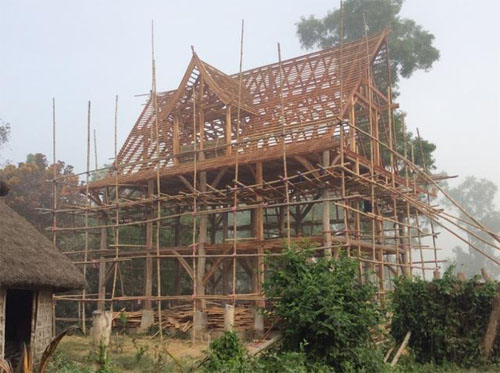
Q: I've built a timber frame from red river gum eucalyptus. It has a teak shingle roof. I'm gonna make straw light clay infill walls using sawdust clay and 10% cement. The question is should I treat the frame with something before or after making the infill walls? I'm in India and we get four months of heavy rain with high humidity. Should I use oil, creosote, linseed oil?
A: (Will Beemer) Since Eucalyptus is highly rot resistant and has a high oil content I don’t think you need to treat it. Local knowledge from woodworkers and builders would be your best advice, however.
None of the locals build with wood, especially not eucalyptus. It was grown here because it does well in the local flood conditions during the rains. But its mostly sold for paper pulp. But by all accounts this particular eucalyptus is - as you say -, it was used to make boat jetties in Australia. This being my first timber frame, I just want to make sure I cover as many of the bases as possible. The wood has a great red colour, but it goes grey with weathering. So I’ll probably oil or wax it to preserve the colour.
Q: I'm building a pole barn type shop/garage (6"x6" beams, 8' O.C.), and looking at unconventional ways of building and insulating the walls. Since the frame structure holds the roof and building, do you think rammed earth walls could be used? Do the walls still need to be 18" thick? Can plywood forms be fully or partially left in place as wall surface and protection from rain?
A: (Kelly) I think that it would be awkward to try to ram walls in a pole building, as the timber framing would get in the way of the ramming process. Besides rammed earth provides very little insulation, unless this is either embedded in the wall or added later. Another concept might be to infill the walls with earthbags filled with insulating material like scoria, perlite or rice hulls. These would then need to be plastered to protect them.
For Email contact go to About Us
See this page to read our Privacy Policy
Established in 2001, GreenHomeBuilding.com is primarily a labor of love. Kelly, and the GreenHomeBuilding team of experts, have answered thousands of questions for readers over the years, and we continue to publish up-to-date information about increasingly important sustainable architecture. If you feel moved to assist us in this work, your kind donation would be much appreciated; this can be easily done through our PayPal account:

VISIT OUR OTHER WEBSITES:
[Natural Building Blog] [Earthbag Building] [Dream Green Homes]
Disclaimer Of Liability And Warranty
I specifically disclaim any warranty, either expressed or implied, concerning the information on these pages. Neither I nor any of the advisor/consultants associated with this site will have liability for loss, damage, or injury, resulting from the use of any information found on this, or any other page at this site. Kelly Hart, Hartworks LLC.