Save Our Forests Questions and Answers
 Greg
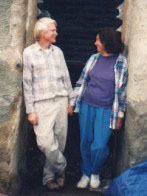
Nolan has
been in the forestry business for 25 years. He started his career in Oregon,
working for the US Forest Service. For ten years he worked as a fire fighter
in the summer and did reforestation contract work in the spring and fall.
He was recruited to leadership positions both in the Forest Service and
working in the private contracting world. In 1980 he headed east two days
before Mt. St. Helens blew her cork (was this a sign?) He settled on the
back forty of the family farm in the Mississippi headwaters region of
central Minnesota where he started Snowy
Pines Reforestation. Since that time he has been immersed in building
community around sustainable forestry and responsible use of our natural
resources. He has worked with a variety of groups to accomplish this,
including Audubon, The Nature Conservancy, MN. Dept. of Natural Resources,
U of MN., Midwest Renewable Energy Assoc., Headwaters Forestry Co-op,
Long Prairie River Stewardship Project, and hundreds of private landowners.
He lives in a solar-electric home which he built from locally harvested
materials. He likes the idea of working with the forest and it's products
from seedlings to siding and flooring. He is interested in fine tuning
our harvest methods to encourage natural regeneration of our native high
quality hardwoods (especially Oak) and caring for the local White Pine
Resource. He avoids the use of chemicals in forest management, believing
we don't know enough about what is happening in our forest soils to apply
such radical treatments. His forestry advise will reflect this philosophy.
Greg
Nolan has
been in the forestry business for 25 years. He started his career in Oregon,
working for the US Forest Service. For ten years he worked as a fire fighter
in the summer and did reforestation contract work in the spring and fall.
He was recruited to leadership positions both in the Forest Service and
working in the private contracting world. In 1980 he headed east two days
before Mt. St. Helens blew her cork (was this a sign?) He settled on the
back forty of the family farm in the Mississippi headwaters region of
central Minnesota where he started Snowy
Pines Reforestation. Since that time he has been immersed in building
community around sustainable forestry and responsible use of our natural
resources. He has worked with a variety of groups to accomplish this,
including Audubon, The Nature Conservancy, MN. Dept. of Natural Resources,
U of MN., Midwest Renewable Energy Assoc., Headwaters Forestry Co-op,
Long Prairie River Stewardship Project, and hundreds of private landowners.
He lives in a solar-electric home which he built from locally harvested
materials. He likes the idea of working with the forest and it's products
from seedlings to siding and flooring. He is interested in fine tuning
our harvest methods to encourage natural regeneration of our native high
quality hardwoods (especially Oak) and caring for the local White Pine
Resource. He avoids the use of chemicals in forest management, believing
we don't know enough about what is happening in our forest soils to apply
such radical treatments. His forestry advise will reflect this philosophy.
Q: I was wondering how many trees are used to construct an average conventional wood frame home of say 2500 square feet? I would be interested in all of the wood used in construction as well as all of the wood used in the furniture.
A: The question of how many "trees" to build an average 2500 sq. ft wood framed home begs for some qualifiers. Most of the trees being harvested in Central Minnesota USA, were I live are being harvested as pulp and ground into chips to be re-glued back into wafer board and I-joist. This enables the industry to harvest very small trees (less then 100 board feet per tree). In the western states (Oregon and Washington USA) were trees are typically sawn into lumber, one tree could have 3000 to 5000 board feet in it. If you were to use wood from well managed forests in our area (Northern Hardwoods, Lake States USA) you can figure a conservative production rate of 200 bd ft per acre per year. If a 2500 sq foot house used 25,000 bd ft ( This I believe is high, I like to solve my building problems with wood) then you would need the sustainably harvested wood production from 125 acres for 1 year. Or 12.5 acres for ten years. Our county, one of 90 in Minnesota has 135,000 acres of commercial forest, most of which is not well managed. At the harvest rate of 200 bd ft per acre per year we can actually improve the forest. We could move from pulp (small diameter) and high graded logging sites to more of a pre settlement condition. We have the science to do this but not the political will.
Q: I have purchased five acres of mostly wooded land for building my home. There are some very tall (mostly oak and hickory) trees. I plan to have supplemental wood heat and plan to use smaller trees for this purpose. My question concerns some large trees that will have to be cut when the house is built. Though few in number, the trees seem too valuable for firewood. What is the best way to make use of these trees?
A: Dear Friend of the Forest, As we build our nests on the planet we should remember to fit in to the circle of life where we can. Utilization of the trees in your front yard as cabinets, trim or furniture is an opportunity to do this. Utilize the carbon (lumber) those trees have so graciously sequestered and stored for you and put it to good use. The easiest way to do this would be to hire a portable band saw to come in and make lumber out of these trees on the spot. You can usually find out about these saw mill people from your state forestry service. Many times the saw miller is a person with many skills and could cut the trees down also, as long as there are not to many obstacles around. If the saw miller is really organized they can tell you how to sticker stack your fresh cut lumber so it will air dry and perhaps they could get you connected with a local kiln to take your lumber to before you make your cabinets. There are also some simple solar kilns out there that can be built if you are planning on doing this more then once. There is probably nothing that would stop you from utilizing this wood in some way, short of lots of nails pounded in the trees or if the trees are rotten. You may have to find a special cabinet maker who is willing to use your home sawed wood. Selling you wood gives most cabinet operations a chance to make a profit as a middleman. They can buy wholesale and you must pay retail..... Don't forget, this carbon sequestering stuff works best when you replace the trees you cut. Keep the cycle going. Plant a tree! Or better yet get involved in taking care of a local forest. Good Luck! PS Hickory is the rage right now for cabinets.
Q: I have 450,000 board feet of heart pine posts which have been salvaged from three whiskey warehouses which were razed. I would like to see this inventory used in residential and commercial construction as an alternative to (1) using new growth wood in these projects and (2) seeing the posts hauled to a landfill or otherwise destroyed. Please advise if you are aware of a ready market.
A: That's a lot of wood!..... I like to reuse wood whenever I can also. I tend to use recycled wood in places were the lumber doesn't need to be graded for strength. Siding, paneling, trim and flooring are all good places to use recycled wood. There are several companies making flooring out of re-sawn beams. There is a magazine put out by the National Wood Flooring Association called Hardwood Floors that is full of advertising from many wood flooring manufactures that brag about using recycled wood to make their flooring. I think recycled flooring is worth more then fresh cut stuff. You can get NWFA at (800) 422 4556.
Q: I have been trying to figure out some good alternatives to the use of wood in making furniture. I have been reading about different forms of lightweight concrete and lightweight clay roofing tiles; I was wondering if any of those could ever be light enough to be about the same weight as wood? I love fine furniture but feel sad at how many trees it takes to make it all. Bamboo is a good alternative but it may be limited in the types of furniture you can make with it. Metal is costly to the environment to mine. Do you have any ideas?
A: (Kelly) I have the same push/pull relationship with wood; I love it and grew up making things with it, it pains me to see our forests devastated. A few other people have asked me about making furniture with lightweight concrete, but I don't know if anyone has actually tried it. While masonry materials have tremendous compressive strength, they are poor in tensile situations, so they are much more likely to crack or fracture under stress than wood is. This can be mitigated to some extent through wire armatures and/or massive design. I think experimentation will be key to finding a mix of materials and design that works for you. I might add that wood, if sustainably harvested, is still a reasonable material to work with.
Q: A few years ago I sent away for some samples from the company Pheonix Biocomposties and I think they did give me a detail of their properties. My father, a materials engineer, looked them over and rejected them . He told me they did not measure up to solid wood and were too expensive. So nothing came of it. I think the samples are still in my garage somewhere. I have renewed my interest in them though. I hope the price has come down. From what I have learned strawboard made from various different crops is controversial. Because it can be used as mulch and is thought to enhance the soil if placed back onto the farm land. Environ which uses soy flour and recycled paper is a good one but I wonder isn't it better to have the soy flour used to feed people than being turned into furniture? And will it work as well with a wood alternative paper like hemp or Kenaf in the future?
My favorite choice is the Dakota Burl which used sunflower seed hulls. This appears to be a completely desirable source for an eco product After they remove the sunflower seeds, companies just usually burn the hulls so that's a total waste of the material and isn't good for the environment. I also read the hulls emit a chemical that discourages the growth of other types of plants near the sunflowers so they would not be a good choice for a compost or a mulch. Also what do you think of Plyboo products ( bamboo board).
A: (Kelly) As for the Plyboo product, I am amazed at what can be done with bamboo. I want to create a web page just on bamboo one of these days. It does seem to be a rather prolifically renewable resource, and is amazingly strong. The samples I have seen of bamboo flooring are quite beautiful and seemingly durable. I would think that using the whole, round bamboo canes would be more environmentally sound than manufacturing other products from the fiber, just because of the waste material and the energy used...but it would be hard to walk on a floor made of round canes.
C: I really like bamboo. As long as the glue used does not contain formaldehyde or other outgassing toxins, I think it could answer my problem of the limit on the different styles of furniture bamboo can be made into. My favorite thing about it is the fact that its a grass so to harvest it you don't even have to kill it. Imagine being able to use something so valuable without having to kill it? And I have read since it is so fast growing it has proven useful in solving the problem of soil erosion in many places. I love bamboo.
Q:
I am interested in conserving our trees...and I have been hearing
about the usage of hemp material...have you heard of this? I would
like to use something other than wood on my floors and walls that
is inexpensive but durable...any suggestions?
A: I think
conserving trees has to be done with an eye on the overall health
of our forests. The use of wood alternatives needs to look at the
embodied energy and the pollution generated. Wood is the material
embodiment of solar energy. 1/2 of wood's weight is carbon sequestered
from the atmosphere. Trees that are crowded and unhealthy don't perform
and tend to die off on their own releasing the carbon to the atmosphere
as they decompose. My experience in forestry tells me if we want healthy
forests we have to take care of the people who manage our forests.
Encourage sustainable well managed local forests by investing in local
wood products and forestry companies that care. The most productive
(clean water, clean air, etc.) and resilient forests are the ones
that are well managed. A good organization to contact about local
sustainable forestry groups is the National Network of Forest Practitioners.
A: (Kelly) I would add that there are many other natural flooring materials that can produce beautiful and enduring floors. You might look at the listings on the Building Components page.
Q: I am interested in finding out, roughly, how many trees of which species one would have to plant in order to remove the CO2 created in manufacturing, transporting, and placing 1 (one) cubic yard or cubic meter of concrete. I live in a spruce/pine boreal forest area in Canada, but the local climate is warm enough for growing a more southerly species and most European/Carolingian hardwoods found in Southern Ontario. Even Black Walnut will grow in a few select sheltered locations, but Paw Paw probably wont. Does anyone have those figures? Even a well reasoned, educated guess would be fine.
A: Planting some trees to offset carbon released in our everyday activities is a good idea. Rather then getting specific about an exchange number and kind of trees vs carbon released during concrete production, we should talk about the idea of how a forest cycles carbon... Planting the trees is the easy part. Managing the forest in a way that produces useful material and then harvesting and processing that material responsibly into long lived products (ex. hardwood floors, lumber used in homes built to last 300 years) is the ticket. A healthy vibrant forest produces a certain amount of biomass each year, of which about 1/2 of the weight of wood is carbon. It is like a block of cheese you take out of the refrigerator everyday at lunch. As long as you only take one slice it will be the same size tomorrow as it was today. At some point if someone doesn't start harvesting and utilizing this biomass then it starts cycling back into the atmosphere through the natural decomposition processes. A forest left to grow on it's own will store carbon through soil building but this is a very slow process. As a tree planting forester I think it is just as important to manage the forests we have as it is to to plant new ones. There are a lot of small private woodland in the US that are managed by default. This is becoming more and more of a problem as we spread suburbia across our working landscape. Consumers buying wood products from sustainable sources are a big part of the carbon sequestering process.
Q: I am writing a paper about the controversial
topic of deforestation in Oregon. As of know, after an area of forest
has been cleared for commercial use the area has to be reforested.
But the not all the species of trees that are cut down are re-planted,
just the ones that could be used for commercial use. Thus leaving
some species on the brink of extinction. If you could provide me with
any information on this topic I would be extremely grateful. Things
I am looking for are:
1)The effect on the environment that this kind of reforestation has
on the environment.
2)Species of trees whose number is dramatically decreasing.
3)And the species of trees that are planted in the reforestation process.
A: Large clearcuts planted to mono culture is not a very health thing to do to the planet. In our business we try to plant only native trees grown from seed sourced from our region. You might want to check with a group called FSEEE (Forest Service Employees for Environmental Ethics). They put out a magazine called The Inner Voice. Over the years they have written some excellent articles on things such as the increased frequency of land slides in clear cut water sheds, the demise of the Yew tree and what happens when forest service employees speak out. Of course most of these articles were written by folks that are on the front line. FSEEE was actually formed to encourage and protect whistle blowers. Their web site is........ www.afseee.org Get some back issues if you can. I would also recommend two books written by Chris Maser a scientist who use to work for the federal government.... The Redesigned Forest and Forest Primeval, The Natural History of an Ancient Forest. Hope this helps.
Q: I am blessed to have a large number of older growth pines that a neighbor is wanting cut from her property. I want to use the pines for a pole barn in my own yard. I've had several people tell me that pine was inferior and that you had to cut it at a certain time to insure it would last in building. My question is, is this true and if so when would the ideal harvest time be?
A: I keep running into these kind of log deals myself. Maybe the word is out that we pay for your misfortune. If it's not the wind then it's a road project or some other construction activity
that I end up with trees from. At this point we get the majority of our logs from salvage..... Make sure your neighbor wouldn't go for a thinning of the trees. It is always nice to leave a functioning forest (60 to 70 percent crown cover) after logging. Weeding the forest periodically will make both of you more $ and you'll never know your logging the forest...... I think there is inferior wood out there but I think it has a lot more to do with the size of the growth rings then what time of the year you cut the tree at. In soft woods if the tree grows more the 1 inch of wood in 10 years (10 rings to the inch) then you can figure on more drying defects, less stability, and not as much rot resistance. I like cutting in early spring when the ground is still froze and I can see what is going on in the canopy. Cutting pine in the summer is mighty pitchy. Yuk...
Q: I live in Soldotna, Ak. I am planning on building a small cabin on my family's property. The problem being, there is not much spruce left. We have over 10 acres of huge straight cottonwood trees. would these be suitable to build with. I would two side the logs with a portable wood mill.
A: I have never heard of cottonwood being used for house logs but I have seen Aspen log homes which is a very similar wood. You will want to make sure the building is up off the ground. 12 inch is a minimum, 18 or 24 inches would be better. 24 inch eaves are also a good idea. Can you do a hip roof? This will keep your eaves closer to the ground and shelter your walls from the driven rain..... Why don't you use the Norwegian chinkless method with your log work. It makes a better seal between the logs and looks much better then flattened logs.
C:
Sometimes landscaping is an overlooked consideration in green building - in particular, the choice of garden mulch. We have a growing problem in Louisiana with cypress forests being logged for garden mulch - an indeterminate amount of it from unsustainable areas that will not regenerate. Since most of the cypress forests are on private land, the state has been slow to react. Consumers can act immediately by not buying cypress mulch.
Q: I'm looking to build a kind of loft bed with a natural-tree look, and am wondering if you either sell, or know a place that sells, lumber in the form of natural tree trunks. Ideal would be a smooth tree like Madrone (if I'm thinking of the right one), maybe around 8 inches diameter and 6 feet, 2 inches in length, preferably sawed in half to fit against the wall, for the main supports, and perhaps some smaller diameter pieces for other components.
A: (Kelly) Tree parts like this are best sourced locally. I suggest that you ask some of your local tree service companies if they might be able to provide what you need...You might even get it for free. Another possibility is to find out if there is a permit that you can buy to collect dead wood in nearby government land...sometimes these are available for collecting firewood.
Q: We are planning on building a small 12 X 12 deck (raised about 8 feet to meet our existing porch). I live in central NY. Please recommend the best materials to use for such a building practice. The builder is recommending composite decking for the floor and pressure treated for railings. I said I would prefer a natural wood for the railings. I am unsure about the composite decking.
A: (Kelly) Composite decking is usually more expensive than wood, but they claim that it lasts a very long time and is rather maintenance-free. If you have available sustainably harvested wood decking, you might compare this...otherwise I would go with the composite. As for railings, I would personally not use treated wood, just because of the toxicity issue...I would prefer wood that has a durable and renewable coating for protection.
Q: I'm working with small sawmill operators in Northern Arizona who process logs from Healthy Forest improvement operations (thinning small diameter pine, for example) such as Wildland Urban Interface projects (WUI) and the like. This pine makes good construction type products; a lot of it #2 grade or better. The problem is there are no markets for this lumber without the application of expensive grade stamps. Most of the producers belong to our regional organization (Northern Arizona Wood Products Association) and we can provide lumber grading training for these small mills. (Here is a program in New York that works back there: http://www.catskillwoodnet.org/secondary/UsingLocallyProducedFramingLumber.aspx My question is: Does Arizona or counties within have building codes that allow for unstamped structural lumber if it is mill-certified by the producer? If that answer is, "No", then how would one go about getting locally produced, mill-graded lumber accepted by local inspectors?
A: I run a small sawmill operation in central Minnesota where the building codes don't exist yet other than within the boundaries of small towns around us. Any construction material I saw I always oversize. A real 2x4 has almost as much wood in it as a 2x6 "store bought". If I need 2x6 rafters I usually cut them at 3x6. They look much nicer in an open beam setting. An engineer's stamp of approval might get this oversized material approved through your code system.
At my sawmill I cut everything I can into one inch. I sell installed flooring, siding, paneling, trim and sheathing. One inch (3/4's) doesn't need the grading stamp for strength, it is graded and sold on appearance and you can make up your own grading system i.e. "rustic" or "blue and buggy" Savvy marketing people are making a fortune off creative terminology. At our local lumber stores they sell a 2x6 for about the same price as a 1x6.
It doesn't make economic sense to cut 2 by material. 2 inch construction material is a commodity being shipped down from Canada in our area and is highly dependent on the home building market. I think they sell their product at cost sometimes. It is not a good market to go into if you want an economically viable operation.
Look at the sheathing market. Real wood (ship-lapped) is a much better material then chip board for sheathing. It just needs someone to market it as the home improvement it is. I have friends that build high end houses in Wisconsin and don't use anything but pine boards for sheathing. They don't like the toxins found in sheath goods and how chip board breaks down in a moist environment (like a roof leak or a small leak in a vapor barrier). They say 1x12's go on as fast as plywood.
Q: I'm working with small sawmill operators in Northern Arizona who process logs from Healthy Forest improvement operations (thinning small diameter pine, for example) such as Wildland Urban Interface projects (WUI) and the like. This pine makes good construction type products; a lot of it #2 grade or better. The problem is there are no markets for this lumber without the application of expensive grade stamps. Most of the producers belong to our regional organization (Northern Arizona Wood Products Association) and we can provide lumber grading training for these small mills. (Here is a program in New York that works back there: www.catskillwoodnet.org
My question is: Does Arizona or counties within have building codes that allow for unstamped structural lumber if it is mill-certified by the producer? If that answer is, "No", then how would one go about getting locally produced, mill-graded lumber accepted by local inspectors?
A: I run a small sawmill operation in central Minnesota where the building codes don't exist yet other then within the boundaries of small towns around us. Any construction material I saw I always oversize. A real 2x4 has almost as much wood in it as a 2x6 "store bought". If I need 2x6 rafters I usually cut them at 3x6. They look much nicer in an open beam setting. An engineer's stamp of approval might get this oversized material approved through your code system. At my sawmill I cut everything I can into one inch. I sell installed flooring, siding, paneling, trim and sheathing. One inch (3/4's) doesn't need the grading stamp for strength, it is graded and sold on appearance and you can make up your own grading system i.e. "rustic" or "blue and buggy" Savvy marketing people are making a fortune off creative terminology. At our local lumber stores they sell a 2x6 for about the same price as a 1x6. It doesn't make economic sense to cut 2 by material. 2 inch construction material is a commodity being shipped down from Canada in our area and is highly dependent on the home building market. I think they sell their product at cost sometimes. It is not a good market to go into if you want an economically viable operation. Look at the sheathing market. Real wood (ship lapped) is a much better material then chip board for sheathing. It just needs someone to market it as the home improvement it is. I have friends that build high end houses in Wisconsin and don't use anything but pine boards for sheathing. They don't like the toxins found in sheath goods and how chip board breaks down in a moist environment (like a roof leak or a small leak in a vapor barrier). They say 1x12's go on as fast as plywood.
C:
I recently toured with Lloyd Irland (goggle: The Irland Group) who comments that "if you aren't the low cost producer in a commodity market, sooner or later, you are going to lose your ass!". By "full sizing" and perhaps selling rough sawn for that exposed beam look you are offering local builders something that Canada and Lowes doesn't offer--pretty savvy marketing.
The trick is to convince the locals to buy local, but if it needs "grade stamped," that's a market barrier. Seems they removed it in New York by "local option" which took legislative action. There is a fear factor involved here. Designers, architects and builders might see un-stamped lumber as a liability they don't want to hide behind the "specification". Full size and seasoned lumber would be stronger than the Canadian SPF so my interest is trying to develop demand by removing that fear via a "local option" program. Not only would local buyers be helping restore forest health by providing market for thinned trees but would reduce the amount of diesel it takes to get building materials from Kamloops to Phoenix. I'll continue working out this way to develop the program...
Q: What is your opinion on using SALVAGED old growth cedar shingles for sidewall application? There seems to be an abundance of cedar salvage material lying in our forest. Seems to me it would be better to salvage this material. As aboveground wood decays the captive co2 is released back into our atmosphere adding to global warming. Regrowth trees need co2 in the soil for a healthy start, this is provided by the decay of underground root systems where c02 is harmlessly released into the soil. I understand when a tree reaches it's maturity the amount of co2 it absorbs greatly diminishes and actually reverts the co2/oxygen ratio. Regrowth trees absorb more co2 and emit more oxygen as they grow to maturity. Seems to me if you utilize the wood material before it decays and releases the harmful co2 back into the atmosphere we are helping our environment. What are your views on this subject?
A: I tend to feel good about using salvaged materials. If you do a good job of harvesting green trees you can improve the forest as you cut (timber stand improvement / cutting the worst first) but this is hard for most people who have production on their minds. I work with a lot of blow down and bug kill material. A lot of carbon and nutrients are cycled into the soil from the annual leaf drop and all the limbs that fall on the earth from the trees. I was told by university types that about 50% of the biomass from a forest in below ground. And I would say from my experience that only about 50% of the trees we cut are utilized in the final product. The rest is limbs and bark and sawdust, all of which can be utilized as fuel to offset the use of fossil fuels. The process of taking the cedar out of your woods and using it on your house as shingles has way less embodied energy then metal siding or cement board. I think the embodied energy in products should affect the UBC code books point of view. If we were serious about climate change it would. Getting our feed stock for industrial activities from well managed forests is a good path.
Q: Why do you ignore log home structures as a natural alternative? Built with standing dead wood the structure is massively energy efficient, is a huge carbon sink, and left to to decay in the forest re-emits the carbon it absorbed when living. I would love to know why a sip panel is promoted and a log wall is not. A sip carries a huge carbon footprint during the manufacturing process. The efficiency of both walls are the same but the log wall is purely a natural fiber and a sip is a massive synthetic. Don't understand your rational.
A: (Kelly) I like log homes, and in some circumstances it makes a lot of sense to build them. This is generally true when there is a local source of surplus logs that need to be thinned sustainably from the forest. Otherwise, to harvest logs just for a log home when it is necessary to either cut down productive forests or to ship the logs much distance it doesn't make sustainable sense. It takes a lot of logs to build a log home. Another issue with log homes is that they do not naturally provide very much insulation, compared to many other materials.
I feel that too often log homes are promoted as natural alternatives without attention to these factors, so in the interest of saving our forests (which sequester much CO2 and provide needed habitat), I have not devoted much attention to them. I do advocate the use of logs for timber framing under similar circumstances. I don't really promote SIP's; I only recognize that they have a place in the realm of sustainable building, just as log homes do.
I don't mean to argue points, but log homes are unbelievably energy efficient. They are as efficient as a sip or any other solid wall structure. It is a function of thermal mass of the wall, not a labeled "R" value. Standing dead logs are a by-product of normal logging. Sawmills don't want the wood because they are dry with checks in them. So they are sold off for fuel for co-generation or paper pulp. Now when the forests have completely died from beatle infestation or forest fire.
Many people think that log homes are less green because they consume a lot of wood. On the contrary, they don't understand the carbon footprint analysis of building a home. I have done a sample analysis with some professionals in Quebec, the log home had a tremendously less carbon foot print that concrete homes, sip homes and framed homes have. The production of a log product emits no toxins into the air and only uses the energy produced by the power company as all the other mediums do. Also a tree (wood) is a sustainable resource...all other mediums are not...they are synthetically produced. A log home is a pure natural thermal mass...it only needs itself to form the wall and only one set of labor to erect it...all other mediums need many other products and labor to complete the finished wall.
I agree with much of what you say. If the logs are harvested as standing dead, then building homes with them is one of the best uses. And it may well be that with the current misfortune of beetle-killed trees in many of our forests, there is an abundance of this resource. And you are certainly right that log homes represent a far lower carbon footprint than concrete or most manufactured products for building. The fact that log walls don't require additional finishes on either side is also well taken.
The question of evaluating the thermal efficiency of log homes is a very tricky one. So much depends on the particular design, and the particular climatic zone where it is built, how efficient it might be. An argument based solely on the thermal mass or the insulative values of materials often ignores these aspects. The same is true with adobe and with ICFs; sometimes they function very well and sometimes they don't...it all depends.
Wood is both a thermal mass and an insulating material, leaning one way or another depending on its density. This makes it more functional in a dual role. But this also means that it will not perform ideally as either; it will always be a compromise. A solid wood home will ultimately not perform quite as well as a very well insulated home with a lot of built-in thermal mass material on the inside. But then, as stated above, this might be a moot point given the right design in the right climate.
Q: On the west coast of the USA in Oregon or Washington, take 10 acres of cleared land, plant a "typical" softwood forest (say douglas fir or whatever they plant now a days) for the purpose of sustainably harvesting trees to make into structural lumber (i.e. 2x4 or 2x6 etc.) specifically for building homes. Then, without clear cutting and including the growth from seedlings, how many board feet could be harvested in 70 years? If possible, to get to this answer could you include: What kind of tree are you using. At the forest's "maturity" (as it is being harvested continually) how many trees per acre are there? How many board feet are in one of these trees at its harvest time? How long does it take a tree to reach maturity (when it is cut for lumber) in this sustainably harvested forest? How many trees per acre could you harvest sustainably.
I know that a diversified forest would be more ecologically stable, support a wider more diverse ecosystem, and provide a more permaculture landscape with a greater yield of resources. However, I need to make a comparison of trees to bamboo. The reason for the question: I am the Chief Sustainability Officer for Bamboo Living Homes. We believe that planting clumping bamboo in tropical and subtropical climates can supply substantial quantities of timber bamboo for houses. This alternative resource will help ease the pressure to clear cut the native forests of the USA and the world. (clumping bamboo can be planted in a mix forest with other broad leaf trees and thus yield a sustainable, stable, permaculture landscape, and diverse ecosystem. Clumping bamboos can be planted in the SE USA.) I have already calculated the carbon footprint of our houses with transport to Hawaii. I am trying to calculate that even with the the carbon footprint for transport, bamboo is a environmentally sound option because of its yield per acre per year. (Ultimately our limiting resources are land and time.)
A: We need to look at forests as a place to manage trees on an all aged basis. Maybe some small (under 1 acre) clearings, but we need to leave the forest intact as we harvest what we need. A well managed high value long lived forest (white pine and/or red oak, etc.) in Minnesota, can grow 500 bd. ft (1 cord) per acre per year while it cleans the water and the air and provides all the other amenities that forests provide. I value the services the intact forest provides as much as the material that can be harvested. In a well managed forest you can't really see where the harvesting is taking place. If a harvested area looks bad, it is bad. A lot of the forests in the lake states need to be managed better. I think it might even be to the point that we should be concentrating on timber management (thinning) rather then tons more planting. Timber stand improvement cutting has a quicker pay back monetarily and may actually sequester more carbon then planting. The real plan would be to thin the forests and utilize the material (win/win). From the sounds of things, maybe we need to do both thinning and planting. Hope this helps with your bamboo project, it sounds like neat stuff.
Q: It is my understanding that, in the Seabird Island Project, Syntal Products' Altwood plastic lumber was used. Could someone please let me know what building components it was used for? Was it used for rainscreen strips, for sill plate, for window liners, for decking, etc.? Has it performed to your expectations? Have there been any drawbacks to having used it?
A: (Tang Lee) We used the plastic lumber for the foundation sills before the rest of the framing was erected. It prevents wicking action and thus we do not need a moisture barrier under the sill plate that is required by the building code. We also used the plastic and cut it for vertical strapping. This strapping is used because we had to create a rain-screen as required in British Columbia due to the leaky condo problems. We do not have any serious drawbacks other than availability.
Comment: Saguaro Ribs can be used in place of latillas in a lot of building applications. You don't have to chop down any trees. After a Saguaro dies of natural causes it takes some time for the pulp inside to decompose and reveal it's wooden skeleton. Using these ribs is a much more natural look and the wood is just as strong and much more eco-friendly. I supply Saguaro Ribs to lumber yards, home builders and furniture manufacturers. I have a large inventory and very good prices. I also stock Ocotillo for fencing. They are sold in bundles of 30 to 35 pieces 5 to 7 foot in length and all wood is cleaned and fumigated. If you are interested, please e-mail Carol: Ccarolann555ATaol.com
Q: I am 19 yrs old and am building my first house. My father and I own a logging company in southwest Missouri, so needless to say I have an abundance of wood available. No where can I find if walnut would work; it seems to be bug resistant and due to the natural stain does not rot. We do have high humidity and good amounts of spring rain here,what do you think?
A: Building a home at 19 is a smart move, and using local materials is even smarter. My father-in-law was in love with walnut. He was a fine furniture builder. I am located a bit north of the natural range of walnut so I don't get to much of it at my mill. I think it is a handsome wood and when I do get it I use for highlights in the wood floors I install or for trim. My tree books rave about walnut for it stability, rot resistance and it's looks. I use red oak as a construction material so I don't think you would have many problems using black walnut for the same. I used low grade red oak, green off the mill for framing. Green wood dried in place with good sheeting nailed to it will dry straight. I would suggest you air dry the lumber and ship lap it if you want to use it as sheathing. I usually cut it at 7/8s inch if I know it will be sheathing material. The shiplap will keep the mice out and make the building stronger. Putting it on at a diagonal will make it even stronger. These sheathing suggestions are not a must. I used wide board American elm and pallet grade red oak green off the mill as my sheathing and ran it horizontally. When the green studs and the green sheathing dried in place my walls became solid like concrete. Wood sheathing is a sign of quality of by gone days. When it comes to beams, red oak used green off the mill will sag under it's own weight, I am not sure about walnut but you can deal with this by using bracing until the wood dries to 15% to 20%. (60 days?) Take your time covering (insulation, vapor barrier, paneling etc.) the inside of your home if you do use green wood. Hope this helps. I am envious.
For Email contact go to About Us
See this page to read our Privacy Policy
Established in 2001, GreenHomeBuilding.com is primarily a labor of love. Kelly, and the GreenHomeBuilding team of experts, have answered thousands of questions for readers over the years, and we continue to publish up-to-date information about increasingly important sustainable architecture. If you feel moved to assist us in this work, your kind donation would be much appreciated; this can be easily done through our PayPal account:

VISIT OUR OTHER WEBSITES:
[Natural Building Blog] [Earthbag Building] [Dream Green Homes]
Disclaimer Of Liability And Warranty
I specifically disclaim any warranty, either expressed or implied, concerning the information on these pages. Neither I nor any of the advisor/consultants associated with this site will have liability for loss, damage, or injury, resulting from the use of any information found on this, or any other page at this site. Kelly Hart, Hartworks LLC.