Miscellaneous Questions about Recycling
 Bill Sitkin says, "At the heart of recycling, for me, is a great love for this planet and the awesome natural systems that support life here. I have always been a 'dumpster diver' and developed a used building materials and deconstruction business known as The ReStore in Crestone, Colorado. I look forward to your questions on anything about recycling materials or deconstructing buildings."
Questions and Answers
Q: I bought a manufactured home 2 years ago. I want to try and do some things to improve the home. I would prefer to live in home-made house built of natural materials, but will have to work with what I have at the moment. The house has carpeting throughout. I have been thinking I would like to replace with bamboo flooring or some other type of non-toxic flooring that I could sweep and mop. Last night I wondered if I might be able to infuse and cover the carpet in some type of sealant, I don't know what...I have read about a sealant to use on toxic building materials, to seal in the toxins. What else? maybe beeswax? some sort of a hard drying natural epoxy? Is there any material that might work? Is there any possibility that I could build a clay layer of flooring on top of the carpet? I figure the carpet has some insulation value, and if I tear it out I will have to throw it away. So, why not just seal it in place? It's already at least a few years old, so I think it has
perhaps released many gases it may have had to release, but I don't really know. Any thoughts on this topic?
A: Your question can be answered if you are prepared to do some experimentation. BioShield has some natural wax products that may work. I have discussed this with a friend and he feels that the carpet will not know the difference nor the wax. You may have to put on several coats or more to get the feel and look you want. If you are working with a pile or shag type carpet then the amount of wax may be significant. Berber and other low pile carpets will work much better. You may end up with a mess and have to pull the carpet anyway, and that would be a total loss as no one would be able to use the carpet at all. Other options include: donating it to a charity, using it as mulch for a garden, selling it.
Q: I have been planning and designing several earthen abodes to live in. I like the article about the shipping containers and would love to contact this gentleman. If you have any advice on shipping containers I would love to hear it. From what I understand they are strong and waterproof. Building a retaining wall one side might be wise but could they actually support the weight of soil etc.
A: Containers are so strong you can stack up to 12 on top of each other. The US is importing more product than exporting so containers are accumulating faster than we can get rid of them. There is a strong movement toward designing container homes that is quite incredible.
Q: Why oh why can I never find anything on building with old refrigerators? I have figured a 12 X 24 studio would take no more than 50 discarded units you could pick up at any rural waste station where you pay to dump your trash. They have at a few fridges sitting out every day just to give away. You dig a shallow trench (12/24), set them side by side, bolt them from the inside to create a tight snug fit, then pour cement in the space. You can just do the trench or go for the whole floor (wood floor would be easy too), then you set the remaining units on their sides on top of the fridges with large gaps for double pane windows (you can grow plants in that space). For a roof you sink rafters into the metal so they are flush with the roof line...then lay thick plywood 4 X 8 sheets covered with roll roofing...pop in a door and you have it. I cannot see why no one is thinking of this. That home is 95% free, and more insulated than anything.
A: More than a few of us have given the idea some thought. Here in Crestone there is one house built with refrigerators for the foundation. I have not seen it yet but know that the house is finished and stable. A more refined version would be to build how you describe and then use icynene to seal any and all gaps on the outside then finish with elastomeric stucco. The issue I see is that folks talk about it but rarely do it. I dare you!! Check out www.flickr.com/photos/stinky_ben/tags/fridgehenge/ .
C: You bet I will do it...and stucco the outside and panel the inside...or maybe leave the inside "as is"...consider all that storage space!
Q: I have been thinking for a long time about building my own in-ground and/or indoor pool. I've given a lot of thought to using "green," alternatives, or recycled materials, but haven't found any information on the internet about doing so. The soil here is a sand/clay mix. Any advice would be greatly appreciated.
A: Great question! One material used for water containment is bentonite. Check out these two sites for starters:
http://www.waterandwastewater.com/www_services/ask_tom_archive/wyoming_bentonite_pond_liners_and_sealants.htm
Of course one needs to think about embodied energy or what it takes to harvest, manufacture and transport this product. That seems to be the sticking point with any manufactured item in our country or the world today. Whenever I plan a project I have a list of requirements for the materials I will be using. 90% of the materials have to be found locally (within 100 miles). At least 80% of the project are from recycled materials. If at all possible the materials are eco friendly.
With that said, when it comes to ponds and pools, a waterproof liner is first on the materials list. The standard deck and pool liners are usually not very eco friendly like EPDM. One however can find EPDM that is left over from construction and consider it recycling. (Matter of consciousness) Another solution would be inner tubes. I have used inner tubes to seal the joints between panels on domes prior to attaching roofing. Again, there is the bonding agent that would be used to seal the inner tube material together. Look for lead free bonding agents. There are great sources for pond liners that are eco friendly through some of the pond supply houses (azponds.com). All in all, any project that entails recycled materials will be somewhat more involved as the process of acquiring the materials can be involved. However, in the name of environmental awareness, no matter how difficult the process it is the preferred method.
C: Many folks don't know this but copper and steel roofing have approx 35% recycled content and aluminum is about 95%. There are are "green" benefits as well.
Q: I came upon this link for an architect utilizing metal shipping containers to put together what he claims to be a fast built and strong home. I once talk to a man with environmental sensitivity who wanted to be able to use those for himself but couldn't figure out how. I live in Florida and want something strong and I also worry a metal house might attract heat , but I still think it looks very promising . I wanted you to see them . Tell me what your opinion is ? Here is the link: architectureandhygiene.com
A: This is the second reference I have seen lately to the use of shipping containers as modular elements in house construction. It seems to be an idea whose time has come, partly because there are lots of these containers piling up in the U.S. since our trade deficit favors this. In general it is a good thing to recycle materials that otherwise have no further use for their intended purpose, and this is true here.
As for whether one can make a comfortable house out of these metal boxes, you have hit on one of the prime concerns: insulation...it is essential. There are many ways to insulate these containers, so this is not a big concern. Another concern that many people would have is whether a metal box would have adverse health effects because of EMF (electro-magnetic frequencies) generation or propagation. Some people are sensitive to these while others are not.
There is no doubt that these containers can be used to fabricate very strong shells that would withstand substantial abuse from the ravages of nature.
Q: I wish to make floor tile out of pulverized eggshell. What can I add to the pulverized eggshell as a bonding agent? My target is to make it for floor tile that can be produced with variety in color.
A: I could not come up with a natural bonding agent that would meet the requirements needed for a tile. However, here are some ideas. Dye varying amounts of the powder with natural dyes and press the powder into tile sized clay slabs and fire. Low fire clay will work if the slab is thick enough to withstand peoples weight. There is a product called Hydrostone which is a type of plaster... fast setting and harder than regular plaster. Build tile shaped forms (there are many forms available commercially that are used for making pavers also) then using the same technique as above for design.
C: Three observations on shipping containers. According to the tags on the doors, the timber component (the floor) almost invariably is treated with serious pesticide. There are multiple purposes to the pesticide treatments - a) to prevent transplantation of harmful insects around the world, b) to protect the structure of the floor, and c) to protect the contents from infestation and damage. The treatments are serious both in quantity, being roughly in the range of 1 to 10 pounds of pesticide in the wood, and serious in quality. Even 5 lbs is enough to kill a staggering number of insects. As often as not, these pesticides have been banned in the US (and frequently Europe too). Some cause cancer (e.g.., DDT) while others cause testicular atrophy (e.g., Phoxim). Some take hours of diligent searching to track down on the internet either because of trade names or cryptic abbreviations. Pesticides are at least somewhat volatile and almost certainly will permeate the contents over time, especially if the can gets hot. Note that the contents can include occupants; caution with food storage in containers also advised, unless strong measures are taken (e.g., remove and replace the floor with untreated wood). Please note that lacquers, varnishes, paints and plastic sheets are highly permeable to organic vapors.
Q: I was wondering if anyone has tried the bail construction method described here: bloggingpoet.squarespace.com
A: (Kelly) I have not heard of building with baled plastic bags, although this might be possible; it has been tried with baled tires and baled paper products.
The blog post states that,"Ranchers and farmers agree it would be a good idea to find something other than straw and hay from which to build houses as increasing competition for agricultural products from the construction industry will only drive-up the cost of food."
The fact is that straw is an agricultural waste product that is often burned if not baled for some use...it has no food value, and as long as we are growing wheat, oats, barley, rice, etc. there is going to be straw as a renewable resource.
I think if one were to collect enough plastic bags to bale for construction it might be better to recycle these into more plastic bags.
C:
I've long wondered about plastic bags. It's my understanding that the recycling of plastic bags exceeds the cost of virgin plastics and that most places recycle less than 1% of the plastic bags with the remainder going in landfills, lakes, rivers and streams. The city in which I live doesn't accept plastic bags in our recycling and none of our local commercial recyclers accept bags either.
Here in North Carolina straw and hay are currently being imported from Canada because we are suffering an extended drought and straw is almost never burned because is is used as mulch on farms, gardens and residential lawns. The cost of straw locally has more than doubled in the last 6 months. Straw is hard to come by, plastic bags blow down the street.
Of course you're correct about straw not having food value, most of the straw bailed locally is from grasses grown specifically for straw as almost no grain crops are grown throughout the western 2/3s of North Carolina. Locally, the biggest users of straw are those who raise pigs, horses and dairy cattle as the straw is added to their mountains of manure, allowed to rot and sold to residential homeowners as "compost." Big business 'round here.
Anyway, I come up with lots of ideas like this (most of them involve building stuff from junk like the 100 mile per gallon street legal, low emissions vehicle I currently drive all over town http://www.lassiter.com/mov/jones.html ) but most people think me a quack (they think all poets quacks) and won't give me the time of day. In a few months or a few years someone who has enough credibility will consider using bales of plastic bags and the media will tout them a hero. It won't be the first time, I hope someone will give my idea a try.
R: (Kelly) Thanks for your analysis of the situation with straw in your neck of the woods. I am more familiar with straw in the Western US, where it isn't so highly valued. I do like your idea of baling plastic bags, if you could figure out a way to collect enough to use...they say that the state flower of New Mexico is a plastic bag hanging from mesquite tree.
Q: We live in Texas and wanted to know if we can use the shiping containers to build a family life center for our church?
A: (Kelly) You can use shipping containers as components for almost any sort of building purpose. At the bottom of this article is a picture of a school that is built almost entirely with them: Containers. The main thing that has to be done is to make sure that they are well-insulated, or they will be unbearable to be in. Also, make sure that the foors are not contaminated with toxic preservative.
Q: What can you tell me about using baled cardboard for home building materials?
A: I have heard of one person that used baled cardboard for his house. The walls were 6 feet thick! The house actually functioned very well. Allowing for the 6 foot walls in the design stage is key. I would imagine framing windows and doors to be quite the job though. Other than these few words I have not had any personal experience with the material.
Q: Do you know of anyone using old paperback books as an insulating layer within the outside walls of a building? I've heard that straw bales have great insulating property and are actually quite fire resistant when made airtight. So why not books? There certainly are a lot of them around. I live in Canada so insulation is a big issue here.
A: (Kelly) I have never heard of anyone using old books as insulation. They would probably work to some extent, but they would not be as good as you might think. The best insulating materials are very light-weight because they contain a lot of trapped air, and books are actually quite dense and heavy. If you were able to shred the paper, then it would work much better. Another factor is that they would have to be kept absolutely dry, or there would be the danger of mold forming on them.
Q: What is the snow load on a 20' or 40' standard storage container?
A: (Kelly) I don't know the answer to this question, but I suspect that you could bury a container under 20 feet of snow and still see no deflection!
Q: While I would very much like to build a cob house, I have the tract house that I have right now. With the many existing houses, it is not reasonable to assume that they are going to be replaced with green homes in the near future. There should be a way to make them greener. My not terribly well built tract house has vinyl siding, blue sheet insulation and no sheathing on the exterior studs. I have been wracking my poor brain over a way to remove the sorry plastic and replace it with 4' by 8' panels that I can construct and put into place on the existing stud walls, one panel at the time. Any ideas?
A: (Kelly) Sometimes the greenest thing to do is to use the materials that you have, rather than send them to the landfill and buy new materials...and this might be the case with your house. The blueboard insulation is both durable and has good insulative value, so it might be best to try to keep it. The vinyl is not so great, and can be quite toxic, especially if it burns, so you might want to replace it. I like wood lap siding, since it looks nice and is easy to install. You might try to find enough of this recycled to do the job. Another approach might be to place stucco mesh (like chicken wire) over the insulation and then plaster your home with a stabilized earthen or lime plaster. As for 4' by 8' panels, there are quite a few siding options that are manufactured that you might consider, including the old standard T111 plywood...but I'm not sure that this would look much better than the vinyl. A more elaborate exterior surface could be achieved with natural stone or brick, but this would take an additional foundation and be more time consuming to install.
Q: I want to use a large boat or boats to create a bermed home. Do I need an engineer or architect to determine how to stabilize the the boat in the earth? Has anyone done this before? There are so many variables dealing with the question of structural integrity alone, and that would depend upon the type of boat and even the individual boat. So I'm thinking that there would have to be some sort of support structure in place to begin with, some sort of frame. As far as the rot, rust and moisture, I can't think of a better medium to work with than a boat built for use on the ocean. I thought that if I can get a good understanding of berming, it will help.
A: (Kelly) This sounds like an interesting concept, but it is difficult to advise you without knowing a whole lot more about the entire situation. It sounds like you do have some idea of the issues and risks involved in doing this. People have done all kinds of things (including burying a travel trailer), so this may well have been done...but how successfully? If I were to seriously consider doing this, I would not look for a wooden boat, since all woods are quite vulnerable to rot when subjected to a subterranean environment. Even steel can rust, while aluminum wouldn't so much. I would first consider either a fiberglass or a ferroconcrete boat, as these would likely last much longer. Boats are designed to withstand a great deal of pressure, especially lateral, but not so much from above. It may be that you would need to provide some sort of additional canopy or roof if you were to literally bury a boat.
Q: We have old asphalt shingles from a 200 sq. ft. building on our ecovillage farm. I want to bury them at the base of our new homes foundation but a friend suggested that they may leach and contaminate the ground/water. I don't want to send it to the landfill so what would be an effective way to dispose of or reuse this crumbly old material?
A: Check out this site: www.shinglerecycling.org It gives the low down on shingle recycling. I have never had to do it so far.
Q: We are Al Dabbour Trading & Contracting Est. company from Kuwait and we are looking forward to making a factory that recycles building materials, like recycling the bricks and other parts of the buildings. We would like to do that with you and would like you to cooperate with us. Is there a possibility of franchising or cooperating?
A: (Kelly) think that it is a wonderful thing to recycle building materials, but this must really be done on a local basis for it to be considered truly sustainable, since shipping such materials a great distance would defeat the purpose of using less energy.
Q: I live at the top of the world. Up here really no one recycles, so there is a lot of garbage going into the landfill, etc. Just wondering, since we have extreme winds and temperatures, plus 82 days of light and at least 67 days of no light, if there is any way to build a home from recycled material. We do have cars, trucks, etc. so I am sure there are tires piled somewhere and during the summer the dirt is everywhere.
A:
There is always a way to recycle creatively. Here is an example of someone in Iceland. www.inhabitat.com
Even though this next link is for real estate, there are many great pictures of what is possible for an Earthship. www.taosearthships.com
Kelly and I both built our homes using recycled rice bags and local soils known as earthbag construction.
The concept of building into the earth as been around for a long time. From partial berming to fully underground to take advantage of the earths constant temp at various depths for heating and cooling, home design is vast and only limited by ones imagination. Kelly has several good DVD programs that will introduce you to some of the possibilities.
Q: We operate a Tibetan Buddhist printing press in Northern CA., generating 1400 lb bales of compressed trim from the books. We are interested in building storage buildings in straw bale technique instead of shipping bales to recyclers. Do you have contacts or know of anyone working with paper bales? I have found projects at the University of AZ in Tucson and in Taos, NM, which are both dry climates. Some concern about paper molding in humid climates, more so than straw, but no direct data. As building with the bales is not necessarily our end goal - finding green recycling uses is more important - we're looking into papercrete and red worm composting. Its just that we will be generating tons of the stuff weekly.
A: Can't say that I do know anyone at this point. I did see a while back a guy that built a house using paper bales for the walls. The walls were quite thick.
Q: Here's a simple thought - why not insulate on the outside of a container home with earthbag/scoria walls on the north and west and have the east (or part of the east) and the south walls passive solar window walls? The inside walls could be done in gypsum board and the floors could be radiant heated tile floors.
A: (Kelly) These are all good ideas, and I have advocated that people consider earthbags for exterior insulation.
Q: I was experimenting with old paint, trying to find a use for it. Here, in Lexington Kentucky, the recommended way to dispose of old paint is to add sand or cat litter to it. Well, I stirred up a batch of sand and paint and used it to patch cracks in my driveway. It worked well. This was interior paint. Another place I tried it was on a tree stump. It's been exposed to the elements for a year and hasn't shown any sign of disrepair.
A: (Kelly) Great idea! Nice way to use up old paint.
Q: I can find very little on the internet about building the outside, load bearing walls of a structure with books. There was one question sent to you about using paperbacks for insulation where you told the person that books wouldn't have as good an insulative value as might be hoped because they don't contain any airspace. Still, solid wooden logs have a fairly good insulative value, so I feel books should, too. My concerns are what I should use to make them inflammable so they aren't a huge fire hazard, if I can directly fill in any minor gaps between the stacked books and the interior gypsum board with expanding foam insulation, and if you know of any information out there about someone that has already build a permanent structure out of books? I have access to thousands of them, both hard-bound and paperback, and (unfortunately) in a wide range of sizes.
A: Great question. I had the opportunity to research the insulation of logs a while back and discovered that the R value of wood was about 2 per inch. But what I discovered was that logs have a higher thermal mass and the ability to retain heat that make it such a good building material. I think books would be the same in that they would be a good thermal mass material if used as such and that you could insulate on the outside to prevent heat from leaving your building. Mind you this is just my thoughts as I have not heard of anyone doing what you suggest. On the other hand there are examples of folks that have taken 6' x 6' square cubes of compressed trash to construct homes. What it comes down to is that someone needs to experiment with your idea and share their findings with the rest of us. You may want to do a internet search for organic architecture.
Q: We live in a straw bale home--in Australia. We worked with an architect and builder, but did some aspects ourselves. I am wanting to build another structure--guest area/massage studio. But I'd like to build the structure out of compressed bales of aluminum cans, or other garbage. Do you have any info on homes that have been built with such materials? I don't want to build with tires.
A: (Kelly) I have not heard of anyone using compressed bales of aluminum cans, but if these are available at a reasonable price then this might well work. Aluminum lasts a very long time, and if there is sufficient trapped air within the bales, then the walls might be somewhat insulating. Obviously, the bales would have to be plastered to make them water tight and presentable. It would take some experimenting to see how well this might work. People have been building houses with baled tires and I have also heard of baled paper being used.
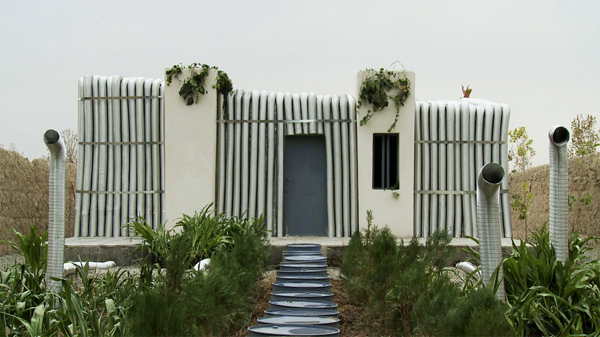
Comment: The aim of my project (above) was to construct a villa which suits of characters and interest. Considering the site situation, which is close to an aluminum pipeline factory. The villa was built using the pipelines as native material. Initially the building consists of a box which is built as a frame made of pipelines. The pipelines of walls were filled by soil because of thermal insulation. For the ceiling to avoid weight, trapped air was used as thermal insulation.
In order to make an attractive roof top and direct rain water, the roof consists of two angled planes in 2 different directions. Two brick vaults have been added to the design to construct the kitchen counter, fireplace and the library. Considering the region is windy and there are farmlands around the villa special windows have been installed on the ground in order to direct wind from the ground into the villa. These ground windows would be closed during winter and cold seasons. Villa has been built on the southern part of the site to use southern light and to have the view of Takhte Rostam. This led to existence of a private yard behind the villa. This yard was designed according to our needs and interests. (Fireplace, seat around it, BBQ, etc.) A dead tree which already existed in the yard was covered by textile to make a shaded area. Pathway to the building was designed by using barrels which were installed into the ground.
(Kelly): This is a unique and interesting project to be sure; very creative use of the pipe material!
Q: I work for a company that produces 20 tons of super shredded paper/yr. We're trying to be green and are having trouble finding anyone who can use it. The shreds are tiny - one letter per piece - and can't be recycled like regular paper. So far, biothermal is too far away and worm farms are not interested. Any ideas in the green construction arena?
A: (Kelly) You might investigate companies that produce cellulose insulation, which is primarily paper...
Q: I am remodeling my bathroom, and found uninsulated dead space (5'x8'x1') behind the shower (not the end with the plumbing) where sound and cold readily pass through. I want to insulate this area, but only have a 2 in floor to ceiling space to access it. I know I can blow in cellulose, but I was wondering if I could possibly reuse clean old carpet to line the area behind the studs. I have a ton of it and am loathe to send it to the dump. Any thoughts why this is the worst idea in the world? There is absolutely no evidence of mold or water in that space.
A: My only comment would be to make sure the carpet is dry before doing it. Give it a good sniff also. Let us know how it goes after a couple of years.
Q: I am currently living in my car. It's not bad; I shower at the Y. I am currently looking for 2nd hand materials to build a hexydome yurt... at little to no cost would be amazing ! Do you have any idea where I should start with assistance?
A: Start with a drawing of what you want. Build a model of the home. Visualize as much detail as possible and add that to the model. The next step is to share your idea and model with friends and get feedback. Incorporate their energy into your project. Materials are not that hard to come by. They seem to be everywhere once you know what you want.
Q: We have access to a considerable amount of xps polystyrene chips (small blocks +/- 10mm) and are looking for ways to utilize it to manufacture insulation boards for cavity walls. Would you recommend mixing it with perlite. If so what formula would you recommend. Any other suggestions on how to obtain a cavity wall insulation with the block that will also comply with fire rating regulations?
A: It is probably a good idea to install horizontal 2 x (thickness of wall) midway up the frame as a fire break. Is perlite flammable? Try lighting it with a flame. I am not sure and do not have any on hand to play with. I am assuming that you want the perlite to fill in the gaps between the small blocks of polystyrene. You will have to experiment by building a sample cavity with glass on one side to determine that ratio and they will probably need to be poured in at the same time or do layers until you see that the gaps are filling. You may have to use a rubber mallet on the wood side of the experimental cavity to help the perlite settle in around the polystyrene.
A: (Kelly) Styrofoam is highly flammable, with toxic fumes. I know that cellulose insulation is mixed with boric acid to make it more fire retardant; perhaps his would also help with the foam.
Q: I am planning to build a sauna and would like to use an old satelite dish for the roof, but have some concerns. )is there any problem with deterioration due to heat? I am located in Vermont so climate may be a factor, but I am hoping to recycle an old fiberglass 12 ft dish to create an extensive turf roof. My main concerns are: Can the material withstand the heat of a sauna? I don't want any melting resin to drip on bathers. Is it strong enough to support a turf roof plus snow weight?
A: You can go about this in a couple of ways. One is to do a load test by piling a bit more weight on top of the fiberglass dish than your estimate as to turf and snow load. I have not thought to repurpose a satellite dish for a sauna but it is a brilliant idea. Continuing on the first point, place the dish on some cinder blocks so you can see how the dish is handling the weight. Fiberglass is quite tough so I am feeling that there will be no problem. You can ask the building department in your area what are the recommended roof snow loads for your area. As for your concern about heat and resin drip I do not think you will come close to the amount of heat needed. The other way is to just build it and hope for the best.