Yurts
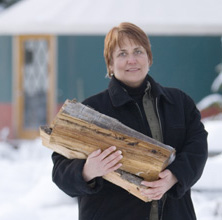 Becky Kemery has lived in four different yurts in three states, through both harsh winters and scorching summers. She founded the North Idaho Public Forum on Sustainability, and her articles on natural building can be found online at alternativesmagazine.com. In her book, YURTS: Living in the Round, Kemery speaks as an insider who knows the pitfalls as well as the sheer joy of living in these beautiful round spaces. This book covers the history, evolution, and contemporary benefits of yurt living. Further information on yurts can be found at Kemery's website YurtInfo.org . She currently lives on a homestead in the mountains of north Idaho.
Questions and Answers
Q: I live in St.Croix, US Virgin Islands. I have been exploring so many options to build on some land I own here, from conventional poured concrete walls, to concrete and block, to a dome, and now, possibly a yurt. However, before I go any further with the yurt (Pacific Yurts seems to build a quality home), I am most curious as to how well a yurt can hold up in a hurricane, particularly if all possible bracing, stabilization, reinforcing, etc, is utilized. Do you have an idea of what would need to be done to give it the best chance of surviving a hurricane here in the Caribbean, and up to what wind speed a yurt may hold up under the best, and under the worst conditions? The yurt is very economical and goes up quickly, and can be quite nice---this is a relief to other options on the island.
A: There's a two-part answer to the hurricane question:
* Yurts do well in high winds, both because they are circular (and therefore the wind goes around the yurt, with no corners to catch the wind) and also because of the amazing strength and flexibility of the
integrated roof and wall structure (the whole structure being held in tension between the central compression ring and the encircling tension band). I've heard one story of a fabric yurt surviving a tornado in Japan that killed 12 people and damaged all the permanent houses nearby. The only thing that happened to the yurt was that the skylight bubble blew off, which is a design feature to allow for pressure release when a vacuum is created inside, thereby keeping the yurt from imploding.
* You have found a good company in Pacific Yurts and will want to discuss this matter with them. I'm pretty sure they'll recommend some form of wind and snow load kit, which is engineered to withstand both strong winds and heavy snow loads. Pacific Yurts sells to lots of ski resorts, where there are often exceptionally high winds. I'm sure they will give you good advice and can provide some engineering specs, if that is what you want.
I've had some stories come through my website (forum and email) about fabric yurts that were damaged in recent wind storms. Upon reflection, I would suggest not using a fabric yurt if you are concerned about hurricanes; rather, I think a frame panel wooden yurt would provide the aesthetic and perhaps some of the economy that is desired while at the same time creating the necessary stability for a high wind situation. I think a round home is his best bet by far for a hurricane situation...
Q: My dad recently retired and acted on a longtime dream to live in a yurt. He built two 30' diameter yurts in Tulare County, California. One is for living in, one is a shop, connected by a covered walkway. He went to the county permit office before he started on them, and they said they had nothing on yurts. He explained what he wanted to do, and they said there was nothing on the books saying he couldn't. I don't think he asked the right question, as anything over 120 square feet in California requires some kind of permit. Be that as it may, a building inspector happened by today and really dug into him. He's using solar, composting toilets, and a gray water system, and propane. He thought everything through, except what the county would do. He's a recently retired ER doctor, and had built three regular houses singlehandedly before. His plan was to build the yurts, move into them, and sell his house. He built the yurts on my grandparent's property in the middle of a plum orchard, but planned to take them down as soon as my grandparents pass on--they're 92, but doing fine.He has no objection to paying for permits or taxes for school or anything else, but he could sure use any references or people to talk to you might know of that might help him get through the process he's about to go through, if it is possible to get through. He worked everyday for 18 months to complete them, and they're very nice. My mom's friends all thought she wouldn't want to move into yurts, but once they saw them, they've all been impressed.In any case, I know my dad probably could have done a bit more homework before going ahead and building them in terms of the rules in California, but what's done is done, and will be all undone if he can't find a way to get everything in compliance. If you know anyone who has gone through something similar, or may be able to advise, I would deeply appreciate it.
A: Here's what I would advise:
* Check my book ("YURTS: Living in the Round") out of the library or get it online and work through the two page sidebar I wrote on working with Building Code officials. It will show your dad what all the issues are that the code official might be concerned with.
* In Appendix 1 I excerpted many of the pertinent sections of the new ICC (International Code Council) set of codes for 2003 (currently the most commonly used set of codes as I understand it).
* I would love to put you in touch with a retired building official from the city of Seattle that is helping me put together a pamphlet on yurts and codes. This would give her a practical situation to work on to see what all the issues are and how helpful (or not) our suggestions are going to be. I'll bet she'd love to talk with your code official and could perhaps diffuse the situation and help find a resolution.
Q: My question pertains to yurt living in Utah. I live in a very small incorporated town - Boulder, Utah that is wrestling with yurt living and building codes. (Yurts that have been around for a number of years previous to the current controversy seem to be allowed as long as they are 100 yds. from a house with septic facilities.) Last year, after a series of town meetings (some rather heated) the planning committee decided that they were not interested in creating ordinances for alternative housing and that as long as yurts could meet the county building codes - based on the UBC - that they would be allowed. No one in the town really knew what that meant and as the newest yurt dwelling resident of Boulder, I volunteered to be the test case. I've recently heard that the new UBC codes may actually have a section on yurts. Is this so and if it is, what does it entail?
A: (Jeff Ruppert) Since the year 2000, the latest versions of the code are the International Building Code (IBC) and related subcodes. I did a text search of the code on a computer and there is no reference to "yurt." Your building department may still be using the Uniform Building Code (UBC) which was ended in 1997. There is a new version of the IBC (as was the case for the UBC) every three years. The latest version is 2006.
Yurts are a type of building that is in the "gray area" for codes. Depending on where you live, they can either be a temporary or permanent structure, per code. The main issues that determine what it is are
structure and energy (there are others, but these two issues tend to dominate the discussions). If you live in a place with snow, chances are you will need it engineered for building department approval. If
you live in a cold climate and there is a minimum insulation requirement for energy efficiency, you would have to install insulation as with any other home. Both of these requirements would apply if you want the yurt to be a dwelling with plumbing and waste treatment. If you want to use it as a temporary structure, per Section 107 of the IBC, the building official is authorized to grant such permits, but they shall be limited to 180 days, and may be extended with reasonable cause, but not indefinitely. Basically, it is totally up to the building official and you are at their whim.
Don't expect to be able to put up any structure that is not up to code as being permanent on your land. Many people struggle with this same issue and the fact is, if the building department will let you do it, you are very lucky. I don't have a silver bullet for this issue. I wish I did, but it can be creative working within the system and getting as close as possible to a solution that is acceptable by both sides.
Q: I am wanting to buy a yurt that is fully permitted and with foundation post and beam into the land. It is in Hawaii but I am having trouble getting financed for this unique kind of home? Any referrals? I wanted a home loan for 30 yr term.
A: (Kelly) Interestingly, I just finished reading a marvelous new book ( Yurts: Living in the Round ) about yurts written by Becky Kemery (she also has a website: http://www.yurtinfo.org ), where she discusses the problems of getting conventional financing on yurts. Because they are generally portable structures without a conventional foundation, banks are wary of loaning money on something that might walk away. She suggests approaching the loan officer with the term "non-conforming house" as opposed to yurt, and have lots of nice pictures to show how solid it appears.
Q: We would like to make earth/clay floor for our traditional Mongolian yurt. Any advise on how it can be done will be greatly appreciated.
A: (Janine Bjornson) If you do not have any experience making an earth floor I would suggest purchasing a booklet on the process. Bill and Athena Steen of the Canelo Project have a booklet on earthen floors. Their web address is: www.caneloproject.com .
Some basics tips that I think are important: -Testing, testing, testing!! I always make several different large (1 yard or metre square) tests. I lay them out at the thickness you will pour the floor in. I try a different recipe for each test. When they dry I can see which tests crack, crumble, or are hard and crack-free (how I want them to be). Then I know the recipe I will use when I pour the real floor. Testing, and RECORDING your testing is one of the most important things.
-Find a good clay soil source. The better your clay soil, the more durable your floor will be. If the soil does not have enough clay content, the floor will be crumbly. If the soil is too silty, the floor may be dusty.
- I lay my floors in three stages. A base coat mix (1.5 inches thick), a secondary base coat mix (1.5 inches thick), and then a top coat (.5 inches thick). It doesn't matter too much if the base coats crack, but your really want that top coat perfect (hard, dust-free, crack-free).
Q: What is your opinion of yurts (Americanized version) for living in year round (in NE Minnesota - cold in winter, moderate snowfall, can be humid in summer)? I like the idea but wonder about the practicality (though the manufacturers say it is do-able).
A (Kelly): I like yurts and the feeling of the space inside of them. There are several manufacturers of these, and some of them do claim they can be used in cold climates. It's all a matter of insulation, so that is what you mainly need to pay attention to. I have yet to see a fabric yurt that I would want to spend a cold winter in...but they may exist. You might see if you can get references to former customers who can can ask about their experience.
C: (Howie Oakes) Just wanted to say thanks for posting a link to us at GoYurt Shelters. We are pretty small (my wife and myself) and can use all help we can get! We are focused on getting back to the original intent of the nomadic Ger...to be a truly portable home! I am not sure if you saw it on the site, but we just became the first yurt company to be certified by the Forest Stewardship Council. All of our wood going forward is going to be local and certified responsibly harvested. We are also 100% pvc free. It was surprising how pervasive pvc is in many of the materials we looked at...
Q: I have bought a 30' diameter yurt from a family run business in Virginia to erect in the woods of the ashram. I know that these portable tents are traditionally laid on the ground but that won't pass muster with the Miss's and it is too wet here. So, I am trying to brainstorm as 'natural' as can be foundation that will allow for drainage and insulation. On site there is medium to large stone and salvaged 10" by 10" barn beams and 2" by 6"'s. I'm hoping that you guys might know of online or 'inmind' resources that I can add to my search.
A: With the local resources that you list, I would definitely think of raising a wooden platform up off the ground enough to keep it dry, or possibly even higher if you wanted some storage space underneath. You could build piers out of the stone to support the large beams and then attach the 2X6s to make the platform. As for insulating this, there are several options. You might read some of the comments here, here or here. Also, there is an article about using bags of volcanic stone to insulate a ceiling, which could also be done under such a floor: http://earthbagbuilding.com/articles/ceilings.htm Instead of stone, you could also use rice hulls, perlite or vermiculite to fill the bags with natural insulation.
Q: I am currently in the States and looking to reside out of the country. My little family and I are not rich people but we are looking to live as self-sufficient as possible. We have struggled for years to survive, and like the idea of either earthships or yurts. Based on the limited budget we have, to start with the yurts seem to be our best option. I would greatly appreciate some sound advice on how we should pursue our venture.
A: I think you are right, a fabric yurt is a great starting place. They are relatively inexpensive and fairly portable, so that if you have to move you can take your shelter with you. You can also purchase a yurt while you have an income coming in and then store it until you are ready to move to your new location. The most challenging part will be building the platform, unless you purchase a "camping yurt" that comes with a groundcloth.
If you have a family you probably want to get a 21' or 24' yurt to get the best balance between portability and a livable size. You can always add a second yurt when you can afford it to create more private space(s). (The camping yurts run from 12-14 feet and might be worth considering as a starting point.)
The portable fabric yurts work well in most climates if you fit them with the right options. You definitely want to add reflective insulation for both hot and cold climates (to reflect heat back inside in winter or away from the yurt in the summer)--it makes a tremendous difference and is well worth the extra cost. If you can't afford it, you can create your own insulation using bubble wrap and industrial strength foil, both of which can be purchased in rolls online. Be sure to put the reflective layers on both sides of the bubble wrap so that it works in the summer as well as winter.
Yurts are actually easier to keep warm than cool. To keep a yurt cool the best idea is to site it under trees. You'll also want to be aware of ventilation (meaning, purchase a dome opener, screens for the doors, and at least a few opening windows). Cupolas are useful (instead of the skylight bubble) in tropical climates.
Be aware that the architectural fabrics covering the yurt last from 10 to 20 years depending on the climate and local conditions (treated canvas lasts 4-9 years with full-time use, again depending on your local conditions). UV rays (lots of sun) and mildew (translate rainforest) are the enemies of fabric coverings.
The one situation for which I would not recommend fabric yurts is the hot, humid climate of the deep South, e.g., New Orleans. In a hot, dry climate one can use a swamp cooler (inexpensive to run and environmentally friendly) to keep the yurt cool, or do what a local scientist I know did and spray water over the yurt to keep it cool. A hot, humid climate demands either air-conditioning or an earthen structure (like adobe or earthships--strawbale would work as well).
When you purchase a yurt, make sure it is from a reputable company that will offer good customer service, answer your questions and be around in ten or fifteen years to replace your fabric. You might want to check out the Forum section on www.yurtinfo.org to see what other yurt buyers have said about companies, and also read the section titled " How to Buy a Yurt ."
Finally, I would advise checking out 'YURTS: Living in the Round" from your local library, and using www.yurtinfo.org , the companion website to the book, to answer further questions you might have and point you to yurt companies and other resources that will be helpful on your "yurt journey." Good luck with your process. I wish you the very best in creating a shelter that will be just right for your family's needs.
Q: I have a yurt and really love it. Unfortunately, the mice do also. They chew on everything in the yurt, including the wooden floor. Any suggestions?
A:
I'm wondering how mice are getting into your yurt. My experience with yurts is that they are much more mouseproof to begin with than conventional homes. The only mice I ever had in my yurts were those that my cat actually brought in.
There shouldn't be gaps between yurt cover and platform where mice can get in. Not knowing what kind of yurt you have, I would suspect that your mice are entering through holes in the floor where your plumbing and electrical are routed. I would start by plugging those holes, perhaps using spray foam around the incoming receptacles.
If you're not able to keep mice out of your yurt then you'll have to resort to the usual solutions--no food available (all food stored in glass jars, enclosed garbage and compost, dishes cleaned right away), mouse traps of one sort or another (live or deadly) or a cat that's a good mouser. Even "cat sitting" for an out of town friend for a few weeks might help.
Q:
My husband and I are going to be caretaking property in Montana, at about 6500'. We have been looking at housing options that are quick AND affordable. I have always been intrigued by round houses, and I am fascinated by yurts.
As cost is a factor, we are thinking of purchasing a yurt, and then next year replacing the canvas with conventional siding and roofing to make the structure more permanent. My husband is a master carpenter, so he has the skills to do this. However, I can not find any information on anyone doing this, and I am not sure if it is even a feasible idea. We are thinking of this as we will be dealing with -30 degree temps, snow loads, high winds, and small children. Do you have any information on anyone doing this?
I have also searched for information on plans to build a permanent yurt (is that an oxymoron?) but the largest I can find is a 16' diameter, not nearly large enough. Is there someplace we could find this information? The yurt would be off-grid using hydro power for electricity and a wood stove for heat.
A:
I have heard of people trying to add conventional siding to a fabric yurt but wouldn't recommend it. The trellis wall is strong in part because it is part of a tensioned structure, with the compression ring at the top of the rafters and the steel cable tying together rafters and wall. You lose that flexibility and tensioned aspect when you add hard siding (the beauty of the trellis wall is its portability; it isn't meant to be turned into a permanent structure).
My suggestion would be to go to the Yurt Companies page at www.yurtinfo.org and research frame panel yurts. Wall plans are available with a roof kit from Smiling Woods Yurts ( www.smilingwoodsyurts.com ). There's a new company, Round Foot Homes, that provides plans for a SIPs panel yurt (check and see if there are any SIPs panel producers in your area). GeoLite ( www.geolitesystems.com ) also sells plans for a frame panel yurt-style structure.
If you put up a fabric yurt first then you can certainly use the platform when you're ready and build a frame panel yurt as a permanent structure. I think this might be what you're looking for, and getting the fabric yurt first will give you some time to save for building and decide on plans. Good luck with your yurt plans!!
Q: I've been wondering if green houses could be completely self reliant with utilites or not. I've done minor studying on such things as windmills and windows that would allow the sun to heat the house and so forth, but I was wondering if a yurt per say, such as those from the Colorado Yurt Company could be entirely self reliant on all utilites?
A: (Kelly) Yes, it is possible to design a home that is completely independent of outside utilities. This has been the goal of Earthship designs for several decades. Many other passive solar homes also incorporate PV panels for renewable electricity, rainwater catchment systems for water, greywater recycling systems and composting toilets deal with waste materials ...so it is possble. A yurt that was built with insulated passive solar glazing, was well insulated in general, and incorporated some of the above features could also approach this goal.
Q: I am researching fabrics that can be used for yurt wall and roof material, still nonpermeable and able to withstand harsh elements, but pvc-free. I know that Red Sky Shelters offers these fabrics, but I am looking for an actual manufacturer in order to purchase for our company like Red Sky Shelters does. I understand that as a business, it's not in their best interest to share where they do their buying. Do you have any insight?
A: You have obviously done your homework--Peter at Red Sky Shelters is one of the most knowledgeable people in the industry re: fabrics, and generously shares his knowledge. You've probably been on his website page dealing with architectural fabrics, where he lists all the alternatives to PVC coatings.
I decided to check things out with Peter myself. He kindly gave me his top suggestion for a supplier for someone who only needs material for one yurt, a company called Tri Vantage headquartered in Ohio with distribution centers in California. Peter informed me that TriVantage recently purchased some of the smaller eco-fabric companies. While they have a large selection of PVC based fabrics, TriVantage also carries a number of the alternative eco-fabrics that Peter talks about on his website. They are also able to work with customers buying a smaller (non-commercial) amount of yardage.
In addition to architectural fabrics, TriVantage carries Sunforger Marine Boatshrunk Canvas ("Marine" = additional treatments for durability). Most tipi makers and some yurt makers use the Sunforger Marine Canvas because it is a natural product with increased durability provided by the coating. The Marine Boatshrunk Canvas can be ordered with or without a fire retardant (FR), which may be required to meet building codes in your state. TriVantage also carries items like thread, grommets, hardware, and clear vinyl (for windows and skylights).
Hemp, probably the greenest alternative of all, is available through Pickering International in San Francisco, tel. 415.474.2288. Debra Williams of Sagebrush Tipi Works recommends the 11oz 100% hemp canvas. The wear factor on hemp is still experimental. Debra recommends treating hemp (esp. for a yurt roof) using Safecoat exterior latex paint, watering it down and painting on a thin coat. This will help shed water as well as protect the fabric from UV rays, thereby increasing the durability of the fabric.
As you move forward with your project, be sure to check out the list of yurt plans on www.yurtinfo.org.
Q: I'm an art student looking for an environmentally positive (and cheap) way to pursue the creative lifestyle. It turns out that living in yurt is something I want to do long term (hopefully for a year, and then I'll see from there), instead of just for vacationing. My problem is- I can't find anywhere that will let me stay. As I am a college student, there isn't exactly spare money left over to buy land, and I'm not too keen on communes because I don't want someone telling me how to live. My original dream was to find an organic farm that would lease a small part of their property in exchange for labor, but nobody seems too into my idea. Is there an alternative that I'm not aware of?
A: You're not alone in your idea of putting a yurt up on someone's land, which is why there's a "Yurt Communities" thread on the yurtinfo.org Forum. The idea is that you can go there and see if anyone's posted land available in places in which you're interested, or you can start a thread with a statement of what you're looking for, and see if you get any responses. I'd try researching and listing on "Craig's List" as well. It's hard to respond with more specifics without knowing the region in which you're looking. If north Idaho is of interest, you might check out Medicine Circle Eco-Retreat as a possibility.
Q: Recently I purchased a used yurt. But it is missing the dome. The cover is a thick vinyl and is yellow and blue. The yurt diameter is 18'. Is there any way to ascertain who manufactured this yurt? However, I may be optimistic here; I may have been scammed. After we purchased it and unrolled everything, it looks more like a yurt-like sales tent. How can I tell?
A: From your description of the yurt and it's diameter, it sounds like you purchased a home-built version rather than one made by an actual yurt manufacturer. 18' is not a standard yurt diameter (they usually run 12', 16', 20 or 21', 24', 27' and 30, depending on the company). It's difficult to tell you more without seeing a picture of it. Most home-built yurts don't use an acrylic dome but rather have a (usually) diamond-shaped covering that can be pulled across the roof hole in case of rain or weather. Whether or not you got "scammed" depends in part on how much you paid for the yurt and what they promised in their advertising. Hopefully everything else (besides the dome) is there and the yurt will provide a useful space for your needs. Good luck!
Q: I have a 24' Pacific Yurt, that has become a part of my home. A section was opened up to add other rooms. I have wood on the inside and outside. The yurt roof is original and is approaching 16 years old. I am wanting to stucco the outside, as that wood is just plywood, but cannot do so until I replace the roof. I wanted to simply nail a layer of thin plywood to the roof beams and then put on shingles, but some have said that is not wise. Any suggestions, as just replacing with new vinyl is also unwise I think as it will have to be cut at the area of adjoining, plus it would not give me the lip needed for stucco to fit underneath at the juncture of wall to roof.
A: (Kelly) What can be done with the roof is partly dependent on how much weight the rafters can handle, and plywood and shingles may be too heavy. If they can handle the weight, you might consider extending the plywood out far enough to create a small eave that will extend the lifetime of the siding and make a good edge to stucco against.
Q: I'm a congenital heart defect survivor who really wants to build a home. I'm finally closing on 20 acres. I want to start with a hexayurt made from insulation board and then use local trees to build a frame around it. I believe that would make the most manageable process of building for me. The site has compacted gravel where a trailer has been. My question is could I build directly onto this compacted area? I'm not expecting to live more than 10 years, I'd like the house to be a testimony to my life. I am physically limited. If I can't build directly on compressed clay with gravel cover, what would you recommend as the least physically demanding method of self building especially when it comes to a foundation? I'd eventually like to create sustainable building options for similarly disabled people.
A: (Kelly) Yurts are frequently built on raised platforms and that is what I would recommend in your situation. You need to create a floor for it in any case, so all you need to do is raise that up a bit on piers and you should have no problems with moisture coming in or frost upheaval.